
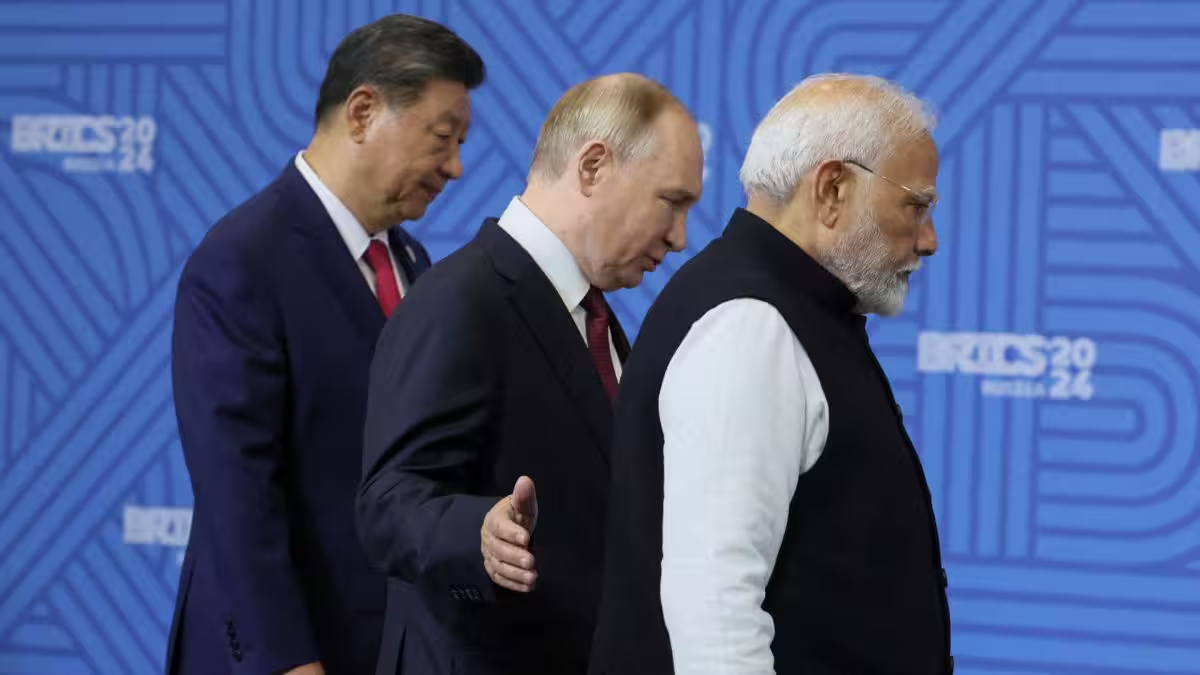
As the Global South finds itself caught in the middle of the US-China trade war, India must use Brics to diversify its supply chains while being careful not to fall into the traps of deglobalisation and economic decoupling, according to Prof Ram Singh of the Indian Institute of Foreign Trade (IIFT).
President Xi Jinping arrived in India on Saturday on his first visit in seven years, signalling a thaw in the bilateral relations, even as India and China continue to be locked in economic and trade tussles. China continues to block the supply of critical minerals and machinery to India, and India scrutinises Chinese mobile-maker Xiaomi for suspected breach of foreign investment laws.
Despite pitching itself as the leader of Global South, China continues to weaponise supply chains and the membership of Brics or Shanghai Cooperation Organisation (SCO) has not meant smooth access to critical minerals and rare earths, and that means Xi remains the fundamental contradiction in the grouping.
India has been an advocate of rule-based transparent trade, with Prime Minister Narendra Modi stressing the point in his Friday address to the Brics Business Forum, held a day ahead of the Brics Summit 2026. He said, “Today, as trade barriers are increasing around the world, India is building economic bridges. Since 2014, we have entered into Free Trade Agreements with nearly 40 countries around the world. Our approach within BRICS is also the same, reduce barriers and expand opportunities for businesses.”
 More from World
Follow our live coverage of the Brics Summit here
As progress towards building secure supply chains is a top priority of the Brics Summit 2026, the contradiction must be addressed but it must be addressed through diversification of supply chains and trade instead of falling into the traps of deglobalisation and decoupling, according to Prof. Ram Singh, Professor of International Trade at the Indian Institute of Foreign Trade (IIFT), Delhi.
“As problems with China persist, the solution lies in finding new sources of critical minerals. This means India must expand its multilateral engagement and deepen its outreach to like-minded countries rather than retreat from the world stage. Deglobalisation is not the way forward. Similarly, the idea of decoupling from China would be counterproductive as maintaining a trading relationship remains necessary despite the challenges. The way forward is to build a more equitable relationship by reducing dependence on China through the diversification of supply chains,” said Singh.
Can Brics help India achieve that? Singh believes it can if countries remain pragmatic.
“Brics members comprise over 40 per cent of the world’s GDP. They are the major swing states whom both the superpowers —the United States and China— court and that gives them substantial leverage to address supply chain issues,” said Singh.
Brics must go from from deliberations to action
Singh said that while Brics has evolved from a platform seeking global governance reforms to a forum that deliberates some of the world’s most pressing issues, it must grow into a platform that also acts on those deliberations to realise its true potential.
Singh said that Brics member should work towards creating strategic reserves for critical minerals, oil, and fertilisers, as the member states include the world’s largest producers of critical minerals, oil, rare earth elements, and fertilisers.
And this would mean overcoming the contradictions of the grouping: the world’s fertiliser supplies remain disrupted from the Russia-Ukraine war and two of the world’s most important routes for the transport of oil —Strait of Hormuz and Red Sea— remain choked from the West Asia conflict involving members Iran, Saudi Arabia, and the UAE. Then there are concerns about deepening trade.
“Brics will never be a trading bloc because that would simply mean the flooding of countries by Chinese goods. India does not want that, and others do not want that as well. What they do want is to turn the grouping into an economic platform that could solve problems with cross-border payments and eventually address supply chain issues. Here, using collective leverage, including regarding fellow member China, is the key instead of decoupling from major powers,” said Singh.