
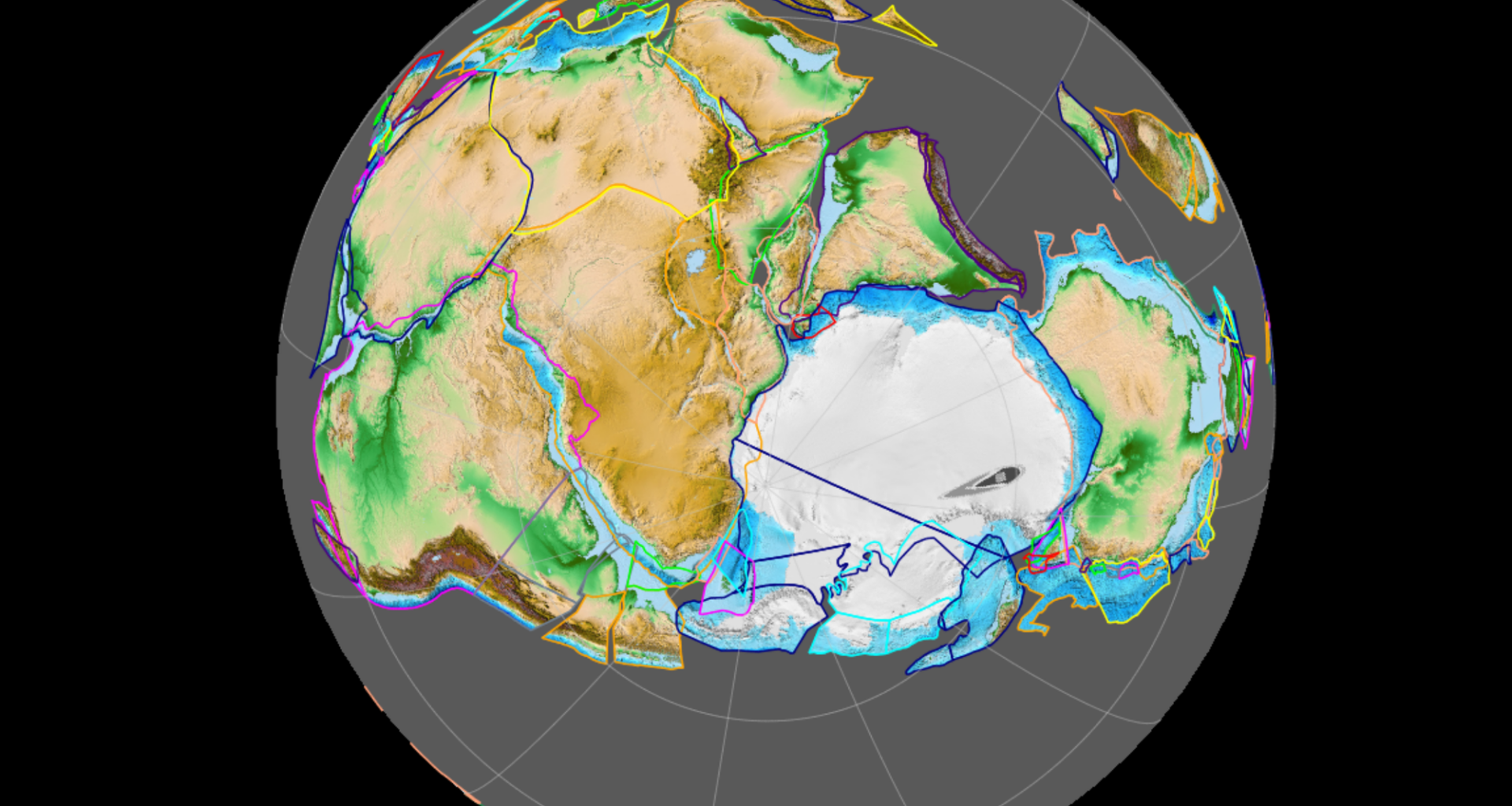
A new global isotopic map has revealed vast fragments of ancient Gondwanan crust buried beneath younger mountain belts across Asia, Europe and North America, suggesting the ancient landmass was substantially larger than previously recognized.Adding the newly identified fragments raises Gondwana’s estimated size from about 64% to roughly 80% of Earth’s continental crust, pushing it above the commonly used threshold for classification as a true supercontinent.The reconstruction also reveals a nearly 32,000-kilometer volcanic and subduction system around Gondwana during the Ediacaran-Cambrian transition, which researchers propose helped reshape climate and environmental conditions during the dramatic expansion of animal life.
Hundreds of millions of years after Gondwana broke apart, enormous pieces of the ancient landmass may still be hiding beneath some of the world’s greatest mountain systems.
Researchers from Curtin University have mapped previously unrecognized fragments of ancient continental crust stretching across large portions of Asia, central Europe and southeastern North America. When those buried pieces are added to the familiar remnants of Gondwana, the ancient landmass appears to have contained roughly 80% of Earth’s continental crust.
That finding addresses a longstanding debate over whether Gondwana was large enough to qualify as a true supercontinent.
The research, published in Science Advances, used more than 25,000 isotopic measurements to peer through younger rocks and reconstruct the deeper continental foundations beneath them. The results suggest the familiar map of Gondwana has been missing millions of square kilometers of continental material.
Continental-scale Nd isotopic (TDM2) map of southwestern Asia, central Europe, and southeastern North America (encompassing peri-Gondwana terranes and orogens). (CREDIT: Bill Collins et al, Science Advances)
The implications may extend beyond ancient geography. The team’s reconstruction also links Gondwana’s assembly with a planet-scale belt of subduction and volcanism that could have influenced Earth’s climate around the time animal life underwent one of its greatest evolutionary expansions.
Gondwana had a missing-land problem
Gondwana assembled during the late Precambrian and early Paleozoic and included familiar continental blocks now separated across the Southern Hemisphere. Africa, South America, Antarctica, Australia and India formed major parts of its core.
Yet size became a problem for calling Gondwana a supercontinent.
One widely used estimate placed core Gondwana at about 100 million square kilometers, or roughly 64% of today’s continental land area. Some definitions suggest a supercontinent should contain about three-quarters or more of the available continental crust.
By that standard, Gondwana appeared too small.
The problem was that subsequent plate tectonic activity had transformed its margins beyond easy recognition. Continental fragments were stretched, detached, collided with other landmasses and incorporated into younger mountain belts.
Much of their ancient identity disappeared beneath the surface.
Fossils found in Australia, Africa, Antarctica, India and South America demonstrate these land masses were once connected. (CREDIT: Osvaldocangaspadill / CC BY-SA 4.0)
Instead of reconstructing Gondwana solely from rocks that remain exposed, the researchers went looking for the deeper crust underneath today’s geological complexity.
Isotopes exposed continents beneath the mountains
The team compiled measurements involving samarium and neodymium isotopes from granitoids and related rocks. These chemical signatures can reveal when the deeper crust from which younger rocks formed was originally extracted from Earth’s mantle.
A granite exposed today might be relatively young while having formed through melting of much older continental material. Its isotopic composition therefore offers a way to see through the age of the surface rock and investigate the deeper basement beneath it.
The researchers assembled more than 25,000 measurements into what they call “basement terrane maps.” The maps exposed surprisingly coherent zones of ancient crust beneath areas that look extremely complicated at the surface.
One enormous region stretches through the Tethyan mountain systems of Asia. Gondwanan-affiliated crust could be traced from Southeast Asia and China toward the Tarim region and Kazakhstan, continuing westward through Iran, Turkey and Europe.
Other remnants appear within the Appalachians of North America.
The Kazakhstan region alone contains an ancient continental block estimated at about 2.2 million square kilometers. The isotopic evidence links parts of this basement with neighboring ancient continental regions.
Comparative analysis of surface geology and deep-seated crustal compositional (TDM2) across Asia. (CREDIT: Bill Collins et al, Science Advances) Greater Gondwana covered about 80% of continental crust
Across the mapped regions, researchers calculated that previously overlooked Gondwanan fragments account for around 23 million square kilometers on average.
Depending on the isotopic threshold used to distinguish older continental material from younger crust, the newly recognized fragments total roughly 20.5 million to 25.5 million square kilometers. Including Kazakhstan raises the possible addition further.
When combined with the approximately 100 million square kilometers assigned to traditional Gondwana, the reconstruction reaches approximately 80% of Earth’s present continental area.
The authors call this expanded landmass “Greater Gondwana.”
The estimate is also deliberately conservative. It excludes several possible components, including submerged continental fragments, portions of continental shelves and material that may have been recycled into Earth’s mantle or extensively reworked into younger crust.
Under the roughly 75% criterion sometimes used to identify supercontinents, the new reconstruction comfortably qualifies.
Reconstruction of Greater Gondwana at ca. 500 Ma or at 550 to 500 Ma compared with conventional paleogeographic interpretations (inset). (CREDIT: Bill Collins et al, Science Advances) A gigantic volcanic system surrounded the continent
Increasing Gondwana’s size also changes its importance in Earth’s broader geological history.
By approximately 500 million years ago, the researchers reconstruct an enormous system of subduction zones and volcanic arcs extending around much of Greater Gondwana. At about 525 million years ago, this network may have stretched approximately 31,700 kilometers, equivalent to around 79% of Earth’s circumference.
It extended through regions that would eventually become parts of Russia, China, Australia, Antarctica, Africa, Europe and the Americas.
The scale is comparable to the modern tectonic system surrounding the Pacific.
As oceanic crust sank beneath continental margins, magma generation would have fed extensive volcanic activity. The researchers propose that this giant circum-Gondwanan system became a long-lived source of gases including carbon dioxide and water vapor.
Its appearance coincided with one of the most dramatic intervals in Earth history, spanning roughly 550 million to 500 million years ago.
Plots of εNd(t) versus (U-Pb) crystallization age. (CREDIT: Bill Collins et al, Science Advances) Gondwana may be connected to the Cambrian transformation
Earth emerged from extreme Neoproterozoic climatic conditions before entering the warmer environments of the Cambrian. At roughly the same time, animal diversity increased dramatically during the event commonly known as the Cambrian explosion.
The researchers propose that Gondwana’s tectonic reorganization could help connect events occurring deep inside Earth with changes at its surface.
A vast volcanic arc operating for millions of years could supply sustained carbon dioxide and water to the atmosphere. The study proposes that this volatile release helped support the transition toward warmer and more humid conditions suitable for expanding animal ecosystems.
That does not establish volcanism as the sole cause of the Cambrian explosion. Biological diversification involved a complex combination of environmental, chemical and evolutionary processes, and the study presents the Gondwanan mechanism as part of that broader transformation.
What the new reconstruction provides is scale. If Greater Gondwana truly contained around four-fifths of Earth’s continental crust, its assembly and subsequent tectonic reorganization were planetary events rather than regional ones.
The mountain belts crossing Eurasia and North America may therefore contain more than remnants of ancient collisions. Deep beneath them are pieces of a vanished supercontinent whose formation may have helped reshape the entire Earth system just as complex animal life began its extraordinary expansion.
Dig deeper into Gondwana, supercontinents and the Cambrian transformation
These studies explore the supercontinent cycle, isotope methods for tracing buried crust and links among Gondwanan tectonics, volcanism, climate and early animal diversification.
The supercontinent cycle: A retrospective essay: Reviews how the assembly and breakup of supercontinents can reorganize Earth’s geosphere, oceans, atmosphere and biosphere over immense spans of geological time. (Gondwana Research, 2014)
Origins of the supercontinent cycle: Examines the development of the supercontinent-cycle concept and its implications for mantle dynamics, tectonics, climate and Earth’s long-term geological evolution. (Geoscience Frontiers, 2013)
Related Stories