
This article originally appeared on Rebecca Thornton’s Substack, Words with Bex . You can subscribe, here .
Harry and Meghan are back in the UK, so finally, I’m examining one of the people I’m asked about the most: Meghan Markle. Or Meghan, Duchess of Sussex.
I started by revisiting the CBS Oprah interview Harry and Meghan did, post-Megxit. I wanted to look at the language and what seemed to generate it. Pretty early on, something caught my attention and interested me enough that I wondered whether it would happen elsewhere.
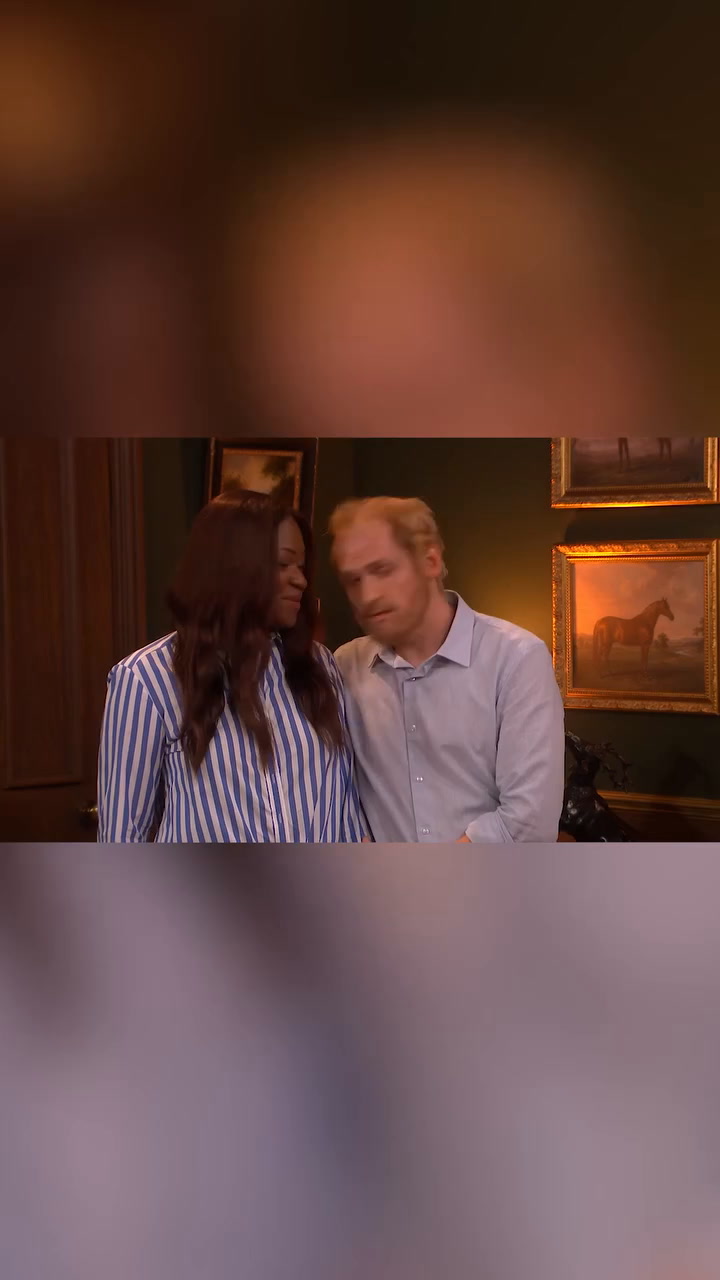
Watch: SNL UK pokes fun at Meghan and Harry’s return. Post continues below.
SnapInsta.to AQPRfIMrrZL VsE 9VS5RSduH1Xm8W2tvvG XD0 GCF2QC 6IR9jly39PYjcw0 MeSMz4D2l5VxbD2cjkLX Oe86q4ERGFb0WOJxblg
Cue popcorn.
I subsequently watched all six episodes of Harry & Meghan, the Netflix documentary. I caught it again. So I started delving into how Meghan communicates, and what emerged was much bigger than what I’d initially noticed. First, though, the story underneath the words.
Harry’s words are often organised around protection.
His mother “tried” to protect him. He couldn’t protect previous girlfriends from the press. Meghan needs protecting, his children need protecting. Eventually, even his accusation against the Palace is expressed that way: they would protect his brother, he says, but not them.
Meghan’s words centre around belonging.
She talks about feeling alone as a child, being excited by Harry’s large family. She tries to “fit in”, to “blend in”, not to stand out. Eventually, she tried so hard, but still wasn’t good enough.
Meghan wants somewhere to belong. Harry wants someone to protect. The two narratives interlock almost perfectly.
You can hear Harry’s language organising around his narrative: Meghan moves from this “girl” (he immediately corrects himself to this “woman” – someone’s taught him well!) and then, “my wife”. Obviously, at that point, Meghan is his actual wife, but there is a charge to those two words.
His own family moves the opposite way: “my family” becomes “the family”, “this family”, then, strikingly, “the family and their people”. Harry’s underlying narrative sits visibly in his words.
With Meghan, something different was happening in the mechanics of how meaning gets communicated.
Let’s dive in!
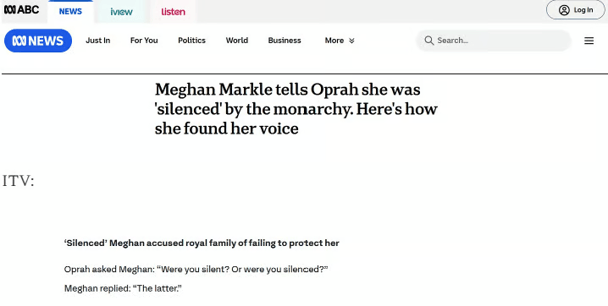
In the Oprah interview, Meghan says that after years of advocating for women to use their voices, she herself became “silent”. Oprah asks:
“Were you silent, or were you silenced?”
“The latter,” says Meghan.
Later, Meghan says there were “concerns and conversations about how dark his (Archie’s) skin might be when he’s born.” Oprah takes this implication to its explosive conclusion: was there concern that her baby would be “too brown”? Meghan effectively replies that if that is the assumption Oprah is making, it is a pretty safe one.
Then, South Africa with ITV journalist Tom Bradby, Meghan talks about being vulnerable, pregnant, newly married and struggling behind the scenes.
She thanks Bradby for asking whether she is okay because, she says, not many people have. Bradby takes the final step: Would it be fair to say, “not really OK?” Three extremely powerful propositions. But look carefully at who actually formulated them.
There is a linguistic concept called implicature. Put simply, we communicate things we haven’t explicitly said all the time. I could tell you somebody was “very confident”, then pause, raise an eyebrow and leave you in absolutely no doubt that I wasn’t paying them a compliment.
Nothing unusual there. Nor is there anything unusual about an interviewer hearing an implication and putting it into words. That is part of interviewing.
What interested me was how Meghan’s implicature works. The first thing is how far she can get while saying remarkably little.
In the documentary, for example, Meghan contrasts her mother – “classy,” “quiet” – with “the other side of my family,” Pause… “Acting differently.”
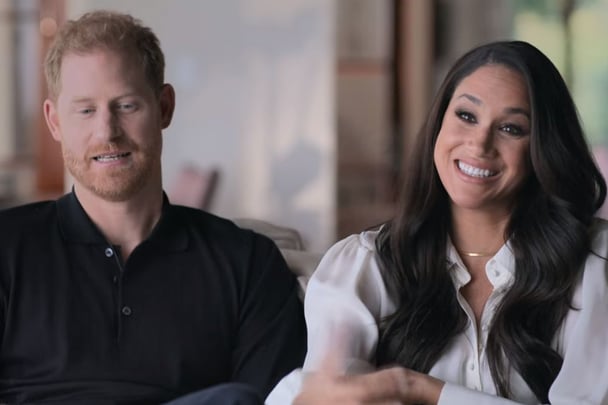
Image: Netflix.
It is an extraordinarily mild description. Obviously, there’s the wider context and our own perception. But even in this small isolated exchange, the implication reaches considerably further than the words themselves, and so “acting differently” isn’t all we receive. Then she talks about learning the conventions of royal life.
“Everything is just…” Gesture. Expression. Pause. “Smaller.”
Smaller. Again, the word is mild. The meaning around it is much less so. Restrained? Contained? Repressed? She doesn’t choose; we do.
So that’s the first component: She stops very short; the explicit words can be strikingly mild, while the stronger judgement is left hanging just beyond them.
At first, I thought this made particular sense in the context of Meghan’s account of being silenced by “the institution”.
If your experience is I’m not allowed to say what is happening to me, meaning has to find another route: through implication, prosody, intonation, stress, rhythm, pitch, pace, pauses. Meghan clearly isn’t only communicating through the lexical content of her words. But here is the important bit — Meghan does it when she cannot speak freely and she does it when she plainly can.
So silencing may explain why this form of communication was useful in one context. It doesn’t explain the pattern. And that led me to the second component: Who finishes the judgement? Sometimes we do; sometimes, an interviewer does it for us.
It’s Oprah who says “silenced”. Oprah supplies “too brown”. Bradby supplies “not really”. Meghan gives enough information for the proposition to emerge, but somebody else crosses the final few feet.
The proof is in the headline pudding. Image: ABC/ITV
Against an organisation Meghan believes has wronged her, she can be blisteringly direct. Associated Newspapers, for example: they published a letter (this refers to the publication of a personal letter from Meghan to her father, Thomas Markle) and when discussing the episode, Meghan is forthright: “They knew. Apologise. Don’t do it again.”
But with people, and interpersonal relationships, something more interesting can happen: the strongest judgement isn’t necessarily hers. It’s ours (Or Oprah’s. Or Bradby’s; you get the picture).
To put it extremely simply: Meghan can supply the material – an entire narrative, sometimes, in just two or three words – and somebody else supplies the conclusion.
I then went back to Kate.
Oprah asks Meghan whether she made the Duchess of Cambridge cry before the wedding. No. “The reverse happened.” But listen to the language Meghan then uses about Kate.
Kate “owned it”…
“She apologised. And she brought me flowers and a note apologising.”
“I’ve forgiven her.”
Later: “She’s a good person.”
And when Oprah asks what actually happened, Meghan refuses to go the extra mile: “I don’t think it’s fair to her to get into the details of that because she apologised.”
On the surface, this is generous language. It may be completely sincere. But look at what else it does. If somebody “owned it”, there was something to own. If somebody apologised, there was something requiring an apology.
And if I tell you “I’ve forgiven her”, I have simultaneously positioned myself as the person who was wronged and the other person requiring forgiveness. Forgiveness is positive language — but it also contains an accusation.
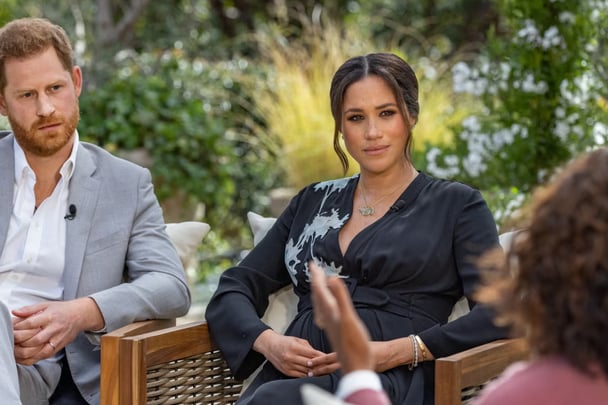
Image: CBS.
Then Meghan describes Kate’s behaviour during the chaos around her father as not making sense when everybody else was “trying to be supportive”. She never explicitly says: Kate was unsupportive. She doesn’t have to; Kate is placed outside the group. Again, we finish it.
And then Meghan refuses to give us the details because it wouldn’t be “fair” to Kate, which looks as though she’s doing the right thing, but simultaneously tells us there are further details. This is where the mechanism changes again.
Sometimes the negative judgement isn’t merely carried around the language. It is carried inside words that appear, literally, to be doing the opposite.
“I’ve forgiven her…She’s a good person…I don’t think it’s fair to her.”
The language can simultaneously protect and damage Kate. So the interesting thing isn’t that Meghan uses implicature. We all do. It’s how adept she is at it and how much that implicature can carry.
The ratio is vast: huge communicative impact with remarkably little explicit verbal ownership. After someone else picks up the judgement, something else extraordinary happens: those formulations (or judgements) leave the interview or documentary and become clips, headlines, arguments and part of the global narrative around Meghan.
Eventually, they boomerang back towards her as things we understand Meghan to have communicated. But go back to the original words. Where exactly did she say it? The formulation has travelled, and somewhere along the way, its authorship has been blurred.
And that creates what I’ve started thinking of as, LINGUISTIC TEFLON.
The judgement lands, but the strongest version of it doesn’t necessarily stick to the speaker, which gives the communication another property. DENIABILITY.
Not necessarily deliberate deniability. I can’t tell you from language whether Meghan consciously intends any of this. I mean something structural: the stronger judgement can travel around the world whilst Meghan, in essence, doesn’t have to claim it.
There is one final effect. If I tell you somebody is awful, I own the judgement. If I give you the material and leave you to form it, you participate in producing it. Suddenly, you’re carrying an emotional judgement you were never actually asked to make.
I wonder whether this explains some of the distrust around Meghan better than the arguments about whether she is “authentic”. Perhaps some of the disconnect comes from feeling a judgement far more strongly than we can locate it in her actual words.
Suddenly, that old apparent contradiction around Harry and Meghan – privacy – looks different too. Of course, you can want visibility and privacy simultaneously. More specifically, you can want enormous visibility while wanting control over what becomes visible. High visibility. Controlled access. Meghan’s communication can do something remarkably similar: High transmission. Controlled explicitness.
Which brings us back to something Harry keeps returning to throughout the documentary. Seeing.
“Nobody sees what happens behind closed doors.”
Harry talks about looking “behind the curtain,” and, referring to his family, “They saw what they wanted to see.”
That line makes the whole documentary fold back in on itself — because we are watching six hours designed to show us exactly what Harry and Meghan want us to see. That doesn’t make it false — but it does make it narrative.
Listen to the hosts of Mamamia Out Loud discussing the royals’ return to the UK. Post continues below.
RELATED PODCAST 
SUBS FREE TASTER: The King’s Very Pointed Harry Letter & Alix Vs Alex
At the very end of Harry & Meghan, Meghan takes out her wedding speech and tells us she wants to share “a story”. She calls it “a modern fairy tale.”
Harry says people saw what they wanted to see. But sometimes somebody else gives us the material, stops just short of the judgment, and leaves us to see what they never actually said.
This article originally appeared on Rebecca’s Substack, Words with Bex . You can subscribe, here .
Bex Thornton is an author and the creator of Words With Bex — showing you what others miss in people, language and behaviour. You can follow her on Instagram here .
Feature image: Getty.