
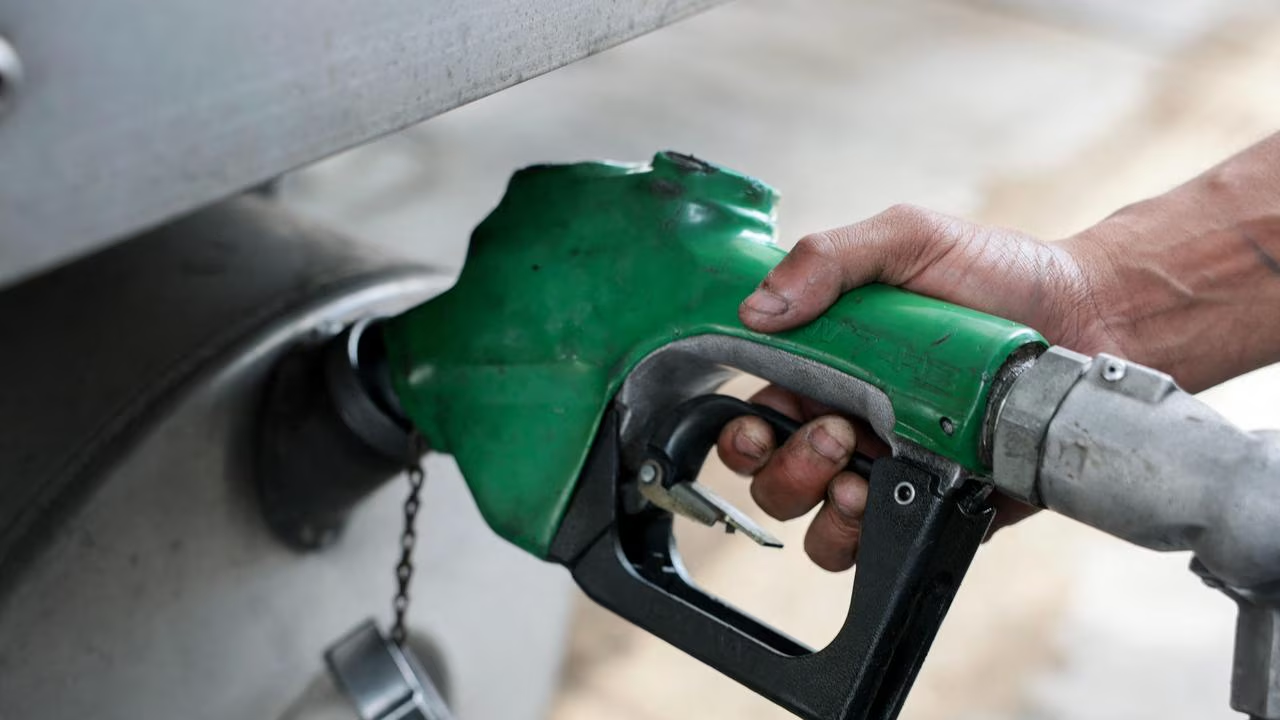
First price hikes came for diesel. This didn’t bother me. My car runs on petrol.
Then they came for jet fuel. This didn’t bother me. I don’t fly often.
Then they came for fertiliser. This didn’t bother me. I’m not a farmer.
Be the first to know when news breaks. Download our new app

Then they came for the food, housing, and every product I need to buy. But I have no money left to spend anyway …
With apologies to Martin Niemöller’s classic warning against apathy and meek acquiescence. But it is a scenario once again playing out on the global political and economic stage.
The world is in the seventh month of US President Donald Trump’s “four-to-five week” war against Iran.
And international strategic analysts warn things have taken a serious turn for the worse.
Despite all assurances, the critical Strait of Hormuz remains essentially closed to global crude oil and liquid petroleum gas shipping. That represents 20 per cent of the global supply.
Saudi Arabia’s backup overland crude oil pipeline to the Red Sea was bombed on Thursday. That cuts another 5 per cent from global flows.
Saudi Arabia’s backup shipping route, through the Red Sea’s Bab el-Mandeb Strait (Gate of Tears), is also now threatened. Houthi rebels at the weekend seized strategic islands in the waterway and the high ground overlooking the Strait itself.
Meanwhile, the ongoing campaign by Ukraine and Russia to destroy each other’s infrastructure and shipping remains relentless. That’s another 1.5 per cent.
The 47th President of the United States, however, insists everything will “work out just fine”.
President Trump, 80, was hitting the luxuriously green golf courses of Ireland as news broke of the latest military setbacks in the Middle East.
He wasn’t worried.
He said the Houthis had already contacted US diplomats to stress that they “don’t want to fight with us” and would “much prefer not having us involved.”
But the US is already deeply involved.
Diesel prices there have soared. Reserves are at record lows. And US consumers must now pay more than $US6 ($A8.4) for every gallon (3.8l) they put in their tanks.
Similar price shocks are now rippling through the global economy. Including Australia.
And most of the reserves used to cushion similar shocks in recent months are drying up.
“Having both straits closed has long been a ‘sum of all fears’ Middle East energy crisis,” states strategic analyst Tyler Rogoway.
“This was always Iran’s fallback plan. This is also why they [Iran] held them [the Houthis] back during Epic Fury.”
Hip-Pocket Reality
“Hormuz Oil Volumes are BACK,” President Trump proclaimed on social media. He posted a graphic claiming 20 million barrels passed through it that week, up from 18 million the week before.
That compares to about 110 million barrels per week before he started the war.
Shipping trackers show just seven tankers (that had their navigation systems turned on) passed through Hormuz the day he made the claim.
Before the war, an average of 67 tankers would make the transit daily.
Less crude oil means less petrol, diesel, plastic resins and fertiliser.
Diesel is in particular short supply. And it’s about to get worse.
Gulf diesel exports are about one quarter their pre-war level. Russia has had to ban exports to fuel its own war-wracked economy. And the world’s remaining refineries are already running at 95 per cent capacity.
All up, global consumption is outstripping supply.
That’s bad news for the Australian economy.
So much so Canberra may soon have to make a tough choice: prioritise food? Or iron ore?
“The diesel fuel price shock caused by the Iran conflict has exposed an uncomfortable reality that mining, one of Australia’s most crucial industries, is overwhelmingly – and increasingly – dependent on imported fuel,” Cyan Ventures analyst Pulkit Athavle argues for the Australian Strategic Policy Institute (ASIP).
Mining consumes about 32 million litres of diesel a day (about 35 per cent of Australian turnover).
But the Australian harvest season is almost upon us.
The International Energy Agency (IEA) requires its members to keep a 90-day supply in reserve for just such crises. Canberra has consistently barely maintained 30 per cent of that level.
For diesel, it’s had to pay extra to raise that buffer from 33 days this time last year to the current 42 days.
And that’s only because other nations maintained the strategic reserves needed to buy the global economy extra time.
But there’s nothing left to show where that came from.
Bottom of the Barrel
Australia’s Macquarie Group predicted in March that crude oil could soar to $US200 a barrel by June if the Strait of Hormuz remained contested.
That didn’t happen.
The co-ordinated release of 400 million barrels of global oil reserves, especially from China and the United States, has kept prices well below $US100.
But US strategic oil reserves are reaching critical lows.
And China is also being forced to tighten the tap.
S & P Global Ratings chief economist Paul Gruenwald last week said a Chinese withdrawal from oil markets in March had “kind of saved the day” as the oil-price “doomsday scenario” unfolded.
But it’s having to re-enter the global market as a buyer because its cut-price Russian fuel has gone up in flames under Ukrainian drone attacks.
Now Saudi Arabia’s Abqaiq to Yanbu pipeline – a 1200km bypass to Hormuz – has been blasted offline.
Riyadh says it closed it as a “precaution”.
But satellite photos show significant damage at key points along the pipeline.
It was previously attacked in April. But Saudi Arabia insisted it was back pumping at full capacity (7 million barrels per day) before the recent strike.
Economists estimate it had actually been shifting 4 to 5 million barrels per day.
Combined with the Houthis’ new threat to the Red Sea’s narrow Gate of Tears, that leaves only the Suez Canal as a safe-ish shipping route to the Middle East.
Houthi rebels are now ideally positioned to attack shipping in the Strait with missiles, rockets, suicide boats and artillery. They occupy Perim Island in the narrows, and the high ground on the Yemen mainland.
Brent crude oil prices leapt to $US107.9 per barrel as a result. That’s up 60 per cent over the past year.
Heating oil is up 119 per cent.
“Market tightness is now most acute,” the IEA’s most recent oil market report states.
Oils Ain’t Oils
“The White House convened US refiners on September 1 to discuss ways to increase output and lower the cost of refined products. The lack of significant announcements after the meeting showed that options in the very near term are limited,” assesses Atlantic Council energy analyst Ben Cahill.
And winter is coming.
A rough rule of thumb states that three barrels of crude oil produce two barrels of petrol and one of diesel. But heating oil is produced from the same crude distillate as diesel. And demand for both soars during winter.
Especially in the Northern Hemisphere.
Ironically, this demand can result in more petrol than needed. If the refineries get enough oil …
“This presents two energy security challenges,” warns Cahill.
“Middle Eastern disruptions threaten global product balances. And spare capacity in global refining is now concentrated in China, where the government can adjust refined product export quotas with little advance warning or regard for regional or global refined product balances”.
Beijing has its own geopolitical and economic priorities.
Its main ally (and fuel source), Russia, is suffering.
Ukrainian attacks on its oil terminals and refineries have slashed its oil exports by 30 per cent so far this year. It’s much worse for refined products.
“Russia has now banned gasoline exports through January 2027, and banned diesel exports until at least September 30,” Cahill reports.
“Damage to refineries in Russia may take many months to repair, and the ultimate toll on refining and petrochemical facilities in the Gulf is uncertain. This suggests that prices of petroleum products, especially diesel, will remain high”.
Meanwhile, the West’s refineries are already running at maximum capacity. Australia has just one operational plant anyway.
“They cannot be pushed further without compromising safety,” Cahill adds.
“Indeed, the greater risk is that refiners defer maintenance … Any accidents that knock out capacity could create significant challenges”.