
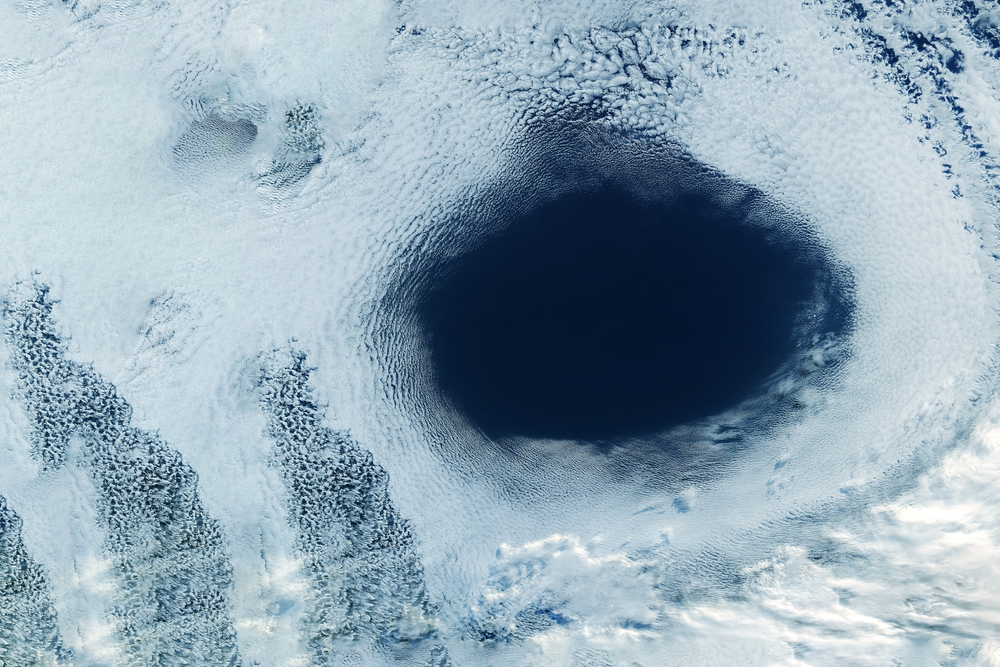
The Copernicus Atmosphere Monitoring Service (CAMS) reported that the Antarctic ozone hole expanded rapidly in the first half of September, reaching an estimated 25 million square kilometres (km²) on 12 September.
The ozone hole reached 15 million km² by the end of August, slightly earlier than the long-term average and at a similar stage to the 2025 season. However, unlike last year, its area has remained above average as the Antarctic spring has progressed.
CAMS found that the ozone hole was around 5 million km² larger than average for this point in September. Forecasts indicated its area could increase further mid-month, although other measures of ozone depletion remained close to average.
How the Antarctic ozone hole is measured
The Antarctic ozone hole is defined as an area south of 60°S where ozone column concentrations fall below 220 Dobson Units (DU).
CAMS monitors the size of this region throughout the Antarctic spring, alongside other indicators including the minimum ozone column value, ozone mass deficit and stratospheric temperature.
These measurements provide a broader picture of ozone depletion than the hole area alone. This is particularly relevant in 2026, as the ozone hole has expanded above average while its ozone-column minimum and ozone mass deficit have remained close to their average values.
2026 ozone hole expands above average
This year, the Antarctic ozone hole began developing at a broadly typical rate from the second half of August, consistent with observations from the previous 46 years.
It reached the 15 million km² threshold by the end of August. This occurred slightly earlier than average and closely followed the development of the 2025 ozone hole, which reached the same size on 30 August.
The situation changed during the first half of September, when the area expanded sharply. By 12 September, it had reached approximately 25 million km², exceeding the area of Antarctica and sitting roughly 5 million km²above the average for the period.
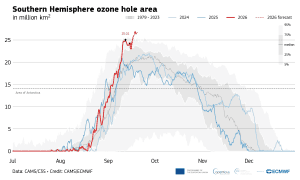 CAMS chart of the ozone hole area on 12 September 2026. The red line shows the data for 2026 and the dotted line the forecast for the following 5 days. The thicker, darker blue line is the evolution of the ozone hole during 2025, and the lighter blue line represents 2024. The grey colours represent the percentile values and the median between 1979 – 2023. Data source: CAMS/C3S Credit: CAMS/ECMWF.
Cold stratosphere drives ozone depletion
The rapid expansion coincided with a sudden fall in the minimum temperature around 20 Km above the South Pole, at the 50 hectopascal level.
Cold conditions in the stratosphere allow polar stratospheric clouds to form. These clouds drive chemical reactions that activate halogens in sunlight, enabling the rapid destruction of ozone during the Southern Hemisphere’s spring.
This process typically takes place between August and November. The Antarctic ozone hole is particularly pronounced because the region’s polar vortex and stratospheric winds provide relatively stable conditions that allow cold air to persist over the continent.
Area is only one measure
Although the 2026 Antarctic ozone hole has grown larger than average, CAMS’ other indicators have remained close to their average values.
The ozone-column minimum measures the lowest ozone concentration within the defined ozone-hole area, while the ozone mass deficit indicates how much ozone is missing from the region.
Together with measurements of the ozone-hole area and stratospheric temperature, these indicators allow CAMS to track how the ozone-depleted region develops throughout the season.
Laurence Rouil, Director of CAMS. Added: “The Antarctic ozone hole’s development can vary considerably from year to year, depending on a range of atmospheric and chemical factors.
“While we have seen its area increase rapidly in early September this year, other indicators remain close to historical averages. These findings highlight the importance of monitoring the complicated interaction between human-made disturbances and natural factors.
“CAMS provides the high-quality data, forecasts and analyses needed to understand the state of the ozone layer and track its long-term recovery.”
Long-term monitoring continues
Scientists have monitored the Antarctic ozone hole using ground-based and satellite observations since the late 1970s. Its largest recorded area in the CAMS dataset was 29.6 million km² on 9 September 2006.
CAMS notes that recent years have generally seen smaller and shorter-lived ozone holes, indicating progress towards recovery of the ozone layer. However, conditions can vary significantly from year to year, making continued monitoring important.
The 2026 season will continue to develop through the Antarctic spring, with CAMS tracking changes in ozone concentration, temperature and the size of the ozone hole as the season progresses.