
Staff writers
Updated September 16, 2026 — 5:38pm,first published September 16, 2026 — 5:13am
Save
You have reached your maximum number of saved items.
Remove items from your saved list to add more.
AAA
The Australian sharemarket took a breather on Wednesday as the rally in oil prices paused and investors treaded lightly ahead of the US Federal Reserve’s interest-rate decision, with markets expecting the first interest rate rise in the world’s largest economy since 2023.
The S&P/ASX 200 finished 24 points, or 0.3 per cent, higher at 8696.50, with seven of its 11 sectors in the green. The benchmark lost 0.9 per cent on Tuesday, hitting a three-month low as the oil-price driven inflation fuelled rate hike bets. The Australian dollar was flat at US71.33¢.
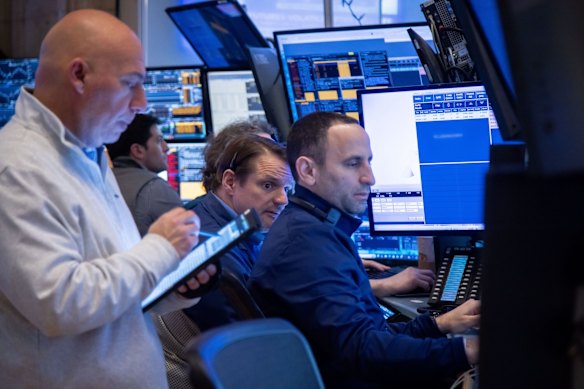 Wall Street lost ground on Tuesday.Bloomberg
“Given the amount of tightening already factored in, and new [Fed] chair [Kevin] Warsh’s dislike of ‘forward guidance’, we believe it might be difficult for the Fed to be more ‘hawkish’ than what is baked in,” said Peter Dragicevich, Asia Pacific currency strategist at Corpay.
The US central bank will announce its rate decision at 4am Thursday AEST, with traders pricing in a 92 per cent chance of the Fed raising the federal funds rate to battle the fuel-led inflation.
Energy stocks paced Wednesday’s gains, even as oil prices eased as a US industry report pointed to a rise in stockpiles. Brent fell toward $US108 a barrel after jumping 4 per cent over the previous two sessions, while West Texas Intermediate was near $US105. The jump — following a shutdown of Saudi Arabia’s East-West pipeline and supply halt in Libya — lifted Brent’s 14-day relative strength index above 70, a technical level that can signal a pullback.
The industry-funded American Petroleum Institute reported that US crude inventories rose by 7.1 million barrels last week, while holdings of gasoline and distillates also expanded, according to a document seen by Bloomberg. Official figures are due for release overnight.
Local oil and gas giant Woodside rose 2.8 per cent. Its rival Santos added 2.1 per cent, while refiners Ampol and Viva Energy gained 2.5 per cent and 3.3 per cent, respectively.
Mining stocks also bounced up in the afternoon, with iron ore and copper heavyweights BHP, Rio Tinto and Fortescue up 1.6 per cent, 1.1 per cent and 2 per cent, respectively, as prices for the metals rose. A 2.3 per cent rise in silver sent South 32, the owner of Australia’s biggest silver mine, up 3.1 per cent. Gold producers Evolution Mining and Newmont rose 1.1 per cent and 2.3 per cent.
The big four banks ended mixed after their losses on Tuesday, with Commonwealth Bank down 0.6 per cent, National Australia Bank down 0.5 per cent and ANZ Bank down 0.3 per cent, while Westpac added 0.2 per cent.
Tech stocks were also mixed, with software makers Xero and WiseTech down 1.6 per cent and 2.4 per cent, while Technology One rose 1.6 per cent and NextDC added 1.3 per cent. Codan jumped 7.5 per cent after saying it raised its CEO Alf Ianniello’s pay after a 486 per cent shareholder return over the past three years.
Related Article
Reliance Worldwide jumped 3.5 per cent after Brookfield Asset Management agreed to buy the plumbing supplies business in a deal that values it at around $4.1 billion. Buying Reliance Worldwide gives Brookfield exposure to the US construction and housing market, which generates around 60 per cent of Reliance’s revenue.
On Wall Street overnight, US stocks slipped after oil prices and the bond market cranked up the pressure. The S&P 500 fell 0.4 per cent. The Dow Jones Industrial Average dropped 328 points, or 0.6 per cent, and the Nasdaq composite sank 0.8 per cent.
Wall Street felt pressure as the yield on the 10-year Treasury, which is the centrepiece of the US bond market, climbed to 5 per cent from 4.97 per cent late on Monday and briefly touched 5.04 per cent overnight. It’s been jumping to its highest level in years, and Monday was the first time it breached 5 per cent since 2023.
Higher yields mean everyone from the US government to households to businesses must pay more in interest to borrow money, which slows the overall economy. They also make people less willing to pay high prices for stocks because they can earn more from sitting in bonds, which are considered safer investments.
“The result is a market that must work harder to generate earnings growth just as investors become less willing to pay premium valuations for that growth,” according to Darrell Cronk, president of Wells Fargo Investment Institute.
The last time the 10-year yield was consistently above 5 per cent was around the turn of the millennium, and it’s been a long march back since it bottomed out below 0.50 per cent in 2020. The pace has accelerated since February, after the war with Iran sent oil prices much higher.
That raised worries about high inflation potentially lasting for years, which are layering atop longstanding concerns about the US government’s massive debt level and other issues.
Inflation remains high enough that the widespread expectation is that the Federal Reserve will hike the federal funds rate for the first time in three years.
Related Article
Traders are still betting on a slight chance that the Federal Reserve could hold off on hiking interest rates, though. If it does, the market could swing because investors may see it as a sign that the Fed is less committed to getting inflation lower.
Fed officials will also release forecasts for where they see interest rates heading in upcoming years, providing another opportunity to inject uncertainty into the market.
On Wall Street, stocks of companies that depend on customers having enough spare cash to spend on their products fell to some of the sharper losses.
Chipotle Mexican Grill dropped 5.9 per cent. Darden Restaurants, the company behind Olive Garden and Longhorn Steakhouse, sank 4.3 per cent.
Dollar Tree, whose customers may have less financial cushion than others, fell 5.4 per cent.
Elsewhere on Wall Street, stocks enmeshed in the cryptocurrency industry sank after the US Senate voted to block legislation creating a new regulatory framework for crypto, while demanding more limits on President Donald Trump’s investments. The price of Bitcoin slumped 3 per cent to $US75,725.19 at 10.20am AEST.
Coinbase Global fell 10.1 per cent and Robinhood Markets lost 3.4 per cent.
In other international markets, indexes fell across much of Europe and Asia. But for several, the drops were not as sharp as Monday’s caused by the slide for AI stocks.
South Korea’s Kospi index, for example, fell 0.9 per cent following Monday’s 3.3 per cent drop.
Save
You have reached your maximum number of saved items.
Remove items from your saved list to add more.
From our partners