
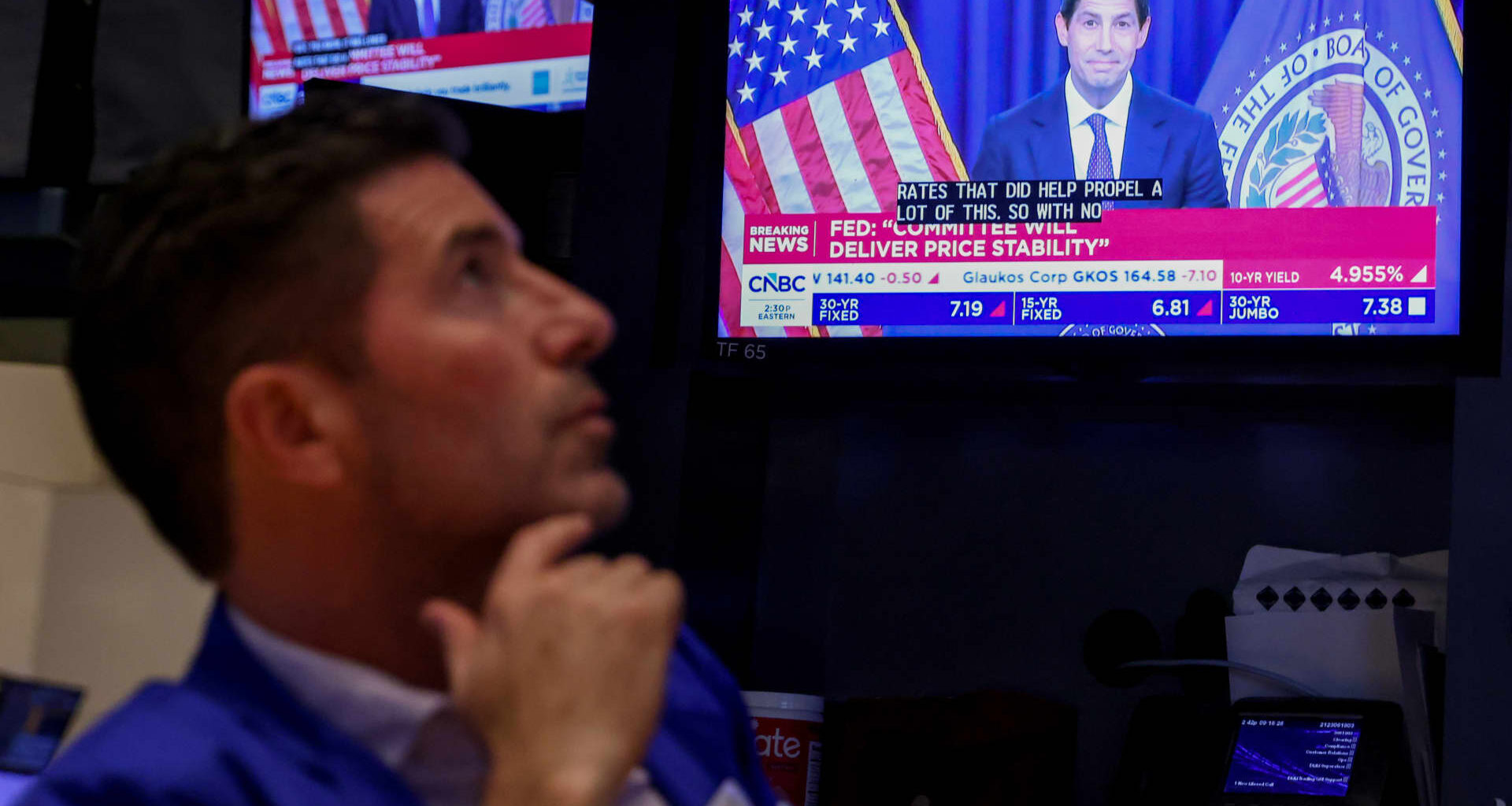
A television station broadcasts Kevin Warsh, chairman of the US Federal Reserve, speaking after a Federal Open Market Committee (FOMC) meeting as a trader works on the floor of the New York Stock Exchange (NYSE) in New York, US, on Wednesday, Sept. 16, 2026.
Michael Nagle | Bloomberg | Getty Images
The Dow Jones Industrial Average fell on Wednesday after the Federal Reserve hiked interest rates for the first time in three years and central bank Chairman Kevin Warsh highlighted persistent inflation.
The 30-stock Dow lost 631.21 points, or 1.21% with Goldman Sachs leading the way lower. The blue-chip average ended the day at 51,461.90. The S&P 500 dropped 0.45% to end at 7,551.81, while the Nasdaq Composite ended the session down 0.01% at 25,978.42. All three were higher at one point during the session before the Fed took action and Warsh spoke at a press conference.
In a unanimous decision, the Fed raised the overnight funds rate by a quarter percentage point, bringing the target range to between 3.75% and 4%. That marked the first hike from the central bank since July 2023. The central bank also signaled another hike could come this year.
Stocks took the widely expected increase in stride at first, but then traded lower during Warsh’s press conference, where he repeatedly highlighted that the inflation risk wasn’t improving. The 10-year Treasury yield traded back above 5% amid fears that maybe the Fed was still behind the curve on inflation even after Wednesday’s hike.
“The plain fact is that inflation is too high, and has been for too long,” Warsh said during the press conference. “This summer’s inflation readings do not tell me that underlying trends have meaningfully improved.”
Stock Chart IconStock chart icon
Dow, 1 day
Art Hogan, B. Riley Wealth’s chief market strategist, noted that even though what the Fed delivered was “within consensus,” Warsh’s “more hawkish” commentary could mean higher yields are here to stay for a while.
“The market is taking its cues currently from the yield on the 10-year bumping back up over 5%, which is a massive psychological level,” Hogan said. That reaction in the yield curve as well as the idea of higher-for-longer inflation could “both become headwinds for markets in the near term,” he added.
Big banks slid after the decision. Bank of America and Wells Fargo shares declined nearly 3% apiece on fear higher rates could slow lending growth and the economy. American Express and Goldman Sachs shares also declined almost 4%.
Adding to the pressures on the economy, U.S. diesel prices hit $6 per gallon on Friday for the first time amid ongoing supply constraints caused by the Ukraine and Iran wars. Additionally, crude oil prices are currently holding above $100 a barrel.
Intel shares advanced 4%, helping to stem losses for the Nasdaq, on a report that it was in talks with South Korea memory giant SK Hynix to build semiconductors in the U.S.