
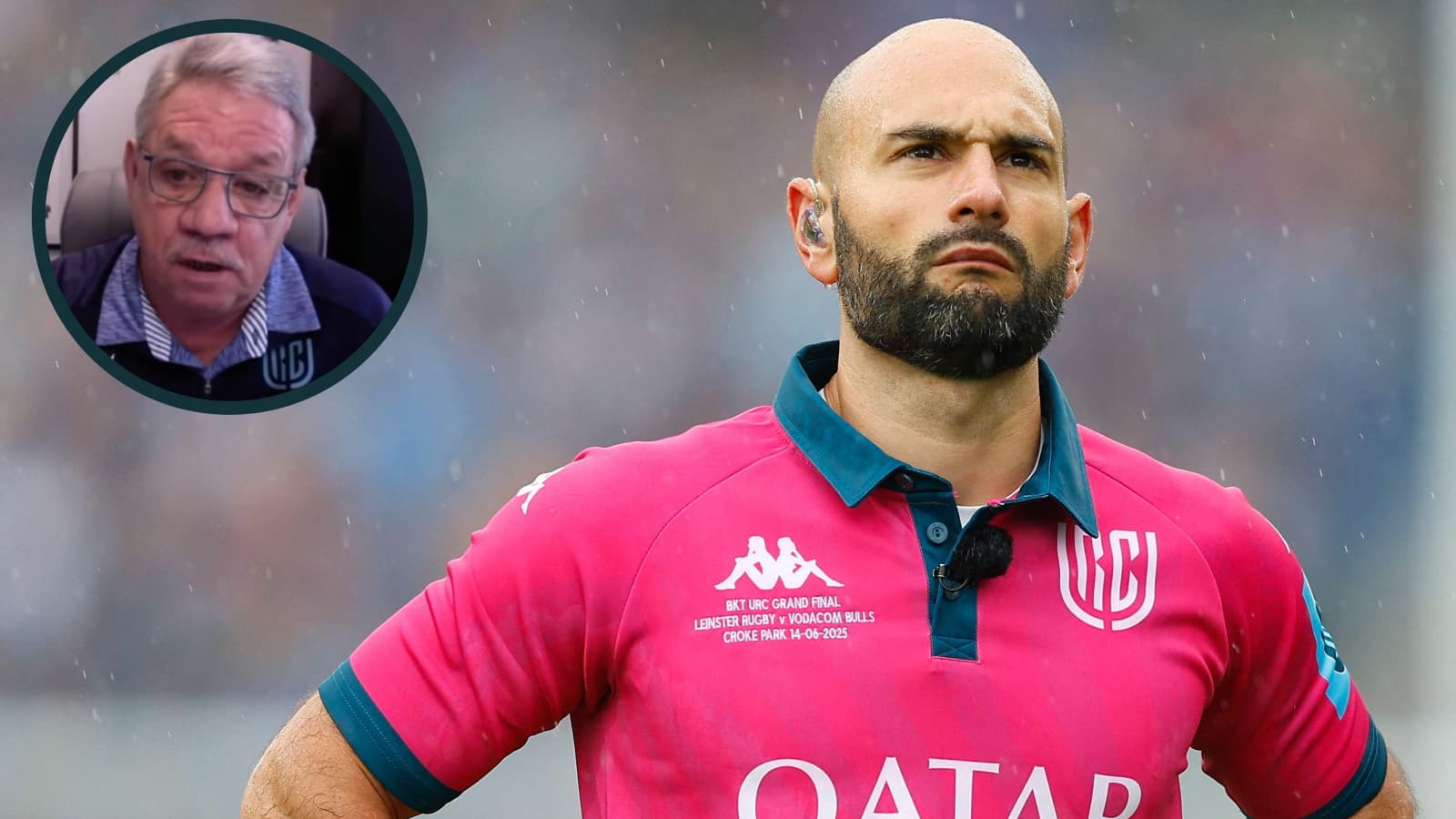
Unlike in international rugby, the United Rugby Championship will allow individual meetings between referees and coaches, Head of Match Officials at the URC, Tappe Henning, has confirmed.
This is in stark contrast to the approach World Rugby is currently taking with the Test game, which was debated at length during Rugby’s Greatest Rivalry Series.
Rassie Erasmus’ complaint
Springboks and All Blacks head coaches Rassie Erasmus and Dave Rennie were both required to be present at any meetings with the officials before a Test match, which is now standard practice in the international game. If one coach opts out of the meeting, it cannot take place.
Erasmus took issue with World Rugby’s decision, stating that it has now forced coaches to air their concerns in the media and doesn’t allow for them to prepare referees on certain plays they wish to use in matches.
“There’s definitely frustration among the coaches that you can’t have meetings with the referee if both teams don’t agree, and it’s now at a stage where you almost accept that both teams’ coaches aren’t always going to agree to a pre-match meeting,” he explained ahead of the RGR Test series opener.
He added: “Sometimes there are small things which you’d normally alert referees in meetings and say, ‘Listen, we might do a midfield maul; just be aware of that and know the law’. Now you can’t because you have to have the meeting with the other coach; you can’t say, ‘We might do a front peel in the lineout, maybe don’t stand there when we do the front peel because you might not see if it’s obstruction or not’.”
Why the URC aren’t aligning with World Rugby’s protocol
Speaking ahead of the URC season, Henning explained that coaches will have the opportunity to speak with the officials before a match if they wish to do so, and those meetings won’t be caveated by the availability or willingness of the opposition coach.
“We’re quite excited about the process that we apply on AMS (athlete management system), which is an evidence-based system to support our match officials to engage with the clubs where they can put clips on,” the former international referee explained.
“As a competition, we still allow coaches to have a call with our match officials, and the reason for it is that we are a high-performance competition with a lot of top international players- probably the most international players in any competition in the world that plays; we recognise that. But like the clubs, we have a strong development element in our competition as well because it is part of a pathway for our players to move into EPCR and international level, and the same for our officials with World Rugby.
“So we talk to each other as much as we can to share knowledge, understanding, and expectations, and we allow coaches to have a meeting with our match officials on request, either by phone call or by a Teams call, 48 hours before the game. It has worked well for us in the past, and that’s why we’re quite eager to continue with that. It’s a little bit different from what has been allowed in the international arena.”
Collaboration between officials, players and clubs is crucial to producing a better product for the fans, according to Henning, who added that it helps develop the referees and prepare them better for the demands of international rugby.
“We believe that it’s beneficial to our clubs, to our coaches, and to our match officials to have those conversations because we have a strong development element and also because of the variety of match officials we have on our panels, from very experienced Ben Whitehouse with 118 URC caps under his belt to newcomers like Hanru van Rooyen and Clara Munarini, who only got one opportunity last year,” he continued.
“So we’ve got a wide variety of experience in our panel of match officials, and that is why we believe that engagement with coaches to have a better understanding is essential for our competition and for us to progress.”
Tappe Henning: ‘We’re all working on the same product’
World Rugby have also put a limit on the number of clips sides can send through to the match officials if teams wish to seek clarity on certain laws or concerns around elements of the opposition or their own games.
That limit is currently set at five, but in the URC, the coaches have been afforded three more clips for before and after a game, the head of match officials confirmed.
“The number of clips and the engagement with coaches: it’s an individual coach who can engage with the match official and ask some questions,” he clarified.
“Coaches are allowed eight clips before a game; they can put eight clips on AMS for the referee to answer. Then, after the game, it’s also eight clips from the game that they would like to see clarity on the decision, the interpretation, and whether it was correct or not.
“So, eight clips before, eight clips afterwards, and the match official answers that, and that will be edited by me to make sure that it is aligned to expectations. But we support that it is communication between the coach and referee, and not a third person in between trying to deal with it.
“Both coaches do not have to be present on that call; it is the individual coach, and it’s by request. I need to be made aware, and that request comes to my desk from the coach by Wednesday at 12:00, and then the meeting, or whatever meeting they decide on, needs to happen 48 hours before kick-off to finalise that.”
Tappe Henning: ‘We’re all working on the same product’
While World Rugby are relenting with the need for both coaches to attend the meetings, Henning is of the opinion that it is beneficial for all if the URC does not adopt the same stance.
“We’re all working on the same product. We’re in the same production line to deliver a product on the field, but if we’re not talking to each other, what suffers? The product will suffer,” he said.
“I cannot think of a car company that will put people in a production line and have certain parts not communicating with others, because the quality of the product is going to suffer.
“That is the reason why I strongly believe, especially with our inexperienced referees, that we need to learn about our product, and we need to take responsibility with our coaches for the product we’re putting out there for the fans to look at and for people to support.
Want more from Planet Rugby? Add us as a preferred source on Google to your favourites list for world-class coverage you can trust.
“How can we work together if we don’t talk to one another? That’s my personal view and opinion, and that’s why I strongly drive coaches to talk to our match officials to make our product better. Not to influence the referee in his decision-making, not to try to impact decisions even before the game is kicked off.
“The referee will still referee what’s in front of him, but it’s to get some clarity and things that we can sort out and a better understanding. If we can do that before kick off, it saves us doing that during the match. We talk to front row players in the change room before a game to try and sort out small things and give clarity about the process, what we focus on, and the expectations. So it will just make our product so much better if we keep on talking to one another.”