
Hoops Rumors is checking in on the 2026 offseason for all 30 NBA teams, recapping the summer’s free agent signings, trades, draft picks, departures, and more. We’ll take a look at each team’s offseason moves and consider what might still be coming before the regular season begins. Today, we’re focusing on the Minnesota Timberwolves.
Free agent signings
 Ayo Dosunmu: Five years, $112,000,000. Fifth-year player option. Re-signed using Bird rights.
Jonathan Kuminga: Two years, $12,431,200. Second-year player option. Signed using taxpayer mid-level exception.
Jaylen Clark: Three years, $10,000,000. Fully guaranteed. Re-signed using Bird rights.
Bones Hyland: One year, minimum salary. Fully guaranteed. Re-signed using minimum salary exception. Waived right to veto trade.
Trey Lyles: One year, minimum salary. Partially guaranteed ($1.5MM). Signed using minimum salary exception.
Jules Bernard: One year, minimum salary. Non-guaranteed (Exhibit 9/10). Signed using minimum salary exception.
Trades
Acquired LaMelo Ball and Josh Green from the Hornets and the draft rights to Isaiah Evans (No. 33 pick) from the Nets in a four-team trade in exchange for Julius Randle (to Nets), Naz Reid (to Hornets), the draft rights to Joshua Jefferson (No. 28 pick; to Nets), the draft rights to Matteo Spagnolo (to Hornets), the Timberwolves’ 2033 first-round pick (to Hornets), the Timberwolves’ 2029 second-round pick (to Hornets), the Timberwolves’ 2032 second-round pick (to Hornets), the Timberwolves’ 2033 second-round pick (to Hornets), and first-round pick swaps in 2028, 2029, and 2030 (to Hornets).
Acquired Cody Williams and John Konchar from the Jazz in exchange for Josh Green and cash ($4MM).
Draft picks
2-33: Isaiah Evans
Signed to four-year, $9,264,648 contract using second-round pick exception. First three years guaranteed. Fourth-year team option.
2-59: Trey Kaufman-Renn
Two-way signings
One year, $91,000 partial guarantee (will increase to $339,441 at start of regular season).
Note: The Timberwolves carried over Rocco Zikarsky and Zyon Pullin on two-way contracts from 2025/26.
Departed/unsigned free agents
Other roster moves
Waived John Konchar ($6,165,000 salary stretched across three seasons).
Salary cap situation
Note: Figures are rounded to one decimal place.
Operating over the first apron ($209MM) and below the second tax apron ($221.7MM).
Hard-capped at second apron.
Team salary: $215.4MM (tax); $217.2MM (apron).
Above luxury tax line by $15MM; above first apron by $8.1MM; below second apron by $4.5MM.
Two traded player exceptions frozen/unavailable (largest worth $10.8MM).
One traded player exception available (worth $2.5MM).
The offseason so far
Since being hired as the Timberwolves’ president of basketball operations four years ago, Tim Connelly has provided periodic reminders that he’s not content to play it safe and focus on job preservation. Connelly controversially surrendered a massive package of players and draft assets for Rudy Gobert during his first year on the job in 2022, then traded Karl-Anthony Towns to New York in 2024.
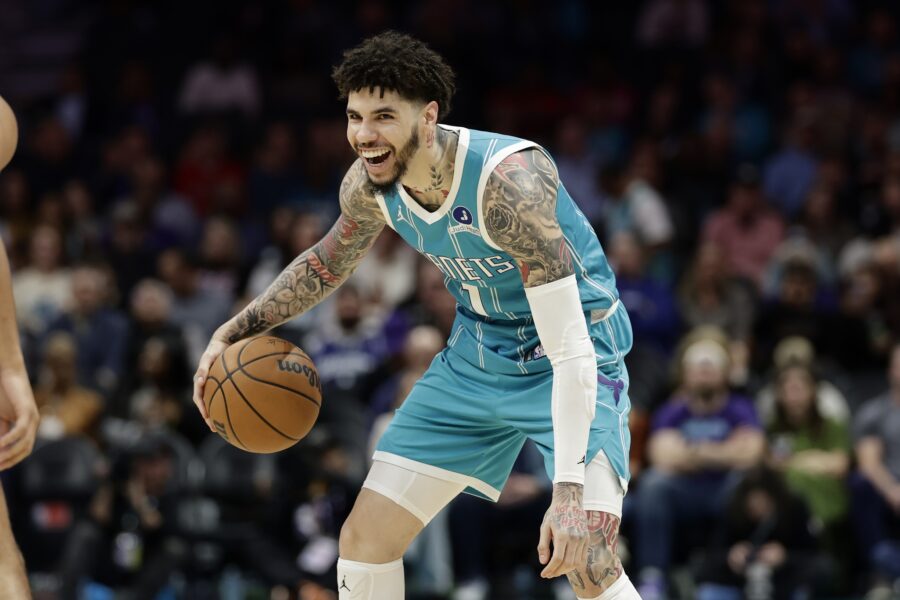
Nearly two years after completing that Towns blockbuster, Connelly was due to take another big swing on the trade market, and he delivered in a major way this offseason by making a deal for Hornets point guard LaMelo Ball.
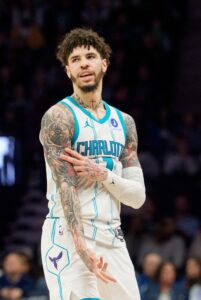 While Minnesota only sent a single first-round pick to Charlotte in the trade, the overall price for Ball certainly wasn’t light. The Timberwolves’ outgoing package included three second-round picks, three first-round pick swaps, and fan favorite Naz Reid, who had been a perennial Sixth Man of the Year candidate in recent years and won the award in 2024.
It was a significant price to pay for a player whose value ahead of the 2025/26 season appeared to be at a low. During the three-year stretch from 2022-25, Ball had been limited to just 105 total games due to a series of injuries, including recurring ankle issues, and he wasn’t exactly leading the Hornets to wins even when he was healthy — the team won 27, 21, and 19 games during those three seasons.
But Ball appeared in 72 regular season games in 2025/26 and proved what he’s capable of when he can stay on the court. His scoring average dipped to 20.1 points per game and he shot just 40.7% from the field, which was nearly a career low, but he cut down on his turnovers and played winning basketball, making everyone around him better.
The Hornets had a remarkable +9.1 net rating and a 123.2 offensive rating during Ball’s time on the floor. Those marks would’ve ranked second and first in the NBA, respectively, over the course of a full season, and represented a massive improvement over the +1.5 net rating and 110.6 offensive rating that Charlotte posted when the star point guard wasn’t playing.
The Timberwolves are hoping that Ball can do for players like Jaden McDaniels, Gobert, and Joan Beringer what he did for the likes of Kon Knueppel, Brandon Miller, and Moussa Diabate in Charlotte, attracting defensive attention and setting his teammates up for open shots and easier finishes around the net. Ball’s presence will also ease some of the pressure on Anthony Edwards, who was overextended offensively in 2025/26 on a team without a true point guard and saw his defensive intensity slip a little as a result.
Acquiring Ball and re-signing mid-season trade acquisition Ayo Dosunmu to a five-year, $112MM contract ensured that Minnesota will have one of the NBA’s very best backcourts, with those two and Edwards all expected to play major roles. But the Wolves will have some production to make up in the frontcourt, where Reid and Julius Randle – who was traded to Brooklyn in a cost-cutting deal – are no longer in the mix.
Minnesota reached an agreement early in free agency to bring back Trey Lyles from Europe on a partially guaranteed minimum-salary contract. But Lyles, an NBA journeyman, is better suited to a backup role, so the front office spent much of the summer trying to figure out how to acquire a starting-caliber power forward with limited roster-building tools at its disposal. Those efforts ultimately paid off when the Wolves convinced Jonathan Kuminga, who had been seeking a more lucrative deal, to accept a two-year, $12.4MM offer that includes a second-year player option.
The Wolves had to send out a possible rotation wing (Josh Green) in a cost-cutting trade in order to free up the taxpayer mid-level exception to sign Kuminga, but the team believed that was a worthwhile trade-off to land a former No. 7 overall pick who is entering his age-24 season and has shown promise on both ends of the floor through five NBA seasons.
Even if Kuminga plays well, there are questions about the Timberwolves’ depth with Reid and Randle gone and Donte DiVincenzo likely to spend most of the season recovering from the Achilles tear he sustained in the first round of the 2026 playoffs. Minnesota will be counting on internal improvement from young players like Beringer, Terrence Shannon Jr., and Jaylen Clark – who signed a new three-year, $10MM deal this offseason – as the team looks to secure a top-five seed in the West.
Up next
Prior to their series of roster moves that included trading Green, signing Kuminga, and waiving John Konchar, the Timberwolves appeared likely to be capped at 14 players on standard contracts entering the regular season. However, with $4.5MM in breathing room below the second tax apron, Minnesota can now afford to bring in a 15th man on a minimum-salary contract ($2.45MM) and still have a little flexibility below that hard cap.
Whether or not the Wolves carry a full 15-man squad into opening night remains to be seen. With DiVincenzo on the shelf and no sense yet of what the club can expect from youngsters like Isaiah Evans and Cody Williams this fall, it wouldn’t be the worst idea to add a 15th man on a non-guaranteed deal for depth purposes, but the pickings are pretty slim at this point. Veteran free agent forwards like Kevin Love, Nicolas Batum, or Jeff Green are fits in theory, but they may not have much left in the tank at this point in their respective careers.
Minnesota still has an unsigned second-rounder from the 2026 draft, but it sounds like No. 59 pick Trey Kaufman-Renn is focused on returning to school for one more year rather than beginning his NBA career. That’d probably be fine with the Wolves, who currently don’t have a two-way slot available and would be able to keep a close eye on Kaufman-Renn as a domestic draft-and-stash prospect.
 Several notable Wolves players are currently extension-eligible, including Edwards, Ball, and DiVincenzo. McDaniels (October 1) and Gobert (Oct. 24) will soon join that group too.
Still, there should be no urgency to make a deal with Edwards, Ball, or McDaniels, each of whom has three years left on his current contract. Edwards can also qualify for a super-max extension if he makes an All-NBA team in 2026/27, so it’s safe to assume he’ll wait until next summer to discuss a new deal.
It would also be pretty shocking if the Wolves extend DiVincenzo while he’s still deep in the process of rehabbing his Achilles tear.
That leaves Gobert as the probable next man up for an extension. The French center could become a free agent as early as 2027, since he holds a $38MM player option for ’27/28, but he won’t become eligible to negotiate a new deal until after opening night. We’ll see whether he and the Wolves want to try to get something done during the season or whether they hold off until the spring to get serious about an extension.
Gobert turned 34 in June, so the Wolves will likely be wary about how many years they’re willing to guarantee, but the big man is still a crucial part of the team’s game plan as its rim-protecting anchor and a perennial Defensive Player of the Year vote-getter.