
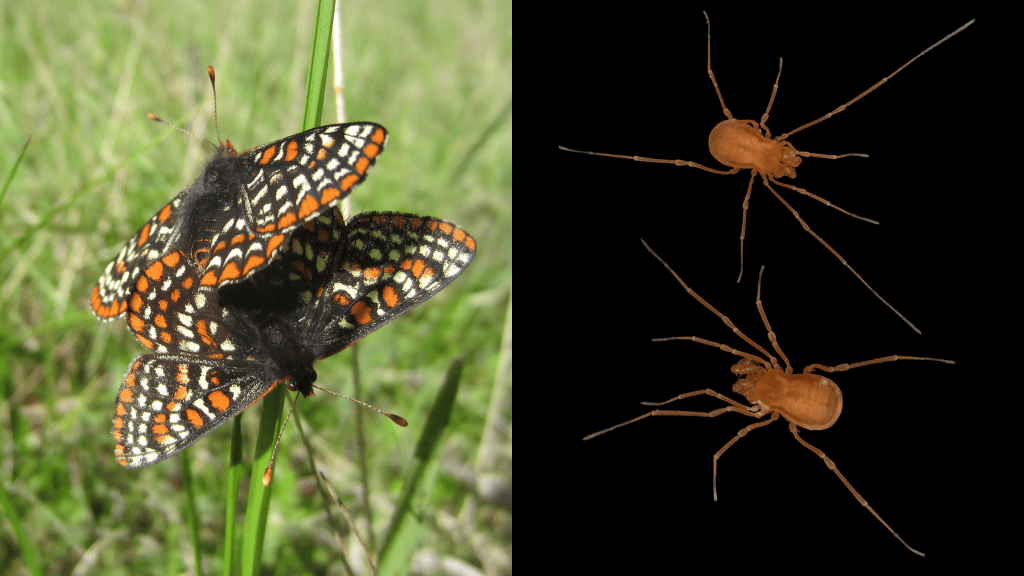
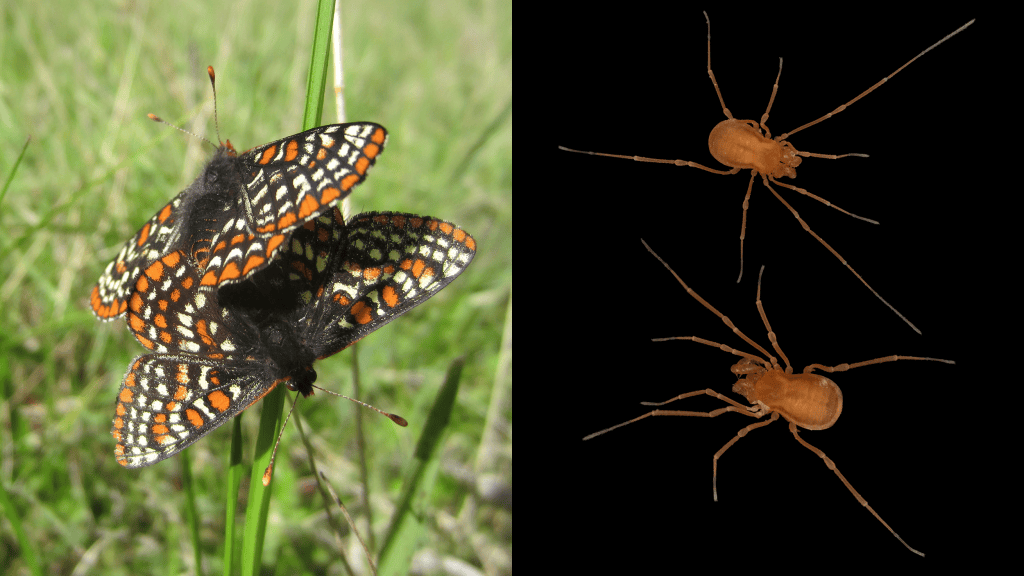
 Most U.S. insects and arachnids remain unassessed for conservation risk, and even many known at-risk species lack legal protection. A study quantifying this lag in arthropod conservation reveals a major blind spot in efforts to save vulnerable wildlife. Euphydryas editha taylori (left) is a critically imperiled butterfly protected by the U.S. Endangered Species Act and Washington state, while Texella welbourni (right) is a critically imperiled arachnid that lacks legal protection. (Butterfly photo by Candace Fallon; arachnid photo by Prakrit Jain)
By Wes Walsh and Laura Figueroa, Ph.D.
 Laura Figueroa, Ph.D.
 Wes Walsh
As two researchers in entomology and ecology, we share an almost comical mutual fascination with arthropods. We love sharing stories of underappreciated taxa in entomology–like flies that pollinate as effectively as bees or spiders that help monitor air quality. In fact, our fondness for underappreciated invertebrates—combined with a 2022 study that showed U.K. and Ireland conservation policies were biased toward Lepidoptera and Odonata—inspired us to ask: Do similar biases exist in United States conservation?
This was during Wes’ time as a master’s student at the University of Massachusetts Amherst, while Laura was Wes’ co-advisor. We set out to see how many described insects and arachnids had been evaluated for conservation risk in the U.S., how well vulnerable species are protected by federal and state endangered species acts, whether taxonomic bias influences assessment and protection, and why state-level policies toward endangered invertebrates vary.
Ultimately, we found that such taxonomic biases do exist in the U.S., with interesting differences in what kinds of arthropods are assessed for conservation risk and which have received legal protection. We published our findings in March in Proceedings of the National Academy of Sciences.
The first step in assessing bias was to compare assessed species to the number of described species in the U.S. We were surprised to discover that there was no single paper or clear database that we could reference to get the number of described insects or arachnids in the U.S. We contacted entomologists across the country, from the University of Florida to the American Museum of Natural History, who all responded, essentially, “I can’t believe that that doesn’t exist, but I also can’t think of an example of what you are asking for.” Ultimately, we had to compile the described species counts from 40 separate sources, comparing what we found against the species present on NatureServe, the conservation database most widely used by the U.S. government to make policy decisions.
We found almost all (88.5%) described insects and arachnids in North America north of Mexico lack conservation assessment by NatureServe, either because they do not have NatureServe entries or because those entries were not evaluated for conservation risk. For species recorded in the U.S. on NatureServe, we found being unassessed reduced the likelihood of legal protection, meaning this pervasive lack of assessment is a barrier to conservation.
So, already, most insects and arachnids are not on policymakers’ radar. More surprising, however, is that, of the small subset that have been assessed and are known to be at-risk, a startling 94.7% are not protected by any state or federal endangered species law. In fact, only 2.5% of at-risk insects and arachnids have nationwide protection under the federal Endangered Species Act, compared to 27.7% of at-risk birds, pointing to a specific failure to legally protect insects and arachnids.
Interestingly, although most (45) states have state endangered species acts, only 27 explicitly consider insects and arachnids eligible for legal protection. In the remaining states, insects and arachnids are either explicitly not eligible for protection, or their eligibility is ambiguous and no insects or arachnids are protected. (Though, luckily, this is changing, with recent legal wins in California and New Mexico.) The only predictor of whether states had their own endangered species acts and whether those acts included insects and arachnids was the amount of total state GDP attributable to the oil, mining, gas, and quarrying industries. This suggests a possible conflict between industries that want access to land and the ability to enact endangered species protections, an issue well-documented under the federal Endangered Species Act.
We found taxonomic biases both in which orders are assessed for conservation risk and in which orders are protected by law, but the favored taxa are not the same. Well-assessed orders are water-quality bioindicators: mayflies (Ephemeroptera), stoneflies (Plecoptera), caddisflies (Trichoptera), and dragonflies and damselflies (Odonata). However, many of those species do not receive protection; instead, butterflies and moths (Lepidoptera) and dragonflies and damselflies (Odonata) receive most of the protections, suggesting that charisma is a stronger driver of conservation than data availability. We also found a stark difference in assessment and legal protection between insects and arachnids, with arachnids being vastly less thoroughly assessed and protected.
Entomology may benefit from lessons learned in the bird conservation world, where partnerships between diverse groups, like hunters and bird watchers, enabled the passage of hallmark conservation legislation. Similarly, since Ephemeroptera, Plecoptera, and Trichoptera are closely tied to recreational fishing and water quality, this may be an opportunity to build diverse coalitions that can more effectively promote insect conservation.
Clearly, there is urgent need for monitoring, life history studies, and conservation assessments of many insects and arachnids. Creating unbiased conservation policies, however, will likely also require outreach and active campaigns to communicate the immense ecological, economic, and cultural value of a broader range of insect and arachnid taxa and improve the general perception of these groups so that they are considered worthy of conservation and receive the protections they need to thrive.
Wes Walsh is a Ph.D. student in ecology and evolutionary biology at the University of Minnesota who recently earned his master’s degree in biology at the University of Massachusetts Amherst. Email: wals0455@umn.edu. Laura Figueroa, Ph.D., is an assistant professor of environmental conservation at the University of Massachusetts Amherst. Email: llf44@umass.edu.
Related
Discover more from Entomology Today
Subscribe to get the latest posts sent to your email.