
Baltimore, a city in desperate need of colour and vibrancy, was flooded with both on the morning of September 12.
The city’s waterfront was so jammed with Springboks fans wearing green that it looked like a lawn was being laid.
South Africans were everywhere, with enough Afrikaans being spoken to
suggest it was mostly expats who had come to Baltimore for the chance to see the Springboks make history.
But that sea of green was made up of more than South Africa’s diaspora. There were Springbok-jersey-wearers with American accents and maybe they had a national connection, but maybe they were US rugby followers who had fallen in love with the Springboks.
The prospect of anyone outside South Africa wearing a Springbok emblem 40 years ago was zero, but now they are writing such a different story – and are a symbol of unity, hope and national pride – that they have become inspirational to non-South Africans.
Since he took over in 2018, head coach Rassie Erasmus and captain Siya Kolisi have focused on making the Springboks the people’s team – expanding the support base beyond the historically rich, educated, white population, and engaging the burgeoning, black middle class.
They have told a simple story that they recognise South Africa is riddled with violent crime, political corruption and infrastructure failures. They know that almost 40% of the country’s 65 million people are living in poverty, with limited access to education and that there are 17 million South Africans who don’t have a job.
They don’t shy from that truth – but confront it and they see the Springboks as a beacon of hope. They recognise they are playing for something bigger than themselves, something bigger than rugby.
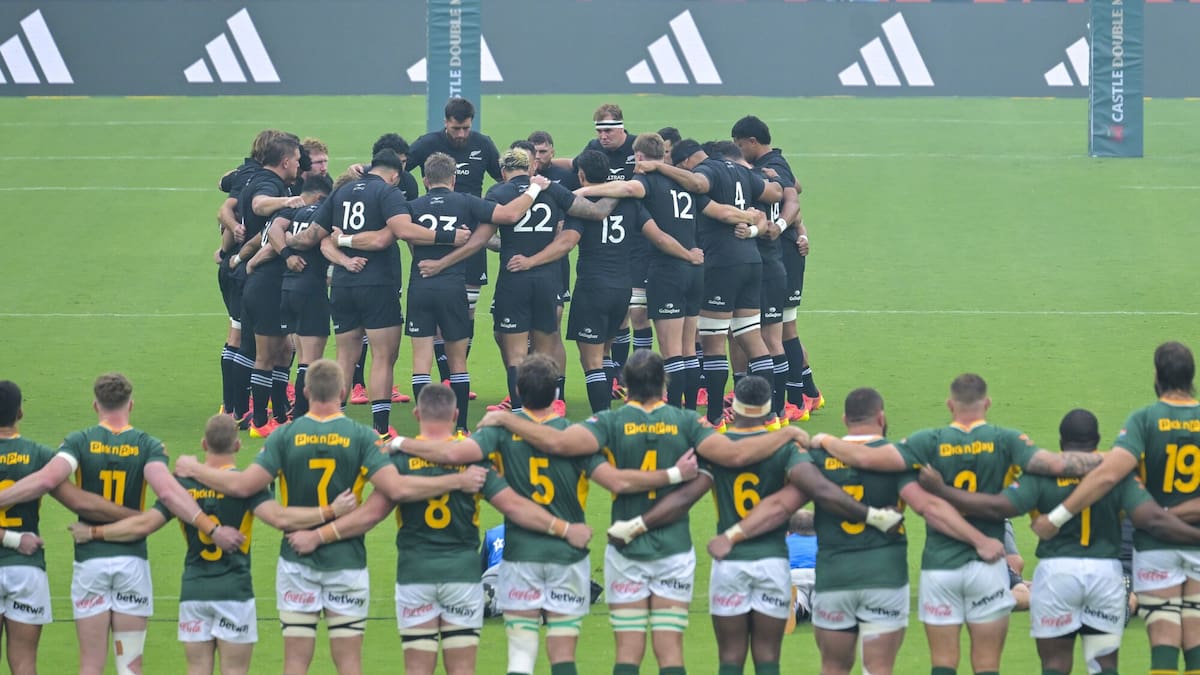
The recent test series between the All Blacks and Springboks highlighted different levels of connection with their respective fans, writes Gregor Paul. Photo / SmartFrame
There is nothing forced or hyped about their messaging: it’s authentic and genuinely powerful when the scale of South Africa’s underclass and the disparities in wealth are realised.
Theirs is a country of barbed wire, electric fences, corrugated iron, shanty towns, people walking down the hard shoulder of motorways, people pushing overloaded shopping trolleys with nowhere to go and people begging at traffic lights – selling whatever they can at traffic lights. It’s a country where it’s impossible not to be conscious of white privilege.
The Springboks want to be something the nation can be proud of: a symbol of unity, not division. A team that brings South Africans together.
The Springboks once stood as the symbol of apartheid, but now they are a team that gives all South Africans a focal point, and because of their success and the compelling nature of their story, they are starting to win a place in the global imagination.
The Springboks, as unlikely as it would have been 40 years ago, are growing their fanbase not only in South Africa but internationally.
The sea of green in Baltimore was evidence the Springboks are starting to make inroads in the US and are becoming the second-favourite team of rugby fans.
“Definitely the interest in the Springboks and the brand because of what Rassie and Siya have achieved in South Africa has got a lot of support outside of South Africa now,” South African Rugby Union (SARU) chief executive Rian Oberholzer says.
After the Soweto test, Springboks captain Siya Kolisi said: “We wished more people could come and see the game.” Photo / SmartFrame
“There are a lot of people who are buying into the ethos of what the Springboks stand for. It is giving opportunity to so many South Africans to be proud of the country again and I think if we can continue in that vein into new markets, I believe it will find some support.
“One of our major sponsors [Nike] is quite keen to assist us with that. We are silently positive that the Springboks brand will be one of the most supported at the 2031 World Cup in America.”
‘Are you Gregor Paul?’
The Springboks are clearly powerful on the field and they are also an intimidating force off it.
On match days in South Africa, an army of fans seemingly appeared out of nowhere. They pop up in hotels, shopping malls, restaurants and bars.
There are, of course, the affluent whites with Dutch heritage – big men who look like they could shift a scrum or win a lineout, with ubiquitous blonde-haired women who could appear on Government posters encouraging people to come to live in South Africa.
But there is also a significant black population overtly supporting the Springboks. And it’s not just on match days.
In Johannesburg, Cape Town and Durban, every day there were people wearing something with a Springbok emblem on it. The brand was everywhere.
This is where SARU has been smart and used a looser licensing agreement with its apparel partner Nike to produce affordable, wearable clothing that is widely available.
There is something for everyone – T-shirts that celebrate the Springboks’ World Cup triumphs; hoodies, fleeces and training tops; official fan replica shirts; replica jerseys and old-school, classic Springboks rugby shirts.
They range in price from $20-$220, reflecting the socio-economic differences in the fan base and South Africans – white and black – are overtly wearing Springboks merchandise all the time.
It’s powerful and weaponised by such initiatives as Bok Friday where everyone – whether at schools, offices, businesses, retailers – is encouraged to wear something to support the team the day before a test.
Even NZME was brought into the fold. On the Friday before the first test at Ellis Park, a member of staff knocked on my hotel door and asked: “Are you Gregor Paul?”
I said “yes” hesitantly as it was unclear where this was going. “This is for you,” she said as she handed me a bag and walked off.
What I found inside was a Springboks T-shirt listing their World Cup triumphs – and a note from the hotel manager that said: “Welcome to the Springboks family, home of the world champions. Wear this with pride”.
I chucked it on my bed, and thought: “What the hell am I going to do with that?”
If the shirt fits
It’s the day before the third test in Soweto and many of the hotel staff at the Marriott Balalaika are wearing Boks shirts.
I come down for breakfast and people wearing green shirts are everywhere, the noise is deafening, and it suddenly feels like I am a pilgrim in an unholy land.
I see Kabelo, one of the hotel staff who, over the past two weeks, has brought me an inordinate number of cappuccinos from the barista – that I don’t seem to have been charged for – and bantered with me about the Springboks being invincible.
He’s wearing his issued grey uniform and so I ask him why he’s not wearing a Springboks shirt for Bok Friday.
He tells me: “I can’t afford one. This is not a well-paid job and shirts are expensive. I don’t have enough money to buy one.”
I tell him: “I think I can fix that for you. I’ll be back in a minute.”
I go to my room and get the rogue Springboks shirt I have been ironically gifted and give it to him. He can hardly believe it. He takes it and soon returns with it on over his grey pullover and he’s grinning from ear to ear.
He’s ecstatic that he’s now got something to wear on Bok Friday. A Springboks T-shirt is social currency and when he inevitably brings me my unasked-for cappuccino, I ask him what he knows about the World Cup triumphs.
He can recite the years the Boks won, and he tells me they learned all about it at school, before listing the games South Africa have played at Soccer Stadium.
It’s not lost on me that here is a young black man proudly wearing his newly acquired Springboks apparel before a sold-out test in Soweto.
The day before I had interviewed former All Blacks captain Sean Fitzpatrick about the rivalry with South Africa and he noted that he’d been oblivious to the politics throughout the 1970s and 1980s, but that he’d noticed coming back since his first visits in the 1990s how different things have become.
“When I first came here in 1992, it was almost 100% white: the team was almost 100% white and the crowd was 100% white.
“Then I came back here in 2024, and saw in the space of 30 years, it had changed. Oh my God, it’s just phenomenal. Rugby did that, sport did that. Mandela did that, wearing the jersey of his oppressors. That 1995 game was like, wow, ‘they just had me in jail for 27 years and I’m happy to embrace it for the good of the country’.”
South African President Nelson Mandela (left) and Springbok Francois Pienaar at the 1995 Rugby World Cup final. Photo / Photosport
In 30 years, the Springboks have built a sense of identity that has won the nation over. They have used storytelling, political figures, back-to-back World Cup titles and merchandise to legitimise the emblem and now they are a team actively supported by eight million whites and the emerging black middle class, which is estimated to also be about eight million people.
There is also support in the rest of the population, but it’s not monetised. It is still, however, incredibly powerful and meaningful as Springboks captain Kolisi alluded to after the Soweto test.
“Driving through Soweto and seeing how the kids were sprinting to come see the bus,” Kolisi said. “They can’t afford to come and see us but seeing that and understanding the history of Soweto, young people fought for me to be sitting here today, for us to be here today, that’s why we wanted the game to be here and that is why the game was here today.
“We wished more people could come and see the game, but it was encouraging to see the kids chasing us and waving at us because that is who we play for.
“Not only the ones who can afford to be here: every single South African.”
Malcolm Marx connects with Springboks fans in Baltimore. Photo / SmartFrame
Clarity of storytelling
Having spent six weeks in South Africa and a week in the US covering Rugby’s Greatest Rivalry (RGR), the biggest takeaway is that the Springboks have a stronger link with their fans than the All Blacks do with theirs.
The South Africans have a better sense of their national identity and how it relates to the Springboks.
But there is something deeper at play with the Boks. They have tapped into the entirety of their population in a way the All Blacks haven’t been able to.
Do the All Blacks project the same clarity of storytelling as the Boks? Do they promote the same simple messages about national identity and who they are playing for?
When that question was put to All Blacks coach Dave Rennie, he said: “How many people in South Africa? Sixty-five million? There’s a lot. So, that’s a small percentage going to a game or supporting in the pubs, when you look at it from that point of view.
“I find it hard to believe that anyone’s as passionate as New Zealanders. When you have success, it builds your support base and people who might be on the fence get on board.
“Ideally, that’s the direction we want to head in. The type of footy we’re trying to play, I think, would really appeal to the New Zealand DNA around how the game should be played.
“I think Kiwis are really passionate about the All Blacks, and even though rugby league’s a big game in our country, I’m sure there’s plenty of league supporters who, on a test day, would be very supportive of the All Blacks.”
Dave Rennie: “I think Kiwis are really passionate about the All Blacks.” Photo / SmartFrame
But can New Zealand Rugby (NZR) say it has connected the All Blacks with the young, growing Pasifika and Māori populations in the same way as the Boks have won the support of young, black South Africans?
The official – and unofficial – tour groups in South Africa were almost exclusively white, older and affluent, and it’s this same, expanded, group who predominantly buy test match tickets in New Zealand as well as All Blacks apparel and Sky subscriptions.
There is no sense that NZR has weaponised merchandise in the same way to build social currency with the urban youth or created a broad enough range of apparel to appeal to the full socio-demographic gambit.
The anecdotal evidence suggests it is the NRL that has captured the young Pasifika market in New Zealand – and that social currency comes from wearing the trademark, short shorts that have historically been a bestseller for Rebel Sport.
There is harder evidence, which has come from NZR itself, which in a document entitled Rugby System Programme has revealed: “NRL now draws 28m NZ viewing hours against Super Rugby’s 19m and NPC’s 14m.”
NZR does have a separate licensing agreement with the Warehouse, enabling it to sell cheaper, All Blacks-branded apparel and merchandise, but it looks cheap and therefore carries a stigma.
In other words, it would be social suicide for a teenager to rock up to school in a Warehouse All Blacks T-shirt. NZR’s newly installed chief commercial officer Chris Brown admits the national body has to lift its merchandise game.
NZ Rugby chief commercial officer Chris Brown says there is an opportunity to create more appealing retail and merchandise to connect with fans.
“We see the opportunity from a retail and merchandising perspective as significant,” he says. “We are doing some strategic analysis to understand what that headroom is. We have got fantastic partners with adidas and Fanatics and some of the domestic retailers who we work with.
“But if we look at best-in-class across sporting organisations, the percentage of our revenue from retail and merchandising … there is opportunity there.
“We are probably around 10% and we think that could grow to 15-20% if we get our strategy right. We are keen to explore that further and understand what we are providing to our fans.
“Is it connecting well? Where are the opportunities and how can we create even more appealing retail and merchandise that drives their pride, drives their fandom and delivers better returns for NZR and our partners.”
Show us the money
There are many reasons why the All Blacks have not captured the whole nation and haven’t married their identity into a national identity the way the Springboks have, but the most impactful has been NZR’s desire to monetise the brand.
To maximise returns, the commercial strategy has inevitably focused on the older, richer fan.
The merchandise strategy has primarily been to sell full-price replica shirts because that’s what older fans want, and ticket prices for tests are set at price points that make it inevitable stadiums will mostly be filled by the same cohort.
And commercialisation has perhaps sent mixed messages about who the All Blacks are and confused the simplicity of their story.
NZR has invested heavily in a content strategy that is designed to take fans behind the scenes of the team and present the players as more accessible.
The plan is to grow the reach of the brand and in time increase the value of broadcast deals, sponsorships and merchandising.
All Blacks fans backing their team in South Africa. Photo / SmartFrame
The numbers generated out of RGR – there were close to two million hits on allblacks.com; social content generated 657 million views, there were 41 million engagements and more than 320,000 net new followers across Meta, TikTok, X and YouTube – suggest the strategy is working.
But NZR has burned through somewhere between $25m and $38m on this content strategy – in which time it has seen an estimated $25m drop in its domestic broadcast income.
Also, to put the growth of new social-media followers into perspective, Tim Payne, a little-known footballer grew his audience by five million followers at the Fifa World Cup.
NZR is spending a fortune to capture almost every moment inside the All Blacks camp without a shred of evidence that it can be monetised.
Also, the storytelling doesn’t all marry with the team’s sense of who they are, who they are playing for and how they want to be perceived.
It doesn’t align with the simple philosophy of the All Blacks being a team chasing performance excellence and trying to enhance the best winning record in global sport.
There was a moment on the RGR tour that summed up the flaws in the content strategy. I was invited by NZR to see the Baltimore Ravens training facility before the fourth test.
It turned out, though, that I was being squeezed into a tour that was organised for former All Blacks Dan Carter and Lima Sopoaga and former Black Fern Portia Woodman-Wycliffe and that the real purpose of the visit was to capture content of those three interacting with the Ravens.
The three esteemed rugby folk were caught on camera gasping at the quality of the training facility, which had a major country-club vibe for high-performance athletes.
The investment in the training centre was incredible, but it meant that Carter, one of the greatest All Blacks in history, was conceding on camera that a mid-level NFL club had high-performance facilities that rugby’s supposed greatest high-performance team could only dream of.
And there it was – the moment of realisation that instead of blowing millions on a content strategy, NZR could have used that money to build a state-of-the-art training facility for the All Blacks. Or, at least, it could be investing the money directly into the team – aiding their ability to win more than they currently do.
Why spend so much on cameras and content to win social media followers when the All Blacks have built their brand on the simplest story of all: how often they win.
When the All Blacks were driven by the desire to be the most dominant team in history, there were no cameras inside the camp, no social media strategy, no plan to pump out digital content to give the world a window into what makes the team tick.
NZR will say it would be commercial suicide to not have a digital presence, but again, there is an evidential basis to say they could have a higher social media following by pumping out clips of the haka, classic tries, great moments and match analysis – content Sky has paid to capture.
More than two million watched the All Blacks play South Africa – crazy high numbers that suggest the nation is invested in the games but doesn’t need to know the personalities or build a relationship with the players on social media.
Maybe the most sobering statistic of all is that in the 10 years before the All Blacks had a content strategy they won two World Cups and 87% of their games. In the five years since they have had cameras embedded in the team, they have won 73%.
The big picture
South Africa is a country where survival is too high on the everyday agenda. I saw a dead body lying on the street in Cape Town one day. I was at the lights in an Uber looking at this man who was clearly dead – his chest wasn’t moving and the pallor was wrong – and people were just stepping over him to cross the road.
I was also in an Uber that was diverted through the suburb of Alexandra in Johannesburg and saw the realities of life in a township, where a million people are living in what looked like abject squalor.
Periodically the lights wouldn’t work in my hotel room – not all of them anyway – as the power was intermittent. Some nights the guard at the hotel gate would warn us against going out – it was too dangerous to walk the 200m to the safety of the shopping mall that would take us to Mandela Square.
But it keeps life simple for the Springboks as a high-performance team in a professional world. They have a clear mission to play for a country that is not burdened with first-world problems but the harrowing issues of the emerging world.
The Boks don’t have a content team or content strategy – there is an old university friend of Erasmus’ embedded with a camera – but there is no clutter or marketing narrative laid over the top of the team.
They are becoming a great team and maybe NZR needs to see the simplicity of their set-up, the clarity of their mission, and the power the Springboks extract from playing for something so much bigger than themselves.
Gregor Paul is one of New Zealand’s most respected rugby writers and columnists. He has won multiple awards for journalism and written several books about sport.
Listen to Elliott Smith’s live commentary on Newstalk ZB Sport and iHeartRadio, or join the Alternative Commentary Collective on iHeartRadio and Radio Hauraki.
SaveShare this article
Reminder, this is a Premium article and requires a subscription to read.
Copy LinkEmailFacebookTwitter/XLinkedInReddit