
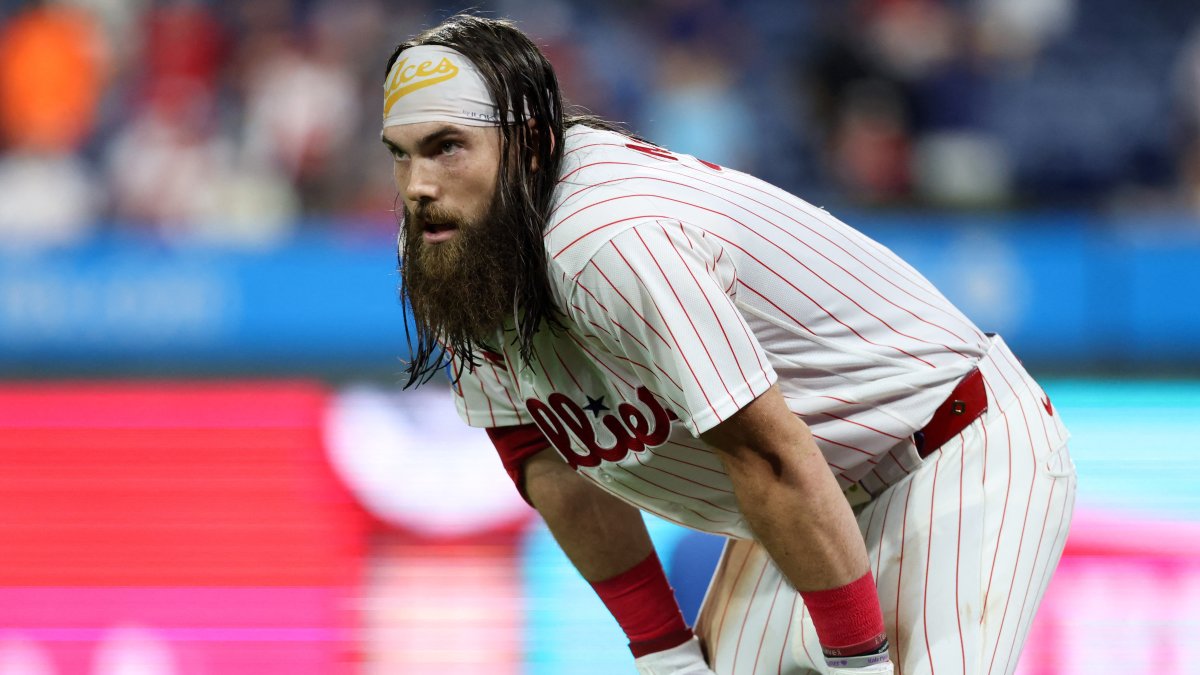
QUEENS, NY — On July 4, Brandon Marsh was named to his first All-Star team.
It carried even more weight because he wasn’t going as a reserve. Marsh was voted a starter in left field for the National League at Citizens Bank Park, the culmination of a first half in which nearly everything had clicked.
In June, his average had climbed as high as .338. When the All-Star announcement arrived, Marsh was hitting .315, the sixth-highest average in the majors.
Since Independence Day, the picture has looked nothing like it.
Marsh is hitting .178, the lowest average in the National League over that span and the third-lowest in the majors.
The drop has been drastic. What has changed underneath it helps explain why.
A large part of Marsh’s first-half success came from the type of contact he was producing, particularly at the bottom of the strike zone.
Through July 3, Marsh saw 1,196 pitches across 328 plate appearances. Of those, 215 — 18 percent — were located within the bottom third of the strike zone: low and in, low-middle and low and away.
When pitchers went there, Marsh made them pay.
He hit .358 with a .965 OPS against pitches in those three zones. Nearly 32 percent of the balls he put in play were line drives.
His average launch angle was 14.7 degrees, which was important. Statcast defines its sweet-spot range as batted balls hit between 8 and 32 degrees. Marsh’s average against those low strikes sat comfortably within it.
That combination fit what made him so difficult to defend. Marsh wasn’t simply reaching pitches at the bottom of the zone. He was getting them off the ground, hitting them on a line and using the entire field.
Then the league started working back.
Don Mattingly acknowledged as much in August, while understandably stopping short of spelling out the Phillies’ scouting report for everyone else.
“They’re just doing some stuff different,” Mattingly said.
That, he explained, came with the territory after the way Marsh had performed.
“When you’ve been one of the best hitters in the game for a long period of time, they’re gonna start working on you a little harder,” Mattingly said.
The interesting part is that opponents haven’t simply started throwing Marsh down more often.
From July 4 through Thursday, Marsh saw 819 pitches. Of those, 148 were in the bottom third of the strike zone.
That’s 18.1 percent, almost identical to the 18 percent he saw during the first three months.
The location hasn’t changed much.
What pitchers are throwing there, and what Marsh is doing with those pitches, has.
Fastballs still make up a healthy portion of the attack. They have accounted for roughly 46 percent of the pitches Marsh has seen in the bottom third since July 4, compared with about 47 percent earlier in the season.
But the rest of the mix has shifted. Marsh has seen more offspeed pitches down there and fewer breaking balls.
Those offspeed pitches have given him particular trouble. Since July 4, Marsh is 3-for-37, an .081 average, in at-bats ending on a changeup or splitter in the bottom third of the zone.
Regardless of pitch type, though, the damage he once did down there has largely disappeared.
His .358 average against low strikes has fallen to .106. His .965 OPS has dropped to .296.
More revealing than the results is how the baseball is coming off his bat.
How Brandon Marsh’s contact down in the zone has changed
Batted-ball rates on pitches in the bottom third of the strike zone, through July 3 vs. since July 4.
MetricThrough July 3Since July 4Line drives rate31.615Ground ball rate35.455Pull rate49.457.5Opposite field rate25.315
Pair that with Marsh’s average launch angle falling from 14.7 degrees to 6.9, below the lower end of Statcast’s sweet-spot range, and the change becomes clear.
More balls are going into the ground. More are going to the pull side.
His hard-hit rate on those pitches has dropped, too, from 51.9 percent to 42.5 percent.
Put it together and the contrast is striking: pitches that frequently became line drives earlier in the season are increasingly becoming pulled ground balls.
Fastballs provide an even cleaner example.
Marsh hit .400 against fastballs in the bottom third of the zone earlier this season. Since July 4, he’s hitting .176 against them.
Where the baseball goes after contact helps explain why.
His average launch angle against low fastballs has fallen from 7.2 degrees to minus-1.2. His ground-ball rate has jumped from 43.6 percent to 78.6 percent.
His pull rate has moved just as dramatically, from 35.9 percent to 64.3 percent.
The frequency of pitches down hasn’t changed.
What Marsh is doing with them has.
His own feel for the slump starts somewhere else.
Asked this week what he has noticed, he immediately pointed to his decisions at the plate.
“Swing decisions, gotta be better,” Marsh said Thursday.
He feels as though he has been expanding the strike zone more.
“Chasing a lot,” Marsh said.
The overall broader numbers show something interesting. Marsh’s chase rate has actually fallen from 38.4 percent — the 11th-highest mark in baseball through July 3 — to 33.9 percent since. His first-pitch swing rate is also down, from 33.5 percent to 27.6 percent.
His in-zone contact rate has gone up.
That doesn’t make what Marsh feels in the batter’s box any less real. It does suggest his slump is more complicated than simply swinging at too many pitches outside the strike zone.
He’s seeing roughly the same share of pitches at the bottom of the zone. The mix within that area has changed, and so has what he’s doing with those strikes when he swings.
Marsh doesn’t sound as though he believes his swing needs to be torn apart.
“I like where the swings are,” he said.
Instead, he is trying to make things simpler.
Marsh said his focus is getting back to using the other side of the field and hitting the baseball “hard on a line.”
In a way, his answer sounds a lot like the hitter the numbers describe from the first three months of the season.
The Phillies still believe that hitter is there.
Marsh is already shielded from many left-handed matchups through the Phillies’ platoon structure. More recently, his struggles have extended into the right-handed pitching he is expected to handle.
Mattingly said Friday that going in another direction against right-handers has crossed his mind, but he isn’t ready to make that kind of change.
“I still feel like we need him,” Mattingly said. “We feel like he’s getting closer to what we want him to be.”
The slump has affected some in-game decisions. Mattingly acknowledged there are situations now in which it is easier to go to a pinch hitter for Marsh earlier than it might have been when he was rolling.
But the Phillies haven’t moved away from him.
And with October approaching, getting Marsh back becomes more than an individual storyline.
The Phillies have the pieces to take one of their deepest lineups in years into the postseason. Marsh was a major reason it looked that way during the first half.
Getting that version of him back doesn’t require another run at .338.
The path Marsh described is much simpler than that: use the field, get the baseball off the ground and turn those pitches at the bottom of the strike zone back into hard line drives.