
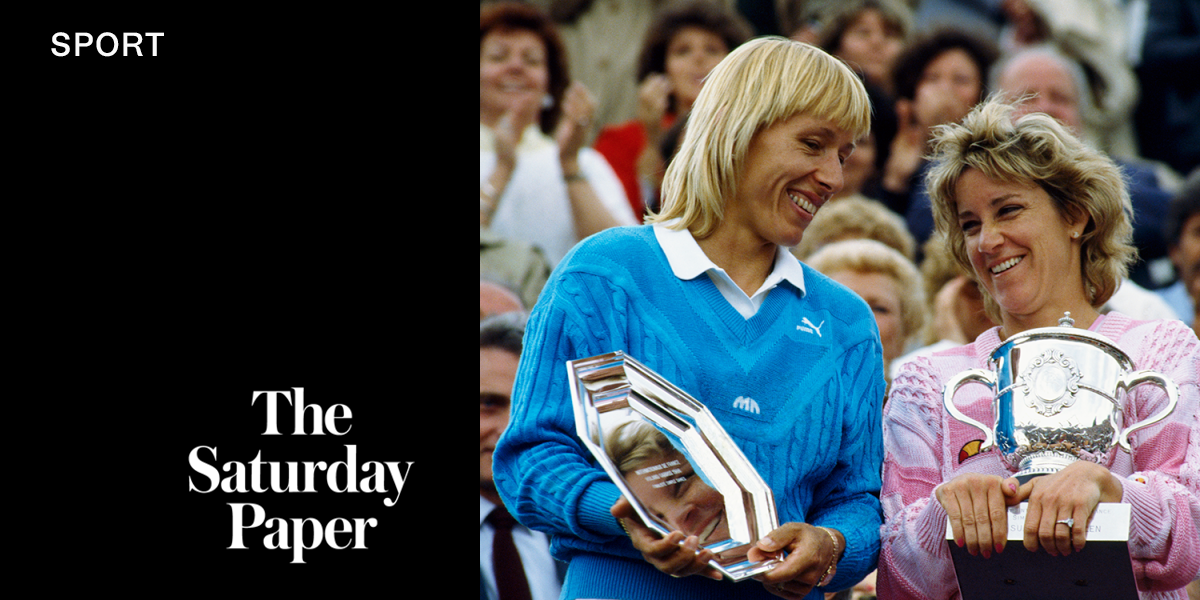
It’s true that athletes can easily acquire public caricatures; even more easily, I think, for athletes of solo sports like tennis. It was true of Chris Evert and Martina Navratilova when they emerged, more or less simultaneously in the 1970s and established their famous rivalry – one of the very best in sport.
By definition, the caricature is a simplification and the athlete can squirm bitterly within its cage. Dominant from the age of 16, Chris Evert was a child prodigy – highly regarded for her looks and sunny girl-next-door vibes as much as her talents. This developed a little but not much: for her cool demeanour, she earnt the nickname “Ice Maiden” and enjoyed the enormous profits that came from producers of watches and soft drinks wanting the imprimatur of America’s daughter.
Martina Navratilova was admired, and became a naturalised American, but there was always something suspiciously exotic about her: the gay defector from a communist country. Her corporate endorsements never came close to matching her great rival’s.
Evert was born in Florida in 1954 to a professional tennis coach father. In interviews, memoirs and now the Netflix documentary Chris & Martina: The Final Set, Evert describes a classic early dyad between a precocious child and their ambitious father. What followed was greatness and a denuded childhood; glory and intense loneliness.
She began tennis to please her father and her commitment quickly mirrored his. Repetition was key to that future glory, and the silliness and freedoms of childhood were sacrificed to them. After her third marriage ended, Evert would contemplate how arrested her growth had been.
Navratilova was born almost two years after Evert, just outside Prague, Czechoslovakia. She was 12 when the Soviet Union led an invasion of her country, prompted by the threateningly liberalising reformist Alexander Dubček. The Czech leader was arrested, removed to Moscow and later exiled. Authoritarianism was restored.
In 1975, aged just 18, Navratilova entered a New York City office of the immigration service to seek asylum. She had become besotted with America and its freedoms and had plotted her defection more or less in isolation. Sorrowfully, she did not tell her family – she could not risk the Communist Party of Czechoslovakia’s discovery of her plans, nor the consequences that would likely follow for her or her family. She did tell three people. One of them was Chris Evert – then a friend as well as a rival. Navratilova was interviewed by American officials, granted asylum in principle and sworn to a secrecy she says she upheld. But the next day, the news of her defection appeared in The Washington Post.
Their loneliness had been most acute when their rivalry was most severe. Yet it was that rivalry that mutually drove them to heights perhaps unachievable without it.
Someone, likely from the immigration office, had leaked it. That day, still a teenager, she became the most famous Cold War defector in the world. She was surveilled; she feared being kidnapped. If she was, and was spirited back to her home country, she could expect a show trial and a prison cell.
Then, of course, there was the guilt and loneliness of isolation from her family – whom she was fairly sure she’d never see again. If the arc of European communism is clear to us now, it wasn’t then.
One curious and touching quality of the Chris & Martina documentary – evident also in Sally Jenkins’s profile of the women in The Washington Post in 2023 – is how acutely each of them experienced the pains of isolation.
When Chris Evert won the Wimbledon singles title in 1976, her joy was lanced when she arrived back at her hotel room. “I suddenly felt this great weight,” she says. “It was depression.”
She had known the sacrifices of her greatness, but now she really felt them. She was without friends; her fame was sustained by strangers. The sad corollary of the cheering grandstands was this empty hotel room and her tears.
Navratilova’s isolation was more acute and more dramatic – she had bravely severed ties with Czechoslovakia, but had done so at enormous cost and now grieved for her mother and younger sister. Her father had died when she was young.
The isolation of both women, though, was also hastened by their own increasing rivalry – one that came to eclipse their friendship. While the greatness of each is, statistically speaking, almost perfectly even – each won 18 grand slam singles titles and finished the year ranked No. 1 seven times; their head-to-head record was 43-37 in favour of Navratilova – this parity didn’t emerge for a while.
In Chris & Martina, Evert admits to being able to have friendships with other pros for only as long as she didn’t consider them serious rivals to her status as world No. 1. Navratilova, good as she was, lost to Evert five times before finally recording a win. In their first 15 encounters, the head-to-head was 13-2 in favour of Evert.
In this time, the two became friends and paired up in doubles. But when Navratilova’s talents and commitment drew level with Evert’s, about 1976, the native-born American decided she could no longer risk the insights their partnership gifted her Czech-born rival. It was the same year Evert made this decision that she fell into a bleak funk in that hotel room in London.
As for Navratilova, dating professional basketballer Nancy Lieberman influenced her friendship and rivalry with Evert. Lieberman thought Navratilova wasn’t sufficiently hungry or disciplined and that she was disastrously too fond of her rival to ever eclipse her as world No. 1. In the Netflix documentary, Evert says it was as though Lieberman “brainwashed Martina into thinking that I was the enemy”.
The Evert–Navratilova friendship was over, replaced with ruthlessness and a zero-sum appreciation of the other’s talent. It’s lonely on the summit.
Hounded by lurid inquiries and besieged by gossip columns and moral panic, Navratilova came out in 1981. Sort of. She told a reporter she was bisexual, a common hedge, but also that it was off the record and she wanted to make the fact public when it suited her. The story ran almost immediately in the New York Daily News.
Navratilova was 24 years old and had already found the contempt of a communist state, the suspicions of American zealots and the pains and treasures of global fame.
Earlier that year, The New York Times ran a piece titled “Homosexuality Sets Off Tremors” about homosexuality among athletes. It cited Navratilova’s denials the year before in the British press that she had been in lesbian relationships; it also carried the following quote from her once-lover Nancy Lieberman: “I have met and associated with a lot of people who are gay. That doesn’t mean I have to be gay. They’re nice people. Our preferences are different.”
These denials might be better understood in the context of the pathologisation of homosexuality at the time. In the same piece, Bruce Ogilvie, a retired sports psychologist who’d once advised Olympians, suggested same-sex desire could arise from “crisis and loneliness”.
Many years later, Evert and Navratilova’s friendship was restored. Here was the mutual admiration of gifted alphas recalled in the tranquillity of retirement. They had shared the summit and a rivalry and a very particular isolation. But now, as of a few years ago, they shared something else: a simultaneous cancer diagnosis. Chris & Martina opens with Evert receiving news from her oncologist that her cancer has returned. We see her receive chemotherapy; see her adult son shave her head of the blonde fluff that’s left from the treatment. We see her in beds with tubes, and at home with soup.
In January 2023, Navratilova was diagnosed with both throat and breast cancer and submitted to an intensive, month-long course of radiation therapy. Like Evert, we see her before treatments and after consultations. For each, centre court has been replaced with CT scanners.
There is something confronting about intimately seeing both women’s fear, frailty and lack of control – not least when it rubs against footage of their heroic peaks. The contrast isn’t merely physical, either. Evert talks about getting better at accepting things beyond her control – a position once unthinkable when much of her life was explicitly winnowed down to the things she could influence, dominate; she needs to learn to let go more now, rather than tightening her grip.
Their friendship is sincere, deep. One visit Navratilova makes to her friend’s house is announced by waving the wand of the Covid-testing kit – she’s negative. Once cold rivals, they now share a couch, watch old tapes and compare chemo stories.
In March 2023, Navratilova declared herself cancer-free. Evert was given similarly good news about the same time – until her ovarian cancer ominously returned in June this year. While Navratilova was providing commentary and analysis for Sky Sports during the recent US Open, Evert was on leave.
Both had extraordinary careers, obviously. They were braided together in ways that generated one of history’s greatest sporting rivalries. That’s enough for a good story. But it’s bookended in the most peculiarly touching way. Evert was one of the only people Navratilova told about her imminent defection. Half a century later, Navratilova was the first person Evert told about her cancer.
Their loneliness had been most acute when their rivalry was most severe. Yet it was that rivalry that mutually drove them to heights perhaps unachievable without it.