
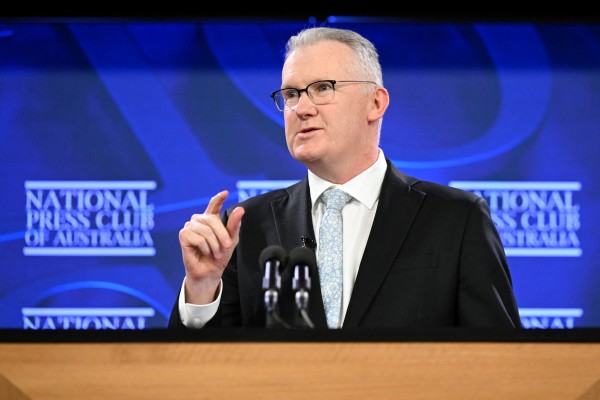
 Days after announcing visa restrictions on dependants of foreign students in the country, Australian Minister for Immigration and Citizenship Tony Burke addresses the National Press Club in Canberra, Australia, September 17, 2026. (AAP/Lukas Coch via REUTERS)
Australia’s proposed changes to temporary migration could alter the choices facing Indian students, particularly those planning to study while bringing spouses or children.
“Australia’s decision to restrict dependants on student visas will fundamentally reshape the international education market,” said Varun Singh, Managing Director, XIPHIAS Immigration.
“While the objective may be to strengthen the integrity of the migration system, we must recognise that international students do not make life-changing decisions in isolation, family is an important part of that decision.”
Singh said the changes could have a particular impact on students planning to move to Australia with their families.
“I expect this policy to have a particularly significant impact on married students, mature professionals and postgraduate applicants, who may now reconsider Australia in favour of destinations offering greater family flexibility,” he said.
Australia would remain a major education destination, Singh added, but the profile of students choosing the country could change.
“The future belongs to genuine students who choose education aligned with skills, employability and long-term career opportunities, not simply a visa pathway,” he said.
Australian Home Affairs Minister Tony Burke has announced measures aimed at tightening temporary migration. They include restrictions on student dependants, tougher rules on changing courses, a ballot for second- and third-year working-holiday visas and restrictions on using visitor visas to remain in Australia.
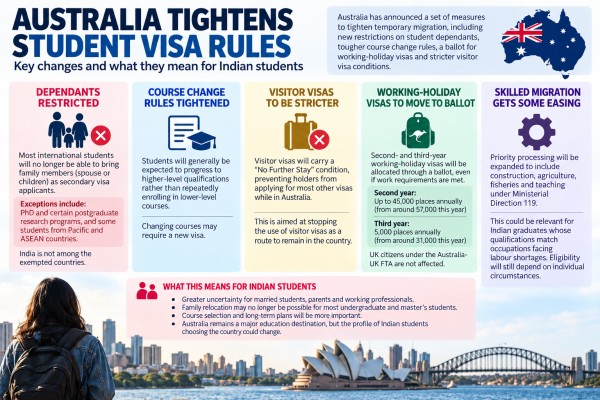
Under the proposed student visa arrangements, most international students would no longer be able to bring family members as secondary visa applicants. Exceptions are expected to include certain postgraduate research programmes, including PhDs, as well as some students from Pacific and ASEAN countries.
India is not included in the regional exemption.
For an Indian student beginning an undergraduate, master’s or other non-exempt programme, a spouse or children may therefore no longer be able to accompany them under the student’s visa arrangements.
The change could be particularly relevant for married applicants, parents and professionals returning to education after several years of work.
Mahadevan Shankar, Founder and CEO of Arzuh International in Brisbane, said the proposed restrictions were already generating divergent views in Australia.
“Apparently the new restrictions allow only students to come without any family members. There’s lot of divergent views within Australia on this matter. The pressure created by right wing politics of Pauline Hanson is forcing left wing Labor government to implement some tightening but not sure how many loopholes may exist. Jugaad always occurs!”, he said.
The final transitional arrangements and exemptions will be important for students already in Australia or preparing to travel. Existing visa holders and families already in Australia are not expected to be separated under the new arrangements. Students enrolled in eligible PhD programmes are also expected to retain access to family arrangements.
The government is also targeting what it calls “visa hopping”, in which people move between temporary visas or courses primarily to extend their stay.
Students will generally be expected to progress to higher-level qualifications rather than repeatedly enrolling in lower-level courses. Those changing courses may also need to apply for a new visa, making course selection before travelling more important.
Australia is separately planning to expand the use of the No Further Stay condition on visitor visas. Future visitor visas would carry a condition preventing holders from applying for most other visas while remaining in Australia.
For Indian families visiting students, this would reinforce the distinction between a temporary visit and using a visitor visa as part of a wider visa pathway.
The government is also changing the system for second- and third-year working-holiday visas. Meeting the required regional work threshold would no longer necessarily guarantee another visa; eligible applicants would instead enter a ballot.
Up to 45,000 places would be available annually for second-year working-holiday visas, compared with around 57,000 people who qualified this year. For third-year visas, the proposed annual cap is 5,000, compared with around 31,000 people who qualified this year.
UK citizens accessing working-holiday arrangements under the Australia-UK Free Trade Agreement will not be affected.
At the same time, Australia plans to expand priority processing under Ministerial Direction 119 to construction, agriculture, fisheries and teaching. This could matter for Indian students after graduation if their qualifications and experience match occupations facing labour shortages.
Priority processing, however, does not automatically qualify graduates for skilled visas. Eligibility will continue to depend on the relevant visa requirements and individual circumstances.
The measures form part of the government’s wider effort to reduce temporary migration and bring net overseas migration down, amid domestic debate over housing affordability, population growth and pressure on infrastructure and public services.
Burke has said Australia needs greater control over who enters the country temporarily, how long they remain and the pathways they use. The government is also increasing enforcement against people who remain in Australia after their visas expire.