
View(s):
By Kasun Warakapitiya
Although the state hospitals are supposed to provide free healthcare, with the prevailing shortage of medicine and medical equipment, it seems that free health is gradually in decline.
Patients, caretakers and nurses claim that free healthcare is in name only.
Most patients are often told to buy medicine from outside.
Medical practitioners said that in emergency situations specific drugs are needed, while specific procedures are performed to save lives. In such instances there is no time to search for substitutes, as the difference of minutes could decide whether the patient survives.
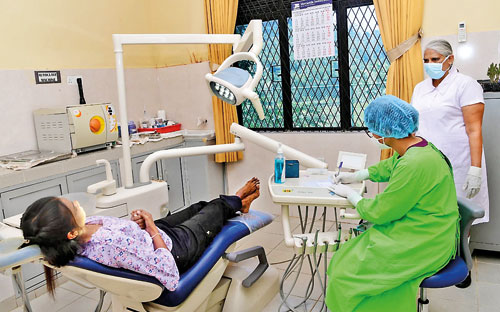
A patient at the recently refurbished Divisional Hospital – Katugahahena
The state hospital nurses who claimed anonymity said that sometimes they had to tell certain patients to bring extra bandages, sutures, equipment, catheters and medication so they could be distributed among patients who are unable to purchase medicine from outside.
Even though the Health Ministry had been allocated Rs 604 billion in the 2025 budget, only Rs 550 was allocated in 2026.
However, Deputy Minister Hansaka Wijemuni explained that in this year, estimates for 2027 medicine requirements are made and orders will be placed.
“However, within the prevailing system, each hospital and the unit does not properly make the estimated requirement, which either results in a shortage or excess of medicine. When there is excess, some medicines expire without being used,” he said.
He said that when estimating the medicine needed, it had been noticed that hospital wards fail to follow guidelines and protocols. Dr Wijemuni said the estimation process is being streamlined. A system will be set up where following guidelines and protocols will be a must. But a cross section of the patients expecting free healthcare had a variety of grievances.
Some were unable to afford the medication and were in debt to friends and relatives, because they had to buy from pharmacies.
Some claimed that they remain in hospital, as their recovery had slowed without certain medications.
Supun Sandaruwan, 32, an accident victim, is being treated for multiple fractures in his leg. He said that he had been taking medication for nine months and two weeks at the National Hospital and had to spend Rs 41,400 on medication bought outside.
“I had nine surgeries in my leg, during the nine months. Apart from the expensive medicine, I had to buy bandages and wound dressings in the last three months,” he said.
He said that he does not blame the attendants, nurses and matrons in the ward, as they are helpless when there is no medicine. They ask us to get medicine from outside, as they cannot bear to see us suffer. They do what they can and emotionally support us to bear the pain as well as the strain on medical expenses.’’
Mr Sandaruwan, who is from Puttalam, said he is taking treatment in a paying ward at Jayawardenapura Hospital, as he was discharged from Colombo Hospital recently, and is channelling a doctor for further treatment, as his leg had not fully healed.
“There is no difference in medical expenses in both paying wards at Jayewardenepura Hospital and National Hospital. I feel that there is no free healthcare in this country anymore,’’ he said.
The Sunday Times learned that some patients were even told to purchase crepe bandages from pharmacies. One patient who was told to buy two crepe bandages said he would wash and reuse a bandage instead.
Another patient, Raj Kumar, 36, a resident of Mulleriyawa, being treated for a cut to an artery in his ankle, said he was told to buy medicine gels, ointments and powders from outside.
“The doctor says every three days I need to buy from outside the prescribed medicine. The problem is that I cannot afford a Rs 6,000 medicine expense every three days,” he said.
He said that he is a labourer and suffered a cut from a tile and was admitted to National Hospital for further treatment after Mulleriyawa Hospital initially treated him.
Mr Kumar said he is already Rs 38,000 in debt due to medical expenses and had agreed to pay back with 20% interest. He remains in hospital thinking of ways to buy his medicine.
He said that the ward doctor only checked on him twice after he was admitted and had told him that he would advise him on ways to get his injury healed faster and prescribe medicine which would react faster if he was privately consulted.
Pasindu Malshan, a 21-year-old boy who had suffered injuries after he was run over by a lorry, said that though he received medication, he was told to get the Rs 300 bandage from outside.
“It is a pity that the National Hospital is short of wound dressings,’’ he said.
The Government Medical Officers Association (GMOA) Secretary, Dr U.K.B. Warakagoda, told the Sunday Times that the shortage of drugs is avoidable if annual needs are estimated and ordered.
He also said the government should also maintain a register of reliable suppliers who provide quality drugs for affordable prices.
Dr Warakagoda pointed out that if drug suppliers who are renowned for providing good-quality drugs in specified time frames are selected, the shortage of drugs could be avoided.
He said physicians and authorities know the amount of drugs needed, as they have access to the drug inventory software. Estimates could be made and drugs bought through the procurement process.
Dr Warakagoda said the ministry should create a system to make the Medical Supplies Division (MSD), State Pharmaceuticals Corporation (SPC), and State Pharmaceutical Manufacturing Corporation (SPMC), as well as the National Medicines Regulatory Authority (NMRA), work together to reduce the shortage of drugs.
Adequate stocks of medicines needed for treating emergency patients as well as cancer patients should be maintained, he said.
Labels missing in immunity drug vials
Deputy Health Minister Dr Hansaka Wijemuni admitted a labelling issue related to the immunity-improving drug Filgrastim. Although the box containing the medicine vials had labelling, the individual vials only have an expiry date and a bar code.
“The company violated the labelling regulations. According to National Medicine Regulatory Authority regulations, the medicine name, quantity, and expiry dates are required to be printed on the labels. It is not advisable to use medicines which do not specify the contents on the vial,’’ he said.
Local purchases of the drug have been allowed. The supplier has been asked to send a new batch of drugs after rectifying the labelling.
GMOA Secretary Dr U.K.B. Warakagod said medical doctors would not use vials which do not have labelling, as they cannot take risks with the lives of patients.
Cash aid to buy drugs limited to Rs 150,000
The Chairperson of the Relief and Rehabilitation Unit of the Cancer Society of Sri Lanka said that the number of cancer patients calling for financial assistance to buy cancer drugs has increased.
She said that during times when cancer drugs are in short supply, the society gives financial help through the drugs fund.
“We give about Rs 150,000 per person; as we are a non-governmental organisation, the assistance which we can provide is limited,” she said.
The best way to say that you found the home of your dreams is by finding it on Hitad.lk. We have listings for apartments for sale or rent in Sri Lanka, no matter what locale you’re looking for! Whether you live in Colombo, Galle, Kandy, Matara, Jaffna and more – we’ve got them all!