
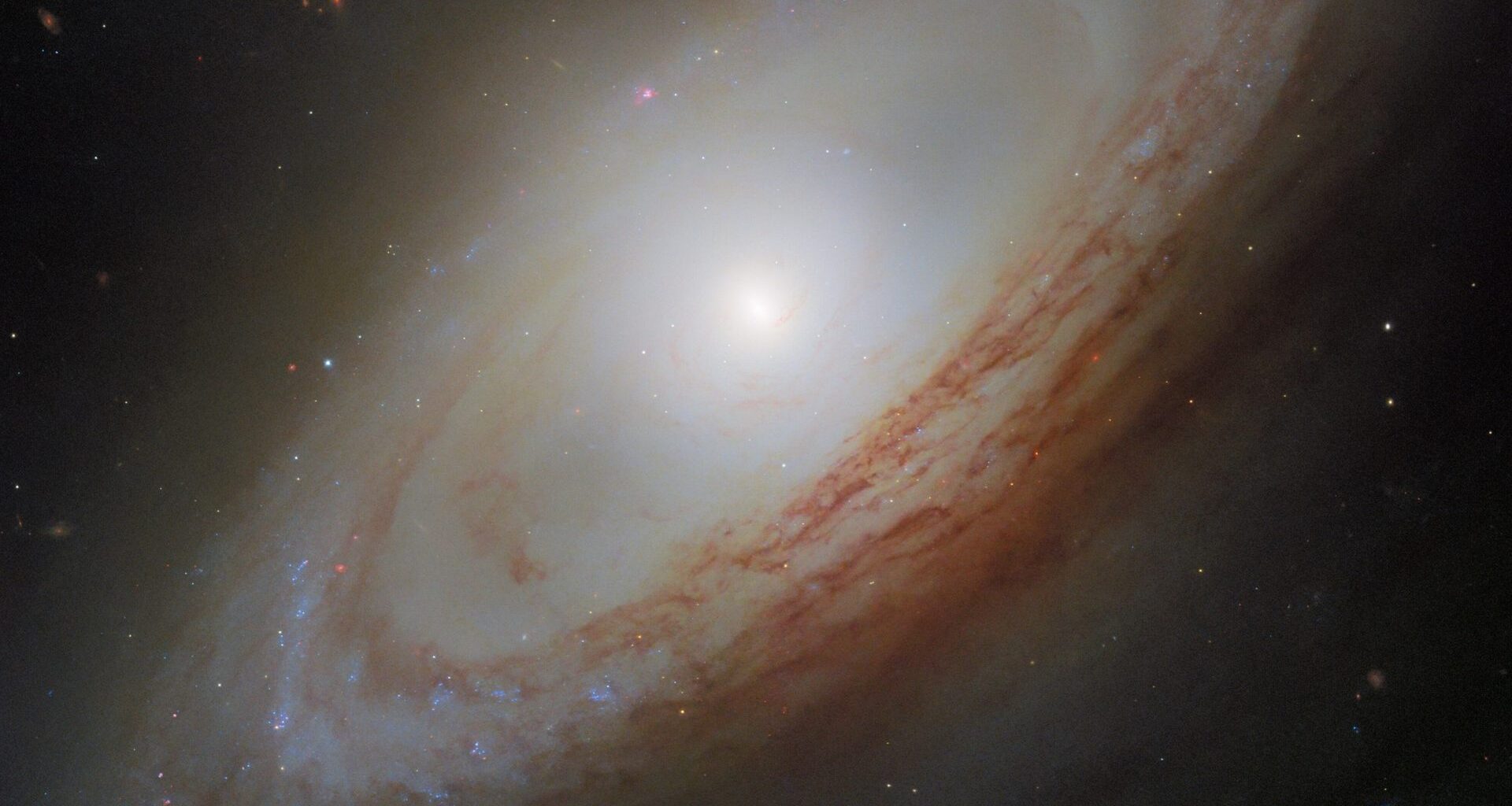
Hubble captured NGC 4698, a strange spiral galaxy whose stars and gas rotate at right angles, revealing clues to a chaotic past.
Today’s Image of the Day from the European Space Agency reveals a spiral galaxy that looks peaceful at first glance.
Its sweeping arms are streaked with dark dust, while young blue stars glow across the outer disk.
Look more closely, though, and the galaxy stops making sense.
Parts of it are arranged almost at right angles to one another, and the stars and gas near its center rotate in a different direction from the main disk.
Something appears to have knocked this galaxy badly out of alignment.
A strange galaxy in Virgo
The galaxy is NGC 4698, located about 55 million light-years from Earth in the constellation Virgo.
It belongs to the Virgo Cluster, a huge collection of more than 1,000 galaxies held together by gravity. It is the nearest large galaxy cluster to our own cosmic neighborhood.
The new view comes from the NASA/ESA Hubble Space Telescope. At first, NGC 4698 has many of the features astronomers expect from a spiral galaxy.
A thin disk contains stars, gas, and dust, while spiral arms curl around its center. In that sense, its basic structure resembles the Milky Way.
Spiral arms keep their distance
NGC 4698 becomes more unusual when its spiral pattern is examined closely.
In many spiral galaxies, the arms wind inward toward the central region. Here, they are most obvious farther out, forming something closer to a ring around the galaxy.
Dust collects along the spiral structure, with pockets of recent star formation scattered farther from the center.
The center looks different. Its softer, off-white glow comes largely from smaller, cooler and older stars packed into the galactic bulge.
A black hole at the center
Those central stars orbit a supermassive black hole with a mass millions of times greater than that of the Sun.
Evidence indicates that the black hole is active and still growing as its gravity pulls material inward.
Supermassive black holes occupy the centers of many large galaxies, including the Milky Way.
Their surroundings can reveal a great deal about a galaxy’s history because gas flowing toward the center can feed the black hole while also affecting star formation nearby.
Parts spin at right angles
The real surprise in NGC 4698 is its geometry. The central bulge does not line up normally with the surrounding disk.
Instead, it extends from the disk at roughly a right angle, making NGC 4698 one of only a small number of spiral galaxies known to have this configuration.
Hubble’s image offers a faint visual clue. The glow of the elongated bulge can be seen extending above and below the dusty disk.
Measurements of motion reveal an even stranger arrangement: stars and gas close to the center rotate perpendicular to the galaxy’s main disk.
Two parts of the same galaxy are effectively following different planes of rotation.
Gas arrived from elsewhere
Astronomers think the explanation probably involves material that came from outside NGC 4698.
If the galaxy captured gas whose motion did not match that of its existing disk, the incoming material could have settled into a new plane.
Stars forming from that gas would preserve the unusual orientation.
Galaxies frequently change through encounters with their neighbors. They can pull material from one another, capture gas, or merge entirely.
Even a relatively small collision can leave structures that survive long after the encounter itself has ended.
A tail points to its past
NGC 4698 carries another possible clue to such an event. Observations have revealed a short tail of hydrogen extending from one side of the galaxy.
Researchers have suggested that the feature could be evidence of a minor galactic merger in its past.
That possibility is especially interesting in the Virgo Cluster. Galaxies there do not evolve in isolation.
They move through a crowded environment where gravity from neighboring galaxies and interactions with gas between galaxies can reshape them.
Other Virgo galaxies show distorted disks, stripped gas, and long gaseous tails produced by their surroundings.
Hubble studies a crowded neighborhood
The observations behind the new image were collected through the Hubble observing program 18103, led by principal investigator David Thilker.
The program is studying Virgo Cluster galaxies closely enough to examine features such as individual star clusters and nebulae.
Researchers are also using those detailed observations to tackle a much larger question: how does life inside a galaxy cluster change a galaxy over time?
By studying star formation, gas, and unusual structures across nearby Virgo galaxies, astronomers can reconstruct some of that history.
NGC 4698 offers an especially striking case. Its calm spiral shape hides a galaxy whose inner and outer regions never quite got on the same page.
Whatever happened in its past, the evidence is still written in the way its stars and gas move today.
Image Credit: NASA Earth Observatory
—–
Like what you read? Subscribe to our newsletter for engaging articles, exclusive content, and the latest updates.
Check us out on EarthSnap, a free app brought to you by Eric Ralls and Earth.com.
—–