
Andrea Kimi Antonelli wasn’t the fastest driver on track in Spain last weekend, but his fortuitous victory was no less of a hammer blow to his would-be title contenders.
His teammate, George Russell, consolidated second place but dropped to 81 points adrift of the lead. More than three clear race victories behind a driver in identical machinery, he said what everyone was already thinking.
“I’m not going to say it’s over, but it’s exceptionally unlikely that I’m in this fight,” he said, per ESPN. “I’m not even thinking about being in the fight, because I don’t think I am in the fight.”

Fox Sports, available on Kayo Sports, is the only place to watch every practice, qualifying session and race in the 2026 FIA Formula One World Championship™ LIVE in 4K. New to Kayo? Join now and get your first month for just $1.
Lewis Hamilton, who for a time looked like a more likely title challenger in a momentarily resurgent Ferrari, was similarly resigned after retiring from the race and dropping to 101 points behind Antonelli.
“There’s no stopping him and Mercedes this year,” he told Sky Sports. “They’ve done a phenomenal job, and they deserve it.”
But hope springs eternal at McLaren.
“We’re going to try and win it,” a buoyed Zak Brown told Sky Sports after the race, reflecting on Lando Norris missing out on what would have been a richly deserved third win in four grands prix and dropping to 106 points behind Antonelli.
The CEO’s optimism was boosted by Norris’s sensational pole a day earlier, the McLaren driver pipping Antonelli to top spot at a circuit the team hadn’t expected to fully suit its car.
“Obviously you have to be realistic, but anything can happen,” Brown told F1 TV. “Today’s F1 at the moment with reliability, the new power units are a little less predictable than the last generation — anything can happen.”
Brown is as much a marketing man as he a racing enthusiast, and you can’t fault him for keeping his chin up.
But he also knows from experience how massive gaps can be vaporised.
Norris’s 106-point deficit is only one more than Max Verstappen’s peak 105-point margin to Oscar Piastri last year.
Like Verstappen, Norris has nine grands prix — at least officially, Middle Eastern rounds pending — to close it.
Verstappen missed the title by two points, but the Dutchman finished ahead of Piastri by 11 points. The turnaround, then, was 116 points.
“All we can do is go for the wins every weekend and see if we can close the gap.”
But of course it’s not as simple as copying last year’s results and dumping them onto this season.
Verstappen has and does enjoy a position at the very centre of Red Bull Racing. The team exists to support his ambitions.
The same hasn’t been true at McLaren, which said last year that it would rather lose the drivers championship to Verstappen than pick a winner — something it came within two points of doing.
But if McLaren really believes Norris has a title chance, the question must be whether it can really stick by its equality principle.
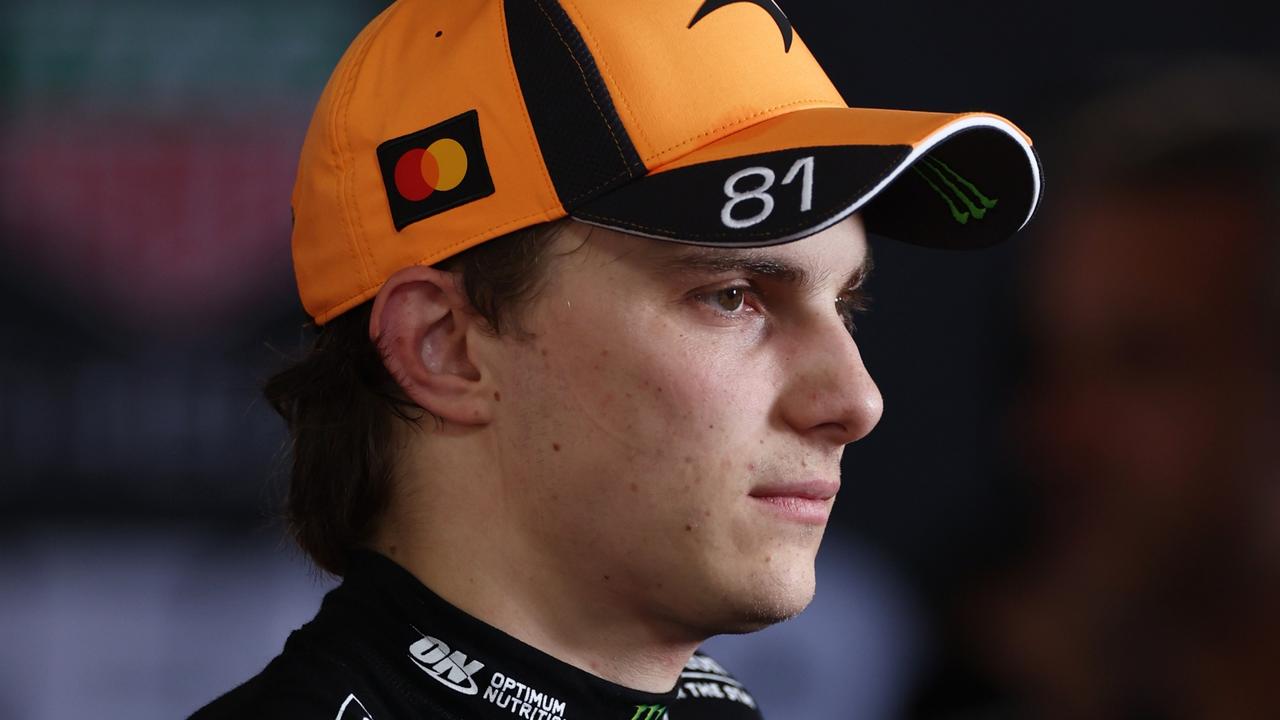
After another difficult weekend in Spain, Oscar Piastri is making that decision easier to make.
2027 Aussie Grand Prix gets sprint race | 01:29
WHERE DID IT GO WRONG FOR PIASTRI?
The Spanish Grand Prix was not an enjoyable weekend for Piastri.
He was comprehensively outqualified by Norris, who blew up what had been a fine-margins difference between the two with that sizzling pole time while Piastri fumbled through a messy session.
The margin was a difficult-to-swallow 0.470s, his second-largest of the year.
His race was similarly anonymous, though circumstances played a role — first-lap damage cost him places and pace, though he did manage to make one of the only six post-first-lap overtakes nonetheless.
The damage and the tedious circuit meant it was hard to gauge just how much slower Piastri was relative to Norris, but there’s no doubting that he was — then again, everyone was.
The problem isn’t the scrappy weekend in isolation; the problem is that it exacerbated an already low run of form.
On average this season he’s qualifying only 0.078s behind Norris, but it’s been 0.241s over the last five rounds. He’s running at a 5-9 head-to-head qualifying deficit, but that’s a more brutal 1-4 over the last five grands prix.
It’s much the same in race trim — he’s 3-6 for the season but 1-4 in the last five grands prix both have finished. While on average he’s finishing 17.8s behind Norris at the flag, that balloons to 24.2s over their last five races.
Piastri has been open about having “not gelled” with this year’s car, though he says describing it as a driving style mismatch is simplistic given the dominance of the heavily hybridised 2026 engine on overall performance.
“Definitely this year’s been a bit tricky in trying to get through a few things,” he said earlier this month. “We’ve tried a few different directions, and sometimes you just need time to find the right one.”
It also wouldn’t be right to say Piastri’s been absolutely nowhere. Only a race ago, in Monza, he comfortably outqualified Norris and slipped behind him only on the last lap in a race heavily influenced by the pressing of the battery boost button.
But that hasn’t been enough to arrest the negative trend at what could be a critical inflection in the championship — but not a championship he’s playing a role in.
CARNAGE as Max takes on 100 drivers | 02:04
WILL McLAREN REALLY MAKE THE CALL?
The last time McLaren contemplated giving Norris title preference was around two years ago, at the end of the European season in 2024.
The team was surging towards the constructors championship, and Norris, as the senior driver, was leading the charge.
Piastri had made great progress in only his second season but was still far from the complete package. Even so, the team struggled to make the decision to favour Norris, memorably being criticised for allowing its drivers to battle in Italy.
It was after that race, ahead of the Azerbaijan Grand Prix, that McLaren bit the bullet and asked Piastri to support Norris’s title campaign.
The maths made sense.
Norris was 62 points off the lead with eight remaining, requiring a turnaround of 7.8 points per round. Piastri was another 44 points adrift. Both were mathematically in it, but only Norris’s shot was believable.
With impeccable irony, Piastri won the race in Baku with Norris’s help, the Englishman holding up victory threat Sergio Pérez around the pit stop window to give his teammate a clear shot at passing Leclerc.
Piastri was only once called to give up a place to help Norris — in the sprint in Brazil — but a wet-weather masterclass from Verstappen the next day snuffed out Norris’s long-shot title dream.
The maths is more difficult for Norris this year.
Norris is 105 points off with nine or eight rounds remaining, requiring a turnaround of 11.6 or 13.1 points per weekend.
But they’re even more acute for Piastri.
Piastri is 172 points off the lead — 66 points behind Norris. If the season is to last only eight rounds, he’ll be eliminated from mathematical contention in Baku if Antonelli outscores him by 11 points.
Given Azerbaijan is more or less when Piastri’s 2025 title campaign began to falter, it’s a grim moment of reflection on his last 12 months.
F1 backs Middle East return in 2027 | 00:54
BUT IS NORRIS REALLY IN IT?
From McLaren’s point of view, though, it takes the decision out of its hands.
The combination of the team’s slow start to the season and Norris’s sizzling form lately has created a situation in which, if it’s taking the reigning world champion’s title defence seriously, it really has only one course of action.
Unfortunately for Piastri, that will surely see him relegated formally to a supporting role.
The significance of such a decision shouldn’t be overstated, however.
The biggest factor in the decision is whether McLaren can take the fight to Mercedes with enough force to outweigh the improbability of Norris’s massive points deficit.
The evidence is limited.
Development rate, season to date
1. Red Bull Racing: improving by 0.047s per race
2. McLaren: improving 0.040s per race
3. Ferrari: improving 0.033s per race
4. Mercedes: improving 0.008s per race
The development rate measures how much closer or further each team is getting to the fastest time set each weekend. Unsurprisingly it’s showing Mercedes’s advantage is shrinking to all its rival frontrunners.
Let’s look at the state of play since McLaren brought its game-changing Hungary upgrade.
Average gap to fastest, last four rounds
1. McLaren: +0.045s
2. Mercedes: +0.111s
3. Ferrari: +0.188s
4. Red Bull Racing: +0.349s
With three of the last four pole positions, there’s reason to believe the McLaren really is a match for the Mercedes right now.
While Budapest and Zandvoort were similar circuits, the Madring was more varied and therefore more heartening. McLaren was also only 0.12s slower than Mercedes in qualifying in Monza, a track that should have punished its draggy car, its waywardness in slow corners and its locked-in short gears.
Azerbaijan next weekend on paper should be a nadir circuit, but if it can perform well there — and it does believe it unlocked something in Madrid — then it can believe it’ll go well everywhere.
Race pace, last four rounds
1. Mercedes: +0.19s
2. McLaren: +0.20s
3. Red Bull Racing: +0.43s
4. Ferrari: +0.52s
In race trim the Mercedes and McLaren cars are evenly matched — and McLaren’s average is weighed down heavily in Italy, where in the race it was well off the blistering pace set by Antonelli on his back-to-front charge.
Norris score, last four rounds
1. Andrea Kimi Antonelli: 88 points
2. Lando Norris: 83 points
3. George Russell: 57 points
4. Lewis Hamilton: 32 points
Though this puts Norris only just in the mix, if you take the positions of the Spanish Grand Prix from before the virtual safety car, you’d end up with Norris ahead of Antonelli 93-81.
None of these figures alone are enough to believe that Norris can overhaul Antonelli in the remaining time even if he were the team’s sole focus. He could certainly win many more races, but the mountain is steep.
It also doesn’t take into account Mercedes holding back one major upgrade package — though McLaren says it’s also pushing development to the end of the season.
But as Brown insists, there’s some hope. McLaren’s trajectory is clearly positive, and it’s not over until the points say so.
Kimi Antonelli claims Spanish Grand Prix | 01:32
WHAT DOES THAT MEAN FOR PIASTRI?
None of this has to change anything for Piastri’s season.
McLaren hasn’t signalled that it will enforce team orders; some part of it must understand the long odds.
Quite apart from that, the downsides to casting Piastri in an exclusive number two role are massive.
The team has repeatedly said that it intends to help Piastri rediscover his form in much the same way it helped Norris in the middle of last season.
McLaren knows how formidable Piastri is when he’s on song, which until this year was more often than not. He’s a title-calibre driver, and the team needs him performing at a high level for the constructors championship, where it’s now only 52 points behind the hapless Ferrari and in much better form.
The constructors championship is what decides the prize money — and, if you work for McLaren, what decides the bonuses. Risking a bump in pay and prizes for an extremely long shot at the drivers title makes little sense — especially if the demoralising effect it might have on Piastri knocks into next season.
There are also realistically few ways Piastri will be able to help Norris without getting back to his best.
Apart from perhaps slipstreaming Norris to a better grid spot at the few tracks where that might be valuable, Piastri would need to be lapping exactly one place ahead of Norris to be able to give up a position. He’s finished ahead of Norris only once in the last five races both finished.
McLaren is also desperately unlikely to deploy Piastri to play interference against Antonelli — the odds of Norris’s comeback are far too long to play those sorts of games, and the team has never appeared inclined to do so anyway.
In short, team orders — papaya rules, if you will — are not the title panacea some think they are.
But that doesn’t make the conversation any easier.
And it doesn’t make Piastri’s form any less of a problem as the Australian targets a recovery in time for 2027 — because if the competitive picture hasn’t changed by next year, the conversation could be much, much harder.