
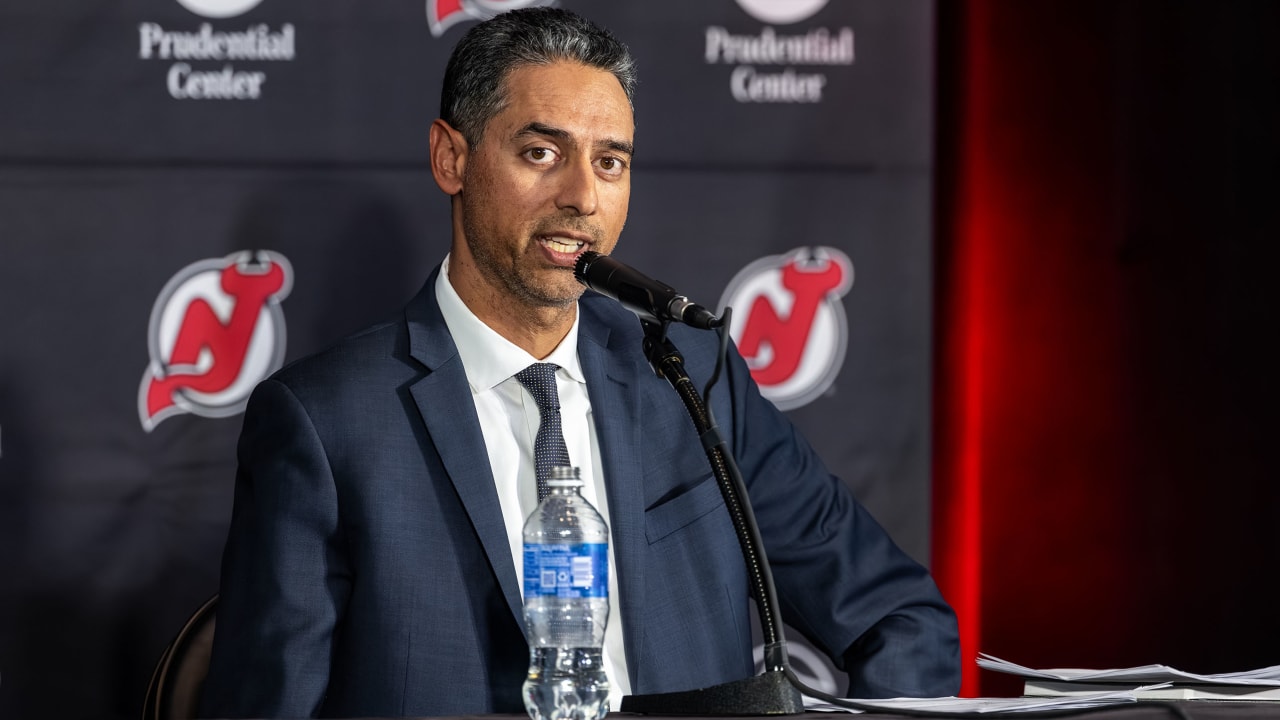
NEWARK, N.J. – Sunny Mehta understands the difference between reasonable expectations and championship ambition. In his first season as general manager of the New Jersey Devils, emotion wins out.
“Any step that we take from last year is going to be considered a ‘success,'” Mehta told NHL.com. “But I guarantee you that unless we win a Stanley Cup, no matter what happens, I’m probably going to be disappointed.”
Mehta said measuring success only by whether the Devils win the Cup may be unfair. Improvement could come in different forms, from returning to the playoffs to establishing the consistency necessary to become an annual contender. New Jersey has failed to qualify for the playoffs 11 times in the past 14 seasons, including last season when it finished seventh in the Metropolitan Division.
“I realize (wanting nothing more than a Stanley Cup) is irrational,” Mehta said. “But that’s just the difference between rationality and emotion.”
That emotion is understandable for a New Jersey native who grew up watching the Devils and witnessed the franchise win its three Stanley Cup championships. He grew up in nearby Totowa, N.J., and played hockey at Ramapo High School.
The position also represents a homecoming as he previously spent four seasons as the Devils’ director of hockey analytics, working under Lou Lamoriello and Ray Shero, before joining Florida’s front office.
After experiencing championship success in Florida, he’s not hiding the ultimate standard he has brought back to New Jersey.
Mehta spoke to NHL.com in a wide-ranging interview, including expectations, the balance between patience and urgency to win now, coach Sheldon Keefe, and working with Hall of Fame goalie Martin Brodeur.
Where do you think the strength lies on this roster?
“Our strength is our depth, and I don’t mean only the players who aren’t in the lineup. I mean top to bottom, from our 12 forwards to our six defensemen. We have a lot of offensive firepower, skill and hockey sense throughout the lineup. I was talking to Connor Brown about how much he has enjoyed playing with Amadeus Lombardi. I told him, ‘We don’t really have a fourth line this year. We kind of have two first lines and two second lines.’ Our so-called bottom two lines could be top-six lines on other teams. Last season, this was a very good team when Jack Hughes or Nico Hischier was on the ice, but not nearly as good when they weren’t. Instead of simply finding better fourth-line players, the goal was to add second line-caliber players and shift everyone accordingly. That depth should make us a much stronger team.”
What do you wish the identity of the Devils to be?
“I’m not a big believer that a team must have one particular style to win. Florida had a clear identity because that style made sense for its players and coach. But the Tampa Bay Lightning, Chicago Blackhawks and Los Angeles Kings all won championships playing different styles. Your identity should fit the players you have. Looking at our roster, we should be a fast, skilled and intelligent team. We want to use our skating aggressively, both with and without the puck. Luke Hughes made a play in the scrimmage (on Sept. 18) where he used his feet in the neutral zone to kill a play without possessing the puck. That is a good example. Speed and skill do not apply only to creating offense. They can also be used to close space, disrupt plays and regain possession. That is probably the stylistic identity that best fits this group.”
What parts of Florida’s championship-building process translate here, and what must be different?
“The biggest difference is the players. Jack Hughes plays differently than Aleksander Barkov. Nico Hischier has some similarities to Barkov but is unique, and Matthew Tkachuk is different from all of them. Every core has its own strengths. The similarity is that when we arrived in Florida, we already had important pieces such as Barkov, Jonathan Huberdeau, Aaron Ekblad and Sergei Bobrovsky. Here, we also have strong core players in Jack, Nico and Jesper Bratt. The challenge is surrounding them with enough good players to build a complete team. You must identify talent, manage the salary cap efficiently and find players on good contracts. Florida hit home runs with players such as Sam Reinhart, Sam Bennett, Gustav Forsling and Carter Verhaeghe. That also required some luck. Our additions of Lombardi, Declan Chisholm, Luke Evangelista and Anthony Mantha reflect a similar process, even if the eventual playing style is different.”