
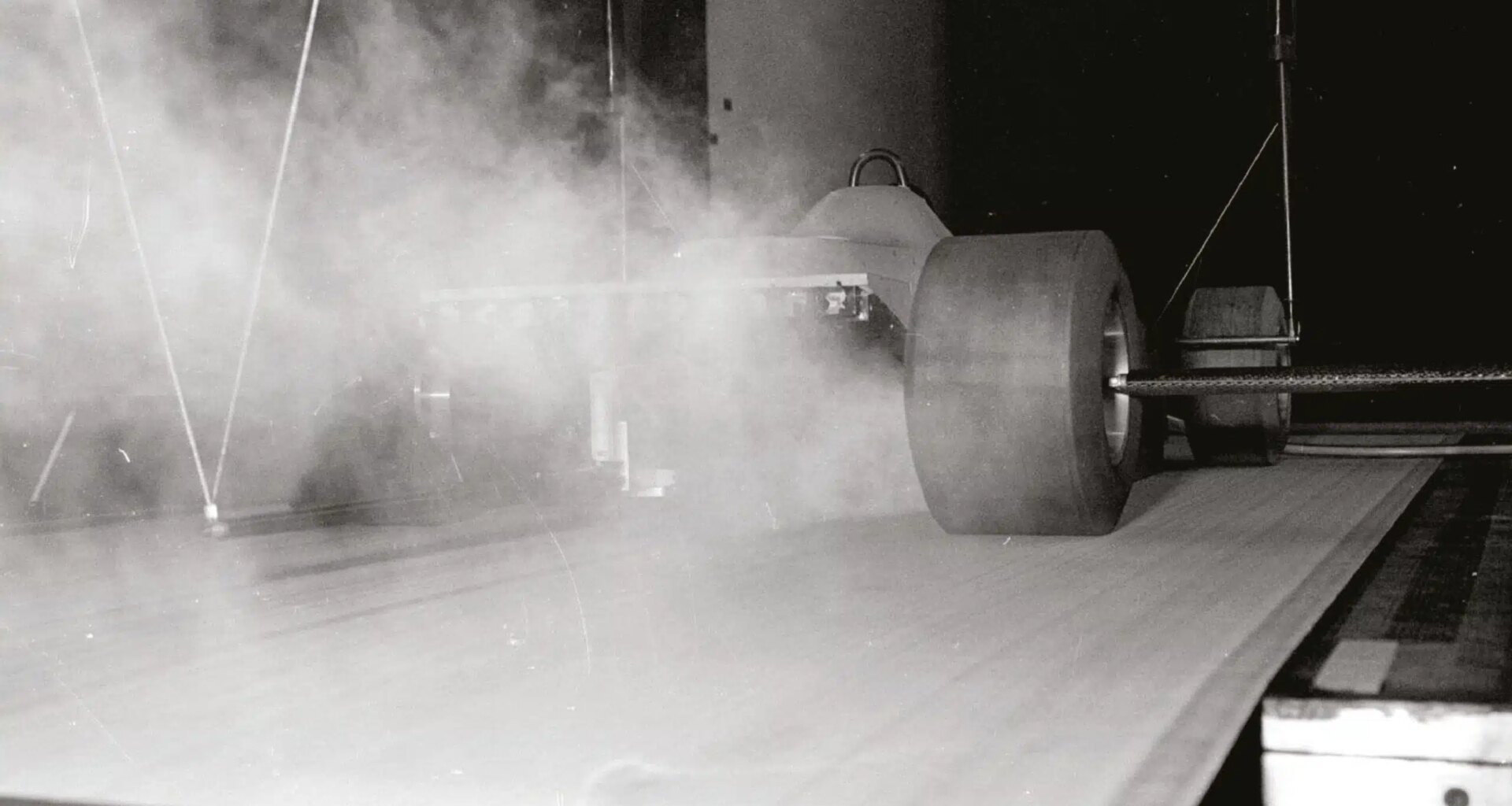
“There’s a lot of work in getting the rolling road design and all the suction systems and computer software and it was quite challenging,” he recalls in the latest issue of Motor Sport. “But I guess at that age you’re not afraid of anything.”
What happened during one of the earliest runs had no precedent. Watching an analogue meter suddenly swing off the scale, Saunders turned to see the MP4 model bouncing violently in the tunnel.
“It got violent and we thought we’ve got an instability problem with the belt,” he added.
As the team adjusted ride height, the readings snapped between two extremes – one where the underbody was generating serious downforce, the other where it had stalled completely.
They were watching an early, undocumented case of porpoising.
Barnard, standing behind Saunders at the time, wanted an explanation nobody could yet give him.

Watson lead de Cesaris en route to the MP4/1’s first win at Silverstone
Grand Prix Photo
“He didn’t really have much of a sense of humour, and at the time rightly so,” Saunders said. “You have to remember that this was groundbreaking stuff. We genuinely didn’t know what it was.”
The team’s response was to improvise: pressure-tapping the underbody to measure how ride height and skirt height together determined when the airflow let go, then writing bespoke plotting software to visualise the data because nothing existed to do it for them.
It is a reminder that some of Formula 1’s supposedly modern aerodynamic problems are really old ones, rediscovered by teams without access to, or without reading, the history.
The MP4 itself was no overnight sensation. John Watson took a podium in only its fifth race, at Jarama, then finished second at Dijon before winning at Silverstone in July 1981, the car’s breakthrough victory.
Read more on the development of the revolutionary McLaren MP4/1, in the October issue of Motor Sport.