
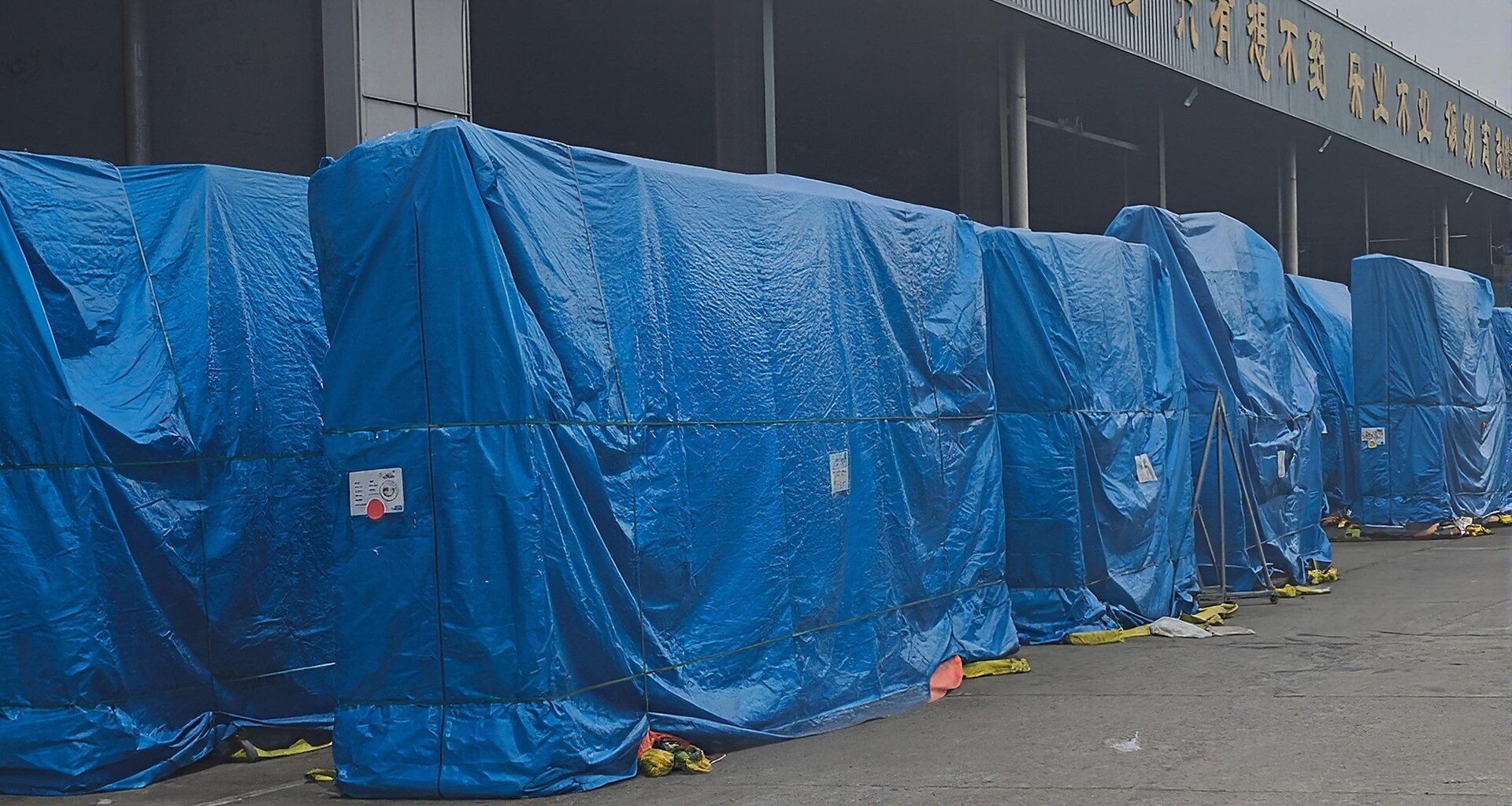
State-of-the-art robots in China are now being used to manufacture houses for the Australian market and at one factory, machines already do more of the work than people. That is according to Steve Walker, Principal of Terrafolia Advisory, who was onsite in China on Monday and told Wood Central the company involved are shipping 30 to 40 complete houses a month to Melbourne, Sydney, and Brisbane.
“My conclusion is simple: this could be the BYD moment for Australian home construction,” Walker said. It comes as the Federal Chamber of Automotive Industries counted 8,231 sales in August for BYD, the Chinese carmaker now second only to Toyota in Australia.
When Walker first toured the plant in 2017, and again in 2020, it was making timber components for modular housing. “Today it is manufacturing highly engineered cassette systems using robotics, with machine input now materially greater than human input,” he says.
 A finished wall cassette, wrapped in US-made DuPont Tyvek HomeWrap with its window already fitted, stands beside stacks of structural timber inside the Chinese factory. (Photo Credit: Supplied to Wood Central / Central PR Group by Steve Walker, Terrafolia Advisory)
According to Walker, the houses are now framed almost entirely in laminated veneer lumber (LVL), graded LVL10 and LVL13, primarily NZ pine, rather than conventional sawn pine. If they can deliver home builders “quality and price for houses – in the way BYD has done with cars,” he says, “it will be an interesting few years.”
At the same time, Australia is the company’s number one target market, with Canada second, and Walker says it wants to grow rapidly over the next two to four years. It plans to list its parent company in the United States, he says, to raise capital and invest in “additional advanced manufacturing capability in China.”
For Walker, the plan is “not simply an export housing proposition” but “a deliberate strategy to combine Chinese manufacturing, automation, capital markets and direct access to large western housing markets.” “Not every manufacturer has the technical know-how, Australian market understanding or relationships to do this,” he says.
The company, which Walker has known for about a decade but has not named, is already working with major industry players, he says. It told him it is only interested in dealing with Australia’s largest property developers because it sees them as lower risk.
It comes after the Committee for Economic Development of Australia (CEDA) and Urbis found in May that Australia could fall 200,000 to 300,000 homes short of the 1.2 million National Housing Accord target for 2029. CEDA also found factory methods could cut build times by 20 to 50 per cent, yet they remain a niche, mostly because Australia’s building rules were written for on-site construction.
Steve Walker’s LinkedIn post of Monday, with photographs of the factory’s structural timber, a finished wall cassette, and houses wrapped on the loading dock. (Source: Steve Walker, Terrafolia Advisory, via LinkedIn)
At the factory, Walker says, he saw “the other side of that equation,” and for Australian home buyers the business “could be a significant opportunity.” For Australia’s forest owners, though, the question is not only whether the country builds its own factory-housing industry, he says, but “where Australian fibre sits” in the global supply chain.
As more building moves into factories, Walker says, demand “shifts away from conventional commodity products towards engineered materials with predictable structural performance.” The opening for growers, he says, is to understand how their wood performs as a structural material and develop “pathways into LVL and other engineered products.”
Australia is leaning more and more on imported LVL to build its houses, with Forest and Wood Products Australia counting more than 250,000 cubic metres of imports in the 2025-26 financial year. Mainland China supplied more than 69 per cent of declared imports in the ten months to October 2025. The Australian Timber Importers Federation blames the surge on Victoria and Western Australia ending native forest harvesting, and says Wesbeam, Australia’s only large-scale LVL manufacturer, could not lift production to fill the gap.
Logs queue for the saw at one of the veneer peeling mills Steve Walker toured in China’s Linyi, Suqian, and Guigang clusters in March, on an earlier visit to the country’s LVL makers. (Photo Credit: Supplied to Wood Central / Central PR Group by Steve Walker, Terrafolia Advisory)
For his part, Walker says one lesson from China is becoming increasingly clear: “The machinery can be bought. Relationship capital cannot.” That capital, he says, is “the investment of time and trust that goes well beyond a buyer and seller transaction.”
The manufacturers that succeed in Australia, and the forest owners who supply them, “will not simply be those with the lowest manufacturing cost,” Walker says. For growers, he says, the opportunity is “not necessarily to manufacture every component ourselves” but “to make sure Australian plantation fibre has a valuable place in the construction systems that ultimately win.” Right now, for a number of engineered wood products in the Australian market, that is not the case.

Jason Ross, publisher, is a 15-year professional in building and construction, connecting with more than 400 specifiers. A Gottstein Fellowship recipient, he is passionate about growing the market for wood-based information. Jason is Wood Central’s in-house emcee and is available for corporate host and MC services.