
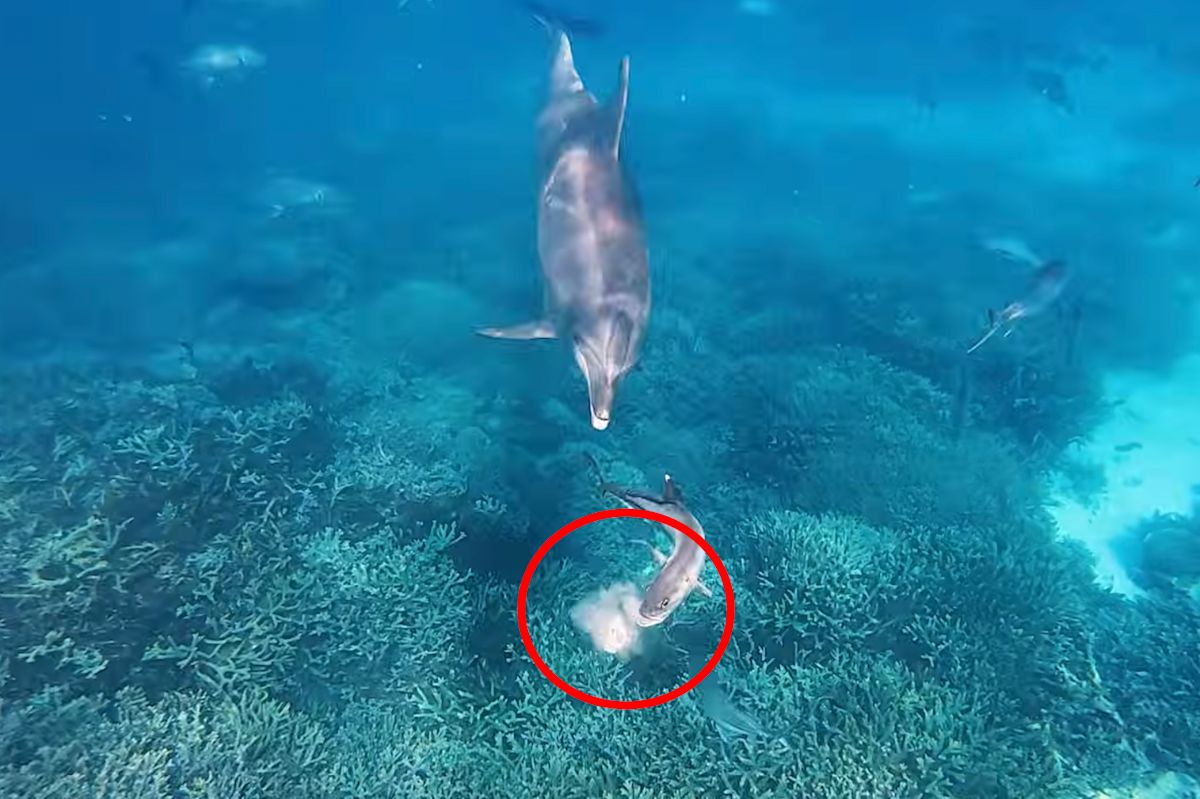
We’ve all gone to questionable lengths for a feed, but one Aussie dolphin has taken the hunt for an easy meal to a whole new level.
A bottlenose dolphin, nicknamed Bubbles, has been caught relentlessly chasing fish until they vomit before eating what comes out.
It’s disgusting. It’s also apparently quite clever.
Scientists studying Bubbles off Queensland’s Lady Elliot Island believe the behaviour is far from random, with the dolphin appearing to carefully choose which fish to target.
“We observed him repeating this behaviour over several years, which suggests he may have learnt to target the fish with the fullest bellies, providing the most rewarding meals,” University of the Sunshine Coast researcher Dr Asia Haines said.
RELATED:
Researchers watched Bubbles scan schools of bigeye trevally before singling out a target, and on one occasion, he repeated his unusual feeding trick 10 times in just half an hour.
They now believe Bubbles could even be using echolocation, following sound waves, to work out which fish have the fullest stomachs before choosing his victim.
In other words, Bubbles may have worked out that sometimes it’s easier to steal someone else’s dinner than catch your own.
Do you have a dolphin story? Contact newsroomau@yahoonews.com

Bubbles appears to carefully scan schools of fish before choosing which one to pursue, Sunshine Coast University researchers found. Source: UniSC
(Tracy Olive)Why researchers believe Bubbles is surviving off fish vomit
Researchers documented 20 encounters between 2021 and 2025, with Bubbles scoring regurgitated food 11 times.
Remarkably, he was never seen eating the trevally themselves.
Instead, researchers believe his unusual strategy could simply be an easier way to get fed while hunting alone.
“It may be that this specialised tactic requires less energy than directly pursuing fast-moving prey, particularly when foraging solo,” UniSC PhD student Romney Edwards-Francis said.
The behaviour, known as kleptoparasitism, has never been seen before, with researchers documenting the first detailed case in a cetacean anywhere in the world
“His behaviour does demonstrate the species’ adaptability and flexibility when it comes to foraging,” UniSC PhD student Romney Edwards-Francis said.
“We also suspect that rare or novel foraging tactics such as kleptoparasitism are likely underreported in dolphins or other cetaceans.
“The challenge is monitoring the animals underwater over longer time periods to capture their full range of behaviours. Combining emerging technologies such as drones with underwater surveys may provide a way to overcome this.”
Bubbles exposes another side to dolphins
If the discovery changes the way you look at supposedly friendly dolphins, Haines has some bad news.
“This perception of dolphins as the ‘good guys of the sea’ has more to do with anthropomorphism — our tendency to assign human characteristics to them — and perhaps that’s because dolphins appear to be smiling,” she said.
“Dolphins are predators and actively hunt their prey, whether it has been stolen from another species or not.”
Bubbles, it seems, has just found a particularly disgusting shortcut.
You can also follow us on Facebook, Instagram, TikTok, X and YouTube.