
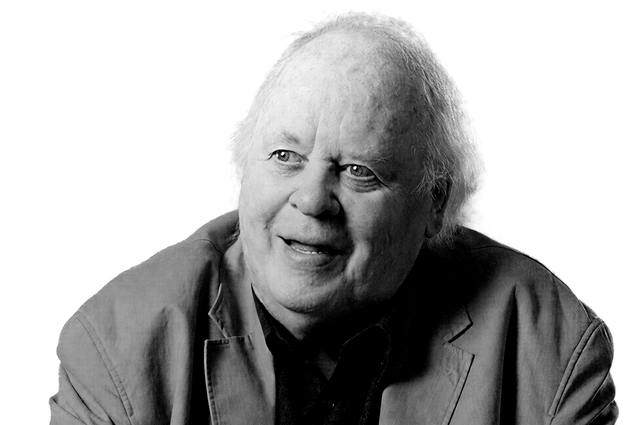
Paul Couch was as enigmatic a person as you might meet. He was equally an architect of mystery and obscurity for much of his 87 years, up until quite recently, but not in a dark way, nor vague. He knew what he was about.
I had the good fortune to meet him in the mid-60s when I joined the office of Romberg and Boyd in East Melbourne with Boyd alongside Missy Harris, Bill Williams, Karl Fender, Linley Vellacott and a few others who came and went.
Paul had his own small nest in the studio where he worked quietly, on projects like the Featherston House, Ormond College, Baker House and Churchill House. I cannot remember his cubby hole having a door, and we knew he was in the building because he drove a huge noisy metallic car – a Bristol – which, when he drove up the lane beside the building, conjured images and mechanical noises of bombers and military might.
And there’s the rub. Paul was the most peaceful and gentle of humans, quietly negotiating the business of architecture (and life) in his inscrutable manner, ambiguous and mysterious, like a character in a detective novel. He did not easily suffer foolishness nor embrace waste; his mind was like that of a monk, and he inhabited a special monastic world.
He was a superb technician in the days of drawing with pencil on trace in a way that defined just what information was needed to build Boyd’s masterpiece designs. He managed effortlessly to encapsulate the essence of an idea into its built form through his precise documentation, and he did so with clarity and exactitude.
His own projects developed relatively late in his career and brought together the attitudes and values of a confident personal and architectural faith. They were spare, conclusive, used limited materials and were uncomplicated formally, almost uncomplete; no frills, no waste, exact and uncompromising.
He limited his palette to things he knew about and could control, so the concrete shards of walls and open floor plans could capture light and breezes without mechanisation. Location in bush settings was honoured; Country was part of the architecture.
Like the man, this architect had paired down life’s needs to an almost abstract sense of a continuity in space. We all have limited time in life, but Paul, in the end, was able to define his life and work precisely, and we are blessed to celebrate what he achieved.
This article was republished with permission from the Robin Boyd Foundation.
Read James Mugavin’s reflection on Lowland Farm House by Paul Couch here.