
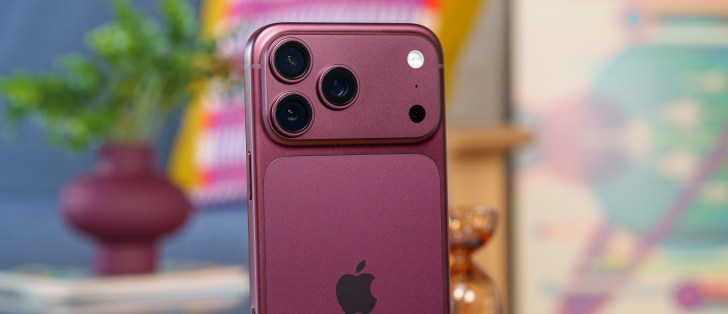
Display
The Apple iPhone 18 Pro Max packs a revamped 6.9-inch LTPO Super Retina XDR OLED display with a reduced cutout thanks to an under-screen IR camera. The panel offers 1,320 x 2,826 pixels (460ppi), a 120Hz refresh rate, and support for HDR10 and Dolby Vision content.
The screen is protected by a flat Ceramic Shield 2 glass.
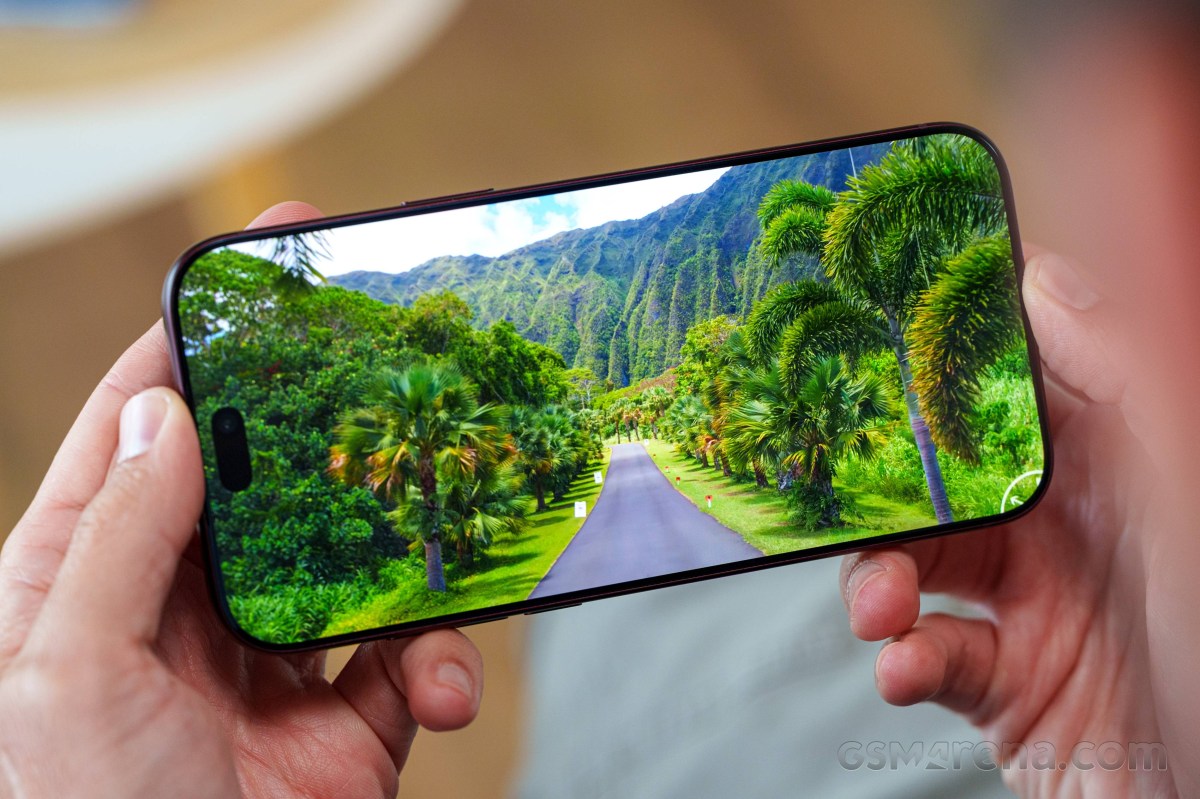
The most notable update for the screen this year is the smaller pill-shaped cutout. Apple has moved the IR camera under the screen by reducing the subpixels above its surface. The lower pixel count is not visible to the naked eye, thankfully, and you can see it only under a microscope.
The official brightness numbers are 1,000 nits for typical, 1,600 nits for automatic, and 3,000 nits for peak brightness.
We measured 969 nits for maximum automatic brightness and 2,722 nits for peak brightness. This is a solid performance for sure, but it’s a bit behind our last year’s measurements on the 17 Pro Max.
The minimum brightness with a white screen was just 1 nit.
The iPhone 18 Pro Max display supports ProMotion – a fancy term for dynamic refresh rate (1Hz-120Hz). It works by lowering the refresh rate down to 1Hz for static pictures and always-on/standby modes. For non-static content, the display usually matches the frame rate of the active app.
The iPhone 18 Pro Max supports HDR10 and Dolby Vision, and it is recognized by all known apps as such. It can display HDR content across non-HDR interfaces the same way Android Ultra HDR works.
Apple has been known for its meticulous attention to haptics, and the iPhone 18 Pro Max deserves praise for the lovely feedback and high accuracy of the Taptic Engine. As teardowns have revealed, the Taptic Engine vibration motor used here is the same as the one in the 17 Pro Max.
Battery life
The iPhone 18 Pro Max is powered by a 5,391mAh (21.06Wh) battery in the nano-SIM model (as reviewed) or a 5,567mAh (21.75Wh) battery in the eSIM-only model. That’s about 500mAh more than in the respective iPhone 17 Pro Max models.
The new battery exceeds the 20Wh threshold, which subjects it to stricter dangerous-goods requirements for air transportation in the EU and US. That would normally make shipping considerably more complicated and expensive for Apple in these regions, except the company has found an ingenious way around the restrictions for the iPhone 18 Pro Max.
You see, to avoid the hassle of shipping phones with batteries above this threshold, manufacturers typically either split the battery into two cells, keeping each one below 20Wh, or limit the usable capacity of models destined for affected markets. Apple has taken a different approach.
We found the details on Apple’s iPhone 18 Pro Max support page, and the solution is quite clever. The phone leaves the factory with a firmware-level capacity restriction that keeps the battery’s usable energy below 20Wh during transport. When the iPhone is started for the first time, that restriction is lifted, giving users access to the battery’s full capacity.
Apple also lets users re-enable the transport restriction if they need to ship the phone by air later on. Once the phone reaches its destination, the restriction can simply be disabled again.
Now, on to the actual battery test. The iPhone 18 Pro Max achieved an Active Use Rating of 19:20 hours, an improvement over the 17:58h of the iPhone 17 Pro Max and the 17:18h of the iPhone 16 Pro Max.
More specifically, the 18 Pro Max brings improvements in call times and our social media/web browsing scenario.
Charging test
Apple advertises the new iPhone 18 Pro and Pro Max as capable of faster wired charging than their predecessors. To achieve the advertised speeds, Apple recommends the thoughtfully named ’40W Dynamic Power Adapter with 60W Max’, which is finally available in the EU (last year, you could only get it in the US).
The iPhone 18 Pro Max retail box states a maximum charging power rating of 54W, up from 42W for the 17 Pro Max. And our testing backs that up, with the new model consistently drawing 53W for the first 10 minutes of the charging process.
For our charging test, we used Google’s 67W dual-port PD/AVS charger, which supports the same charging standards as Apple’s adapter.
Apple promises a 50% charge in 15 minutes when using their 60W AVS adapter, and our testing pretty much confirms that. We got to 50% in 15 minutes and 81% in 30 minutes.
The battery reached 100% in 55 minutes, which is quite impressive compared to last year’s 17 Pro Max. Still, both iPhones continue charging at low power even after reaching the 100% mark. In case you’re curious, it took around 73 minutes for charging to stop completely.
Just like last year, the iPhone 18 Pro Max supports fast wireless charging up to 25W via MagSafe when using a compatible Qi2 charger and a 35W+ power adapter. We tried Apple’s own 25W wireless charger, and we can confirm that the phone reached 50% in 30 minutes.
In terms of battery preservation features, iOS offers a Battery Health option, which allows you to set the charge limit at a chosen point between 80% and 100%.
Alternatively, the Optimized Charging feature will learn your charging habits and minimize the time the battery spends at 100%.
As usual, you can see the cycle count and the estimated battery health level in the battery settings.
Speakers – loudness and quality
The Apple iPhone 18 Pro Max has a hybrid setup of stereo speakers where the earpiece is pulling a double duty. And while it is not as loud and punchy as the bottom speaker, together they sound balanced.
The iPhone 18 Pro Max earned a Very Good rating on our speaker loudness test.
The iPhone 18 Pro Max sounds a bit brighter than last year’s 17 Pro Max, but the difference is not huge and depending on the test track, you might even miss it.
Use the Playback controls to listen to the phone sample recordings (best use headphones). We measure the average loudness of the speakers in LUFS. A lower absolute value means a louder sound. A look at the frequency response chart will tell you how far off the ideal “0db” flat line is the reproduction of the bass, treble, and mid frequencies. You can add more phones to compare how they differ. The scores and ratings are not comparable with our older loudspeaker test. Learn more about how we test here.