
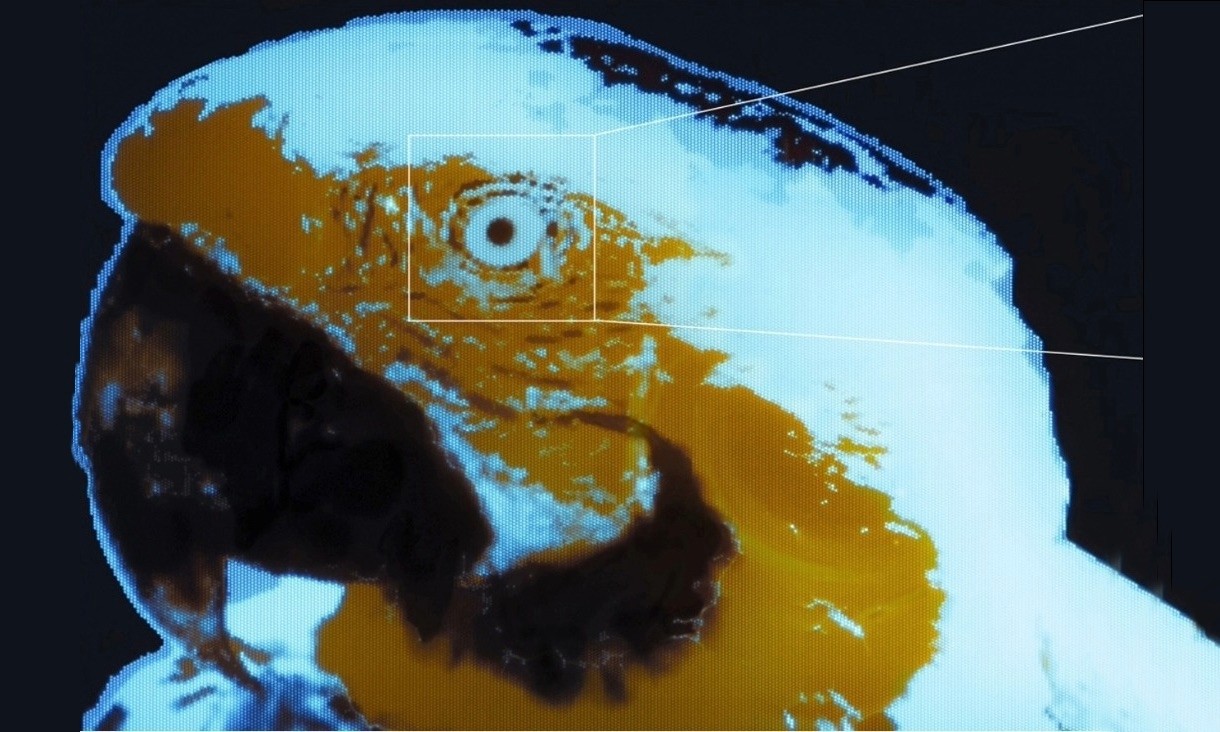
Photoresists for lithography
The lead scientists in Zurich made luminescent polymers in various colours that serve as photoresists – a light-sensitive material used to engrave patterns on a surface – whilst withstanding harsh chemical conditions.
Associate Professor Yinyin Bao, who conducted research at ETH Zurich and is now at the University of Helsinki, said these polymers can enable the creation of fine-scale geometric structures on a semiconductor chip when exposed to UV light.
“We’ve developed a new class of long-chain molecules that can be manufactured into OLED pixels using direct light exposure,” he said.
Bao led the research together with ETH’s Professor Chih-Jen Shih.
RMIT’s Christofferson provided computer simulations on how the molecules could effectively shield themselves while still being able to emit light.
Protective shell, luminescent core
To protect the sensitive luminescent molecules from aggressive chemicals, the researchers developed a molecular complex based on the core-shell principle: at its centre lies the colour-emitting molecule.
Surrounding it are arms arranged in a star-like pattern, the outer ends of which react to UV light.
When exposed to light, they cross-link with the arms of other stars, thereby shielding the OLED molecules during the manufacturing process used to make computer chips, called photolithography.
“We separate the two functions spatially,” explained Shih.
“The light-emitting molecule is protected inside, whilst the reactive cross-linking groups are on the outside. This allows the photoresist to react during lithography without causing significant damage to the light-emitting core.”