
How emoji trends have shifted from pandemic-era reactions to everyday laughter, and why Australians are still embracing these tiny digital expressions.Key points:Google Trends data shows a fascinating evolution of popular emojis, reflecting changing moods and online culture.
Australians remain enthusiastic emoji users, with laughter, hearts and positive reactions consistently among the country’s favourites.
Younger users are giving some emojis new meanings, showing how digital language continues to evolve.
A picture might be worth a thousand words, but in 2026, a single emoji can say just about everything.
Google Trends recently highlighted the emojis that reached all-time highs in US searches each year, creating a surprisingly accurate snapshot of how online culture has evolved. The list ranges from the memorable pandemic-era 👁️👄👁️ in 2020 to 😮💨 in 2021, the relatable 🫠 melting face in 2022, the cheerful 🩷 pink heart in 2023, and finally the return of full-blown laughter with 🤣 rolling on the floor laughing in 2026.
While these particular trends come from the United States, the broader story is one that will feel familiar to Australians too.
Why emojis keep changing
Emojis have become one of the world’s most widely understood forms of communication. According to data compiled by Emojipedia, emoji use continues to grow globally, with billions of emoji appearing in social media posts, messages and online conversations every day.
What’s interesting is that new favourites often emerge during significant cultural moments. The melting face emoji 🫠, for example, became a symbol of exhaustion, awkwardness and “holding it together” during a period when many people felt overwhelmed. The pink heart 🩷 quickly found popularity thanks to its warm, friendly tone and fresh alternative to traditional hearts.
In short, emojis evolve because we do.
Emojis evolve because we do.
Australia’s love affair with emojis
Australians have long been enthusiastic emoji users. Adobe’s Global Emoji Trends research found more than half of Australians increased their emoji use, while 91 per cent said emojis make it easier to express themselves. Many also felt emojis helped create friendlier and more engaging conversations.
Hope 103.2 is proudly supported by
Australian favourites tend to mirror broader international trends. Laughter faces, hearts, thumbs-up gestures and expressions of gratitude consistently feature among the country’s most-used emojis. Meta’s Australian data has similarly shown positive and expressive emojis dominating Facebook and Instagram conversations.
Perhaps that’s no surprise. In an era of short-form content, emojis can quickly add humour, warmth or context that text alone sometimes struggles to deliver.
What younger users are doing differently
If you’ve ever received a message filled with emojis and wondered whether it meant exactly what it appeared to mean, you’re not alone.
One of the most fascinating parts of emoji culture is how meanings change between generations. Linguists and emoji researchers have noted that some younger users increasingly use 💀 (skull) to mean “I’m dead from laughing”, while 😭 (loudly crying face) is often used to express overwhelming amusement rather than sadness.
The same goes for language itself. Some commentators have pointed out that phrases like “I’ll Google it” are gradually giving way to broader expressions such as “I’ll search it”, reflecting changes in how people use technology. Like emojis, digital language keeps adapting to new habits and platforms.
The future of emoji
If Google’s timeline proves anything, it’s that emojis are more than colourful decorations. They act as tiny cultural time capsules, capturing how people feel, joke and connect at a particular moment in history.
Emojis act as tiny cultural time capsules, capturing how people feel, joke and connect at a particular moment in history.
Today’s favourite emoji may be tomorrow’s nostalgic throwback. Yet whether you’re sending a classic ❤️, a cheerful 🩷, a dramatically melting 🫠 or a full-scale 🤣, the goal remains the same: helping us say a little more with a little less.
And that’s a language almost everyone understands.
This article was researched and prepared by staff writers, with assistance from AI in its presentation. Final review and fact-checking were undertaken by our Digital Team prior to publication.
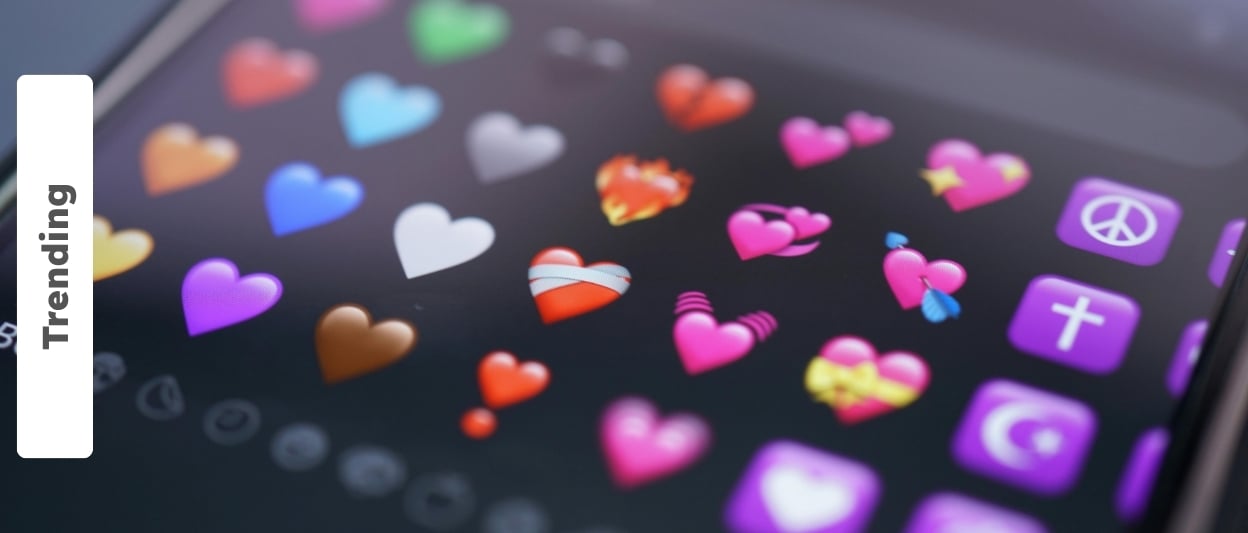
Feature image: Photo by Tim Witzdam (Pexels) via Canva.com