
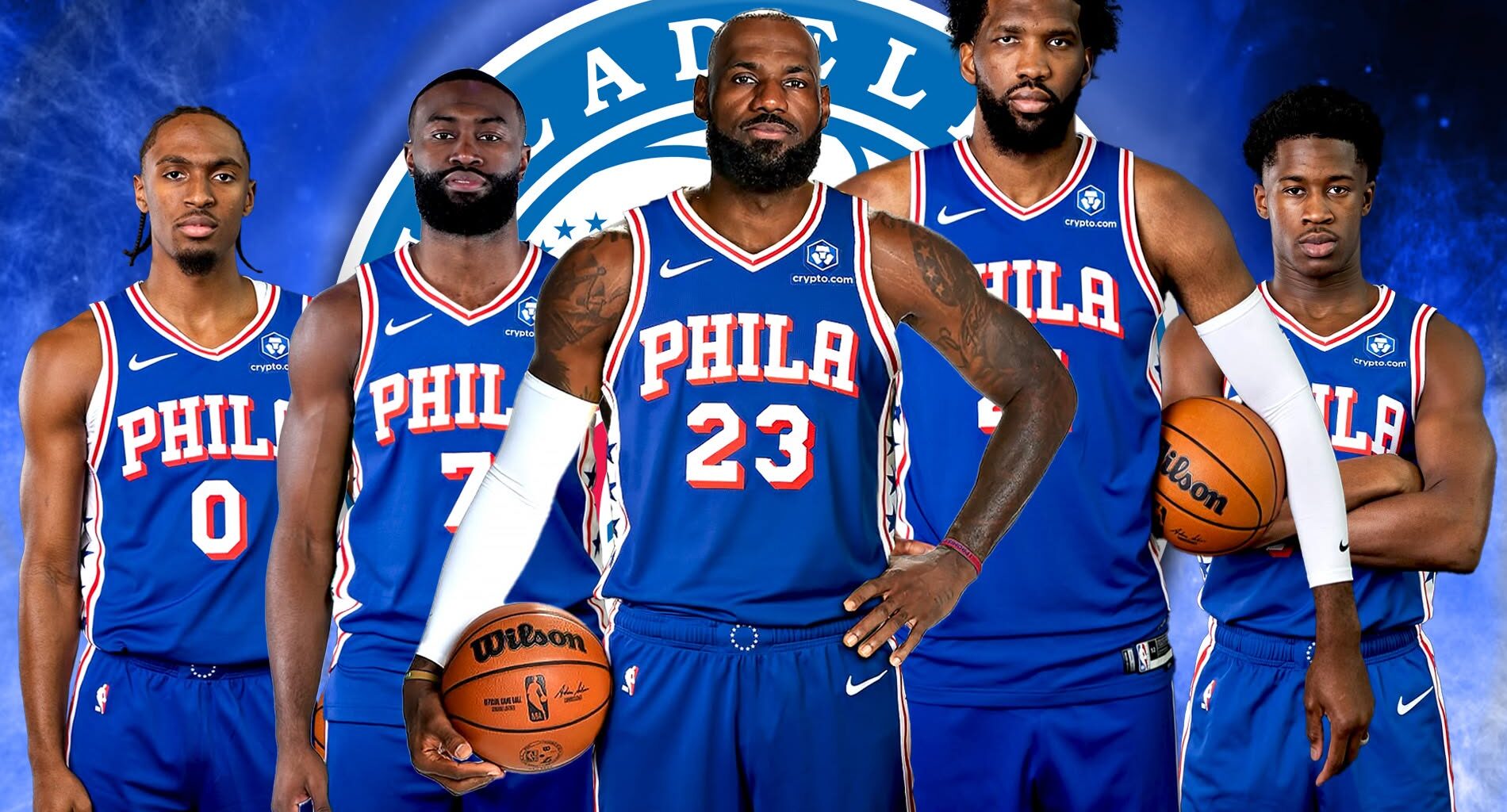
The 76ers might be the trickiest team in the NBA heading into 2026-27 because you can look at this roster for five seconds, see Tyrese Maxey, VJ Edgecombe, Jaylen Brown, LeBron James, and Joel Embiid in the same starting lineup, and immediately think this offense should be completely ridiculous.
You look a little deeper at the numbers, Embiid’s health, the shooting, and how all these high-usage players are supposed to share one basketball, and suddenly there are a lot more questions than the names alone would suggest.
That’s basically what makes this team so interesting, because last year’s Sixers weren’t close to being an elite statistical team, even though they finished 45-37, grabbed the seventh seed and beat the Celtics in seven games before getting swept by the Knicks in the Eastern Conference Semifinals.
They ranked 17th in offensive rating at 115.4, 16th in defensive rating at 115.5, and 18th in net rating at minus-0.2, while their expected record based on point differential was only 41-41, so we’re talking about a team that performed almost exactly like an average NBA team for long stretches.
That’s why this offseason was so wild, because instead of making little moves around Maxey and Embiid, the Sixers basically changed the entire equation, trading for Jaylen Brown, adding LeBron James, Anfernee Simons, Kentavious Caldwell-Pope, and Dean Wade, while keeping Maxey, Embiid, and Edgecombe as the foundation of the roster.
So yeah, there’s a ridiculous amount of talent here, probably more individual shot creation than any Sixers team of the Embiid era has ever had, but there are also some structural problems that can’t just be ignored because the names look cool on a starting lineup graphic, and those issues are exactly where the 2026-27 season is going to be decided.
Strengths
1. The Crazy Amount Of Shot Creation
Maxey already showed he can carry superstar-level offensive volume, averaging a career-high 28.3 points, 4.1 rebounds, and 6.6 assists in 70 games while shooting 46.2% from the field, 36.7% from three, and 89.2% from the line, good for a 58.8% TS, and the part I like even more is that he did all of that while averaging only 2.4 turnovers despite playing 38.0 minutes and handling the ball constantly. He became one of only three NBA players to average at least 28.0 points and 6.0 assists, and the only one in the Eastern Conference, so Maxey has clearly reached legitimate All-NBA offensive engine territory.
Now put Jaylen Brown next to him, who is coming off the highest-scoring season of his career: 28.7 points, 6.9 rebounds, and 5.1 assists while shooting 47.7% from the field, and he did it with an enormous individual creation burden. His usage climbed into the mid-30s, while he averaged 18.7 isolation possessions per 100, third-most in the league, and this team starts to get crazy.
Then you still have Embiid, who averaged 26.9 points, 7.7 rebounds, and 3.9 assists in 31.6 minutes, shot 48.9% from the field, generated 8.8 free-throw attempts per game, and finished at 60.5% true shooting, so even in a season where he clearly wasn’t peak MVP Embiid physically, defenses still had to send help when he got the ball around the elbow or low post.
And then there’s LeBron, which is where the whole thing becomes kind of stupid, because the fourth guy we’re mentioning here just averaged 20.9 points, 6.1 rebounds, and 7.2 assists on 51.5% from the field, with a 33.9% assist share that ranked in the 96th percentile among players with at least 500 minutes.
At this point in his career, LeBron obviously shouldn’t be asked to score 30 points every night, but that’s exactly why this roster makes sense for him, because the Sixers need him to organize, punish small defenders, and create efficient shots for everyone else.
Last season, the Sixers scored 115.9 points per game and produced only 24.6 assists, so a lot of their offense came from individual players manufacturing difficult shots rather than the team consistently creating easy ones, and the talent upgrade gives them a chance to completely change that equation.
Basically, this team shouldn’t run out of answers very often, and that matters a lot once playoff defenses start blowing up the first and second action, because the Sixers can now go to the third option, and that might still be an All-NBA player.
2. The Backcourt Is The Athletic Engine
The funniest thing about the Sixers is that they somehow became both extremely old and extremely young at the same time, because Embiid is 32, Brown is about to turn 30, and LeBron is 41, but the backcourt core is Maxey at 25 and VJ Edgecombe at 21, and that matters because those two can supply the speed, transition pressure, and point-of-attack energy that the veteran stars can’t provide for 82 games anymore.
Maxey’s scoring gets all the attention, but his defensive activity took another jump last season at 1.9 steals and 0.8 blocks, and the Sixers posted a 113.4 defensive rating with him on the floor compared with 114.4 when he sat. His size at 6-foot-2 can still become a problem in certain matchups, but he’s no longer just a small scoring guard teams automatically target every possession, especially because his speed allows him to pressure the ball and recover after screens.
Edgecombe is the more interesting piece defensively, because his rookie season already gave us a pretty clear picture of what his athleticism can become: 16.0 points, 5.6 rebounds, 4.2 assists, and 1.4 steals in 35.0 minutes, with a 19.6% usage rate and a 2.30 assist-to-turnover ratio. He also grabbed 1.6 offensive rebounds per game as a 6-foot-4 guard, which tells you how much chaos he creates just by flying into plays from the perimeter.
The Sixers were already pretty disruptive last year, averaging 9.1 steals and 5.7 blocks, and now Brown gives them another strong, physical wing defender while Edgecombe gets another full year of NBA development, so Nurse has more options if he wants to pressure the ball, switch, or use aggressive help schemes before dropping Embiid closer to the basket.
That’s also why Edgecombe might be the most important fifth starter in the league, because the Sixers don’t actually need him to become a 22-point scorer right now, they need him to defend the best perimeter player, run the floor, rebound, cut, make quick passes, and hit enough open threes to keep the floor open.
His rookie efficiency wasn’t amazing at 43.8% from the field, 35.4% from three, and 54.0% true shooting, but that’s completely acceptable for a 20-year-old rookie who already played 75 games and 35 minutes per night, while his low 19.6% usage makes him much easier to fit around four players who need the basketball more.
3. The Offensive Depth Is Way Better Than It Looks
People are obviously going to talk about the starting five, but I actually think the bench offense could become one of the more underrated parts of this team since Anfernee Simons is an extremely overqualified sixth man.
Simons averaged 14.3 points in only 24.9 minutes last season while shooting 43.9% from the field, 38.4% from three and 89.6% from the line, and this is somebody who averaged 22.6 points and 5.5 assists as a full-time starter only two seasons earlier, so his scoring ability didn’t randomly disappear, his role simply changed.
The shooting is the most important part, because Simons has hit 42.7% of his catch-and-shoot threes over the last six seasons, sixth-best among 118 players with at least 1,000 attempts over that span, and that’s exactly the kind of weapon the Sixers need around players who attract multiple defenders.
Dean Wade gives them a low-usage stretch forward who shot 37.5% from three last season, Caldwell-Pope has a career 36.5% three-point mark even after dropping to 31.6% last year, Justin Edwards remains another developmental wing, and the center rotation behind Embiid includes Adem Bona and Ariel Hukporti, so this roster at least has different player types instead of eight guys trying to do the same thing.
Last season, the entire offense changed depending on who was available, and the on/off numbers showed it pretty clearly, because the Sixers scored at a 119.1 rating with Embiid on the floor and only 111.3 with him off, an enormous 7.8-point offensive difference. This roster has a much better chance of roaming those non-Embiid minutes because there’s simply more creation available now.
4. Embiid Still Dominates When He’s Healthy
Everything with Joel eventually becomes a health conversation, and we’re obviously getting there later, but first we can’t ignore what happened when he actually played last season because the Sixers were just a different team.
With Embiid on the floor, they posted a 119.1 offensive rating, a 113.2 defensive rating, and a plus-5.8 net rating across 1,201 minutes, while they were minus-2.8 per in his minutes off the floor, an 8.6-point swing in net rating.
The individual production wasn’t MVP Embiid anymore, but 26.9 points, 7.7 rebounds, 3.9 assists, and 1.2 blocks on 60.5% true shooting is still star production, and he continues to create something almost nobody else on this roster can create at the same level: free throws. The Sixers attempted 24.8 free throws per game last season, and Embiid personally generated 8.8 in only 31.6 minutes whenever he played.
That becomes even more important with Brown and Maxey because both guys are downhill attackers, so if the Sixers can constantly get defenses into rotation and foul trouble, they should have a much easier way of scoring in ugly half-court games.
The defense still changes with Embiid, not because he’s going to switch onto guards at the perimeter at this stage of his career, but because his size lets Nurse build schemes around keeping him near the rim, using more zone and conservative coverages to avoid forcing him into constant space.
If Embiid can give the Sixers something close to 30 good minutes in the playoffs while Maxey, Brown, and LeBron handle more of the creation workload, his job becomes simpler than it has been in years: fewer banging from the elbow, more paint touches, more screening, more rolling, and more energy left for defense.
Weaknesses
1. The Entire Thing Still Depends On Embiid’s Body
You knew this was coming, as Embiid appeared in only 38 regular-season games last season, and he has played just 96 regular-season games over the last three years, an average of 32 per season. Even including the playoffs, he played only 45 of a possible 94 games for the Sixers in 2025-26, or 48% of their total.
That’s honestly the central variable of the entire roster, because the difference between Embiid playing 60 games and Embiid playing 30 changes everything from playoff seeding to rotation to how much workload Maxey and Brown have to carry.
Last year’s playoff numbers didn’t exactly erase the concern either, because Embiid played seven games, averaged 24.0 points, 7.3 rebounds, and 5.4 assists, but shot only 46.0% from the field, 17.9% from three, and, with his mobility, became something opponents could attack.
LeBron creates another age-related health concern too, because he’ll turn 42 in December and played 60 games last season, and even though averaging 20.9 points and 7.2 assists at that age is completely insane, the Sixers can’t build their regular-season plan around him playing 70 games and carrying huge minutes either.
This is a roster with some serious mileage, and Nurse is probably going to have to treat the regular season like a long load-management puzzle rather than chasing every win with playoff-style rotations.
2. Somebody Has To Give Up Their Numbers
This might be the most interesting basketball question on the team because the Sixers have a ton of creators, but basketball doesn’t let you use four balls at once.
Embiid and Brown each posted a 32.5% usage rate in the 2026 playoffs, Maxey averaged 11.2 minutes of ball possesion per game, second-most among playoff players, while Brown also had the third-most isolation touches per 100 in the NBA.
Now you’re putting all three together and then adding LeBron, who still posted a 26.2% usage rate last season, so yeah, somebody’s numbers are going down, probably several guys, and that’s completely fine as long as the efficiency goes up.
The good part is that Embiid, Maxey, and Brown ranked 12th, 15th, and 26th out of 182 players in shot difficulty last season, so all three were taking some of the toughest shots in the league and should get easier looks playing together.
3. The Shooting Still Isn’t As Good As The Names Make You Think
The Sixers shot only 34.9% from three last season, 23rd in the NBA, while attempting 35.3 threes per game, and the new starting lineup isn’t exactly filled with 40% shooters either. Maxey shot 36.7%, Edgecombe 35.4%, Brown 34.7%, Embiid 33.3%, and LeBron 31.7% last season.
That’s not disastrous, because most of those guys are respected enough that defenses can’t leave them open, but it’s also nowhere near the spacing environment you would ideally build around Embiid post-ups or LeBron drives.
Brown is the one I’m watching most closely because 34.7% from three is playable, but when he’s sharing the floor with LeBron at 31.7% and Embiid at 33.3%, opponents might start cheating off whichever player they trust least, shrinking the floor and daring the Sixers to win with volume from outside.
The bench helps, especially Simons, who hit 38.4% from three last season and has been an elite catch-and-shoot player over a much larger sample, but Caldwell-Pope isn’t solving the issue either because he shot only 31.6% from deep last season and just must return to his best version in that department.
This is why Simons could be way more important than people expect, because if a Maxey-Brown-LeBron-Embiid lineup starts feeling crowded, Nurse can insert him and immediately create a completely different feel.
Edgecombe improving from 35.4% to something around 37% would be huge too, because he’s probably going to receive the most open attempts of anyone in the starting group, and if he starts scoring off defenders’ help, suddenly everything opens up.
The Sixers don’t need to launch 50 threes every night, but they absolutely can’t shoot 34.9% again and expect all this offensive talent to function perfectly, because playoff defenses are going to pack the paint and ask them to prove they can beat it from outside.
4. Rebounding And Defensive Balance Could Get Ugly
This group wasn’t a strong rebounding team last season, even before losing Andre Drummond, and their new starting lineup might create some pretty weird defensive matchups.
The Sixers averaged only 31.5 defensive rebounds per game last season, 25th in the NBA, while Drummond led the team with 8.4 total rebounds per game in limited minutes, so losing him removes the best pure rebounder on the roster.
The playoff numbers were even uglier, because the Sixers posted only a 71.4% defensive rebounding rate and 20.1% offensive rebounding rate across their 11 postseason games, while the Knicks averaged 43.0 rebounds per game against them in the second round compared with only 32.5 for the Sixers, a crazy gap.
Now ask Embiid, whose workload has to be managed, to control the glass while LeBron and Brown spend a lot of time at the forward spots, and suddenly other teams might start crashing the glass with too many bodies.
The defensive fit has similar questions, because Maxey is still a 6-foot-2 guard, LeBron is 41, Embiid’s mobility isn’t what it was during his defensive peak, and Simons has never been somebody you want defending good point guards and wings, so Nurse has to be pretty smart about which combinations he uses.
Brown and Edgecombe help a lot because both can take difficult perimeter players, Caldwell-Pope gives them another veteran option if he gets physically right, and Embiid can still protect the paint if he’s allowed to stay close to the basket. But last season the Sixers were only 16th in defensive rating, so we’re not starting from some elite defensive foundation here either.
The playoffs became a total disaster statistically, with the defense allowing 120.5 points in DefRTG while the offense managed only 109.9, creating a minus-10.6 net rating over 11 games, and against the Knicks specifically, they allowed 124.3 points per game while scoring only 102.0 themselves.
That’s why I don’t think the Sixers need to be obsessed with playing their five most talented names together for 35 minutes every night, some matchups might need Wade for size and spacing, others might need Caldwell-Pope for perimeter defense, Simons might close when they need shooting, and Adem Bona could become pretty important whenever Embiid isn’t available.
The Sixers Have A Massive Ceiling But Many Questions
This team is way better on paper than the one that went 45-37 last season, because you’re taking a group that finished 17th offensively and 16th defensively and adding Brown, LeBron, and Simons without losing Maxey, Edgecombe, or Embiid, so the raw talent upgrade is enormous.
The tricky part is that this roster still comes with clear risks, mainly Embiid’s health, LeBron’s age, the lack of rebounding and some defensive issues in certain lineups, so the Sixers have a huge ceiling but also a lot that needs to go right. That’s why I wouldn’t look at this roster and say the Sixers just need everybody to play like they did last season, actually, that’s probably the opposite of what they need.
They need Maxey to score a little less and move a little more, Brown to isolate less, Embiid to simplify his offense and spend more time near the paint, LeBron to organize without needing to dominate the ball, Edgecombe to become an elite complementary player, Simons to shoot the hell out of the ball, and everybody else to defend and rebound as their minutes depend on it.