
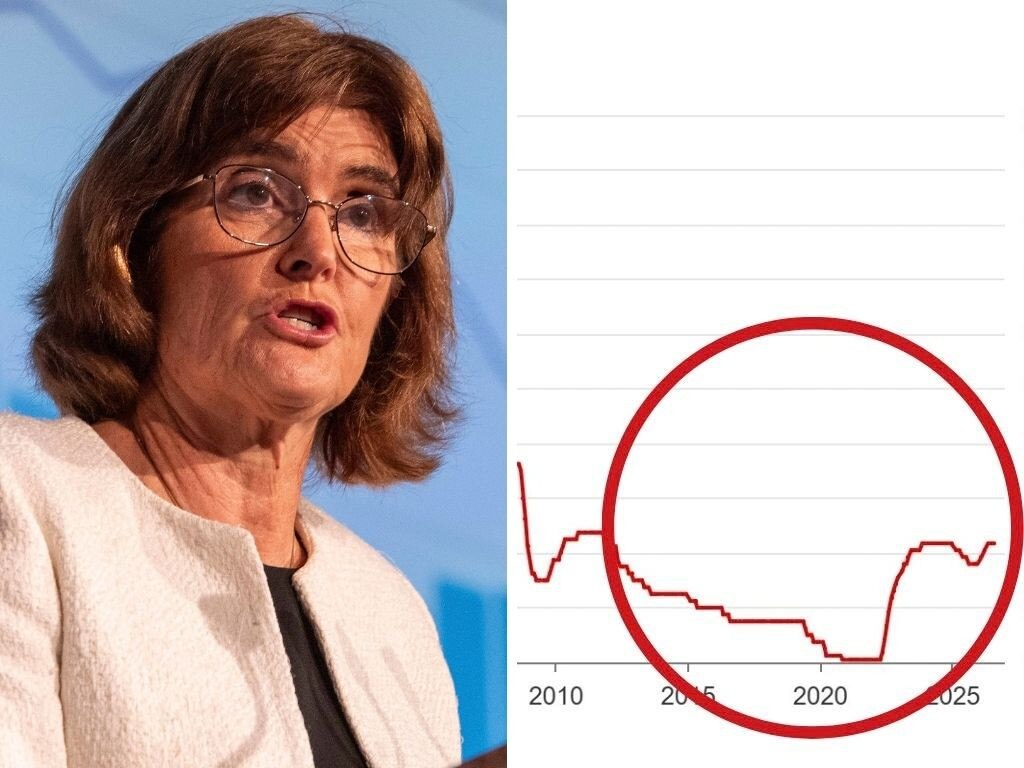
As the RBA weighs up another, even multiple rate rises before the end of the year, Governor Michele Bullock has been issued a sombre warning.
New research has revealed: just one interest rate rise can affect home ownership for more than a decade.
Emerging research by University of Sydney economist Dr James Graham has found a single Reserve Bank of Australia interest rate rise could suppress home ownership for more than a decade, with young Aussies bearing the brunt of the impact.
MORE: Boomers smashed by new Aus tax, others pay less

The RBA is expected to raise interest rates again next Tuesday. Picture: NewsWire/ Monique Harmer
Using housing statistics and a detailed large-scale model, Dr Graham from the School of Economics, is analysing how monetary policy affects Australians’ ability to buy and own homes over time.
Dr Graham said early findings from the study show a standard 0.25 percentage point increase in interest rates leads to an immediate five per cent decline in home purchases, and buying remains low for up to two years.
“Home ownership rates also fall following a rate rise, declining 0.1 percentage points within the quarter following a rise and continuing to fall for four years before reaching their lowest point at 0.3 percentage points below baseline,” he said.
“A 0.3 percentage point fall in home ownership rate equates to tens of thousands fewer Australian households owning their home.”
The modelling revealed home ownership does not return to its pre-rate-rise level for more than a decade.

Sydney University’s James Graham said a rate rise can set Aussie households back decades. Picture: LinkedIn
“Even a single, modest interest rate rise can be extremely costly for households trying to enter the housing market,” Dr Graham said.
“These findings suggest the effects of monetary policy decisions on home ownership persist well beyond the immediate economic cycle.”
Dr Graham said the data shows younger households with less income are hit hardest and experience the largest decline in home ownership following an interest rate rise.
“Following a rise, incomes typically fall and households are forced to draw down savings that would otherwise have gone towards a house deposit, making future home ownership more difficult,” he said.
“Home ownership among middle-aged Australians falls several years later because many were unable to purchase a home when they were younger, whereas older households are largely insulated from the effects of monetary policy decisions.”
Repeated rate rises have already had a significant effect upon Australia’s property market. Picture: Daily Telegraph/ Brendan Read
It comes as a separate Household, Income and Labour Dynamics in Australia (HILDA) annual survey found half of young adults aged 18 to 29 were living with their parents in 2024, up from 39 per cent in 2001.
The survey indicated two-thirds of young adults who leave the parental home rent privately, and housing stress among those living in mainland capital cities rose from 18 per cent in 2001 to 25 per cent in 2024.
Housing costs surged to record highs in mainland capital cities, with 36 per cent of private renters and 30 per cent of mortgage holders spending over 30 per cent of disposable income on housing in 2024.
For mortgage holders in mainland capital cities, median weekly costs rose from $418 in 2001 to $623 in 2008, declined gradually through the 2010s, fell sharply to $548 in 2021 as interest rates reached historic lows, then surged to $705 in 2024 – an increase of $157 (29 per cent).
With the next interest rate decision due on Tuesday expected to be another rise, the prospect of another move in borrowing costs has put further focus on housing affordability impact for Aussies, while the path of home ownership could become more difficult for the next generation of buyers.