
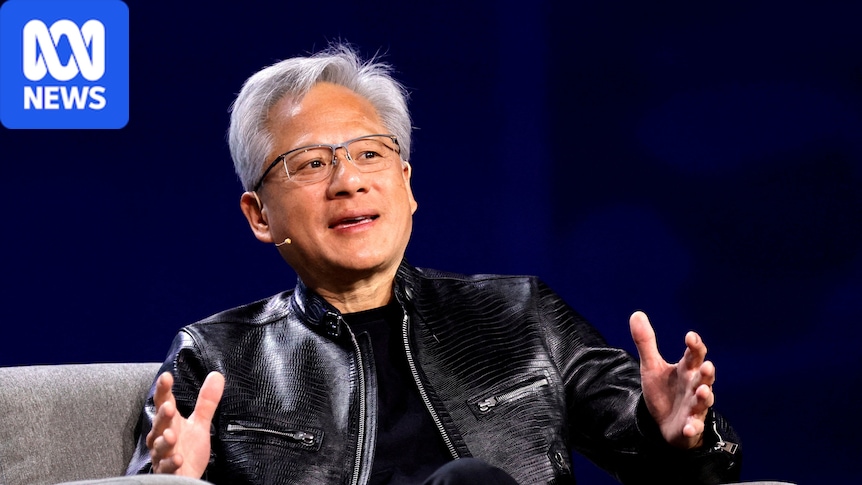
Before the world knew his name, Jensen Huang had already become one of the most influential figures in artificial intelligence (AI) development.
He had also cultivated a close relationship with United States President Donald Trump, which was evident when he took a call from him during a live AI summit in Los Angeles last week.
Last year, Huang revealed to media that Trump often called him late at night.
Huang, the founder of Nvidia, the tech giant that dominates the world’s AI chip market, had just criticised several prominent AI figures for their “doomsday” predictions.
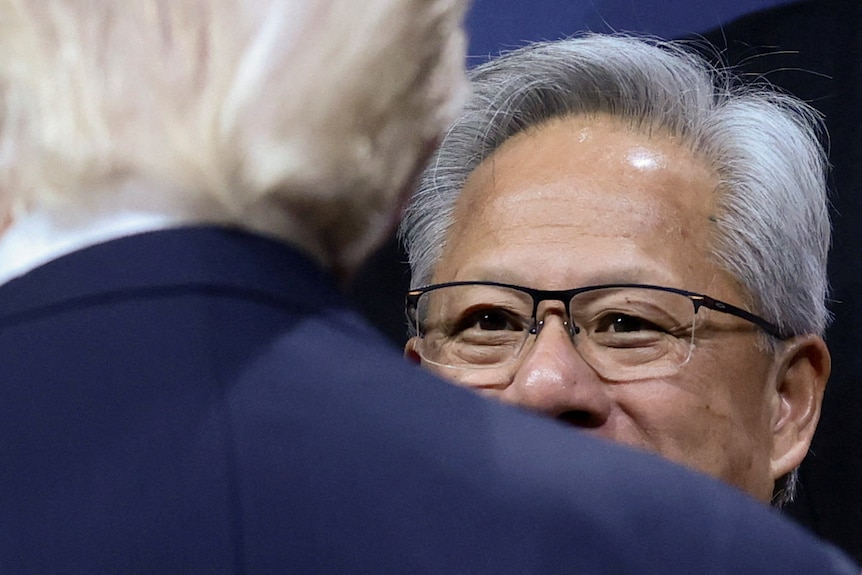
Donald Trump says his views on the risks and potential of AI align with those of Jensen Huang. (Reuters: Evelyn Hockstein)
When Trump called, he told Huang over speakerphone that he endorsed his stance and dismissed AI safety warnings as “a hoax”.
“I’m with you all the way … We’re going to lead,” Trump said.
Analysts say the exchange reflects a carefully forged relationship.
“Huang has been extremely savvy in cultivating a close personal relationship with Trump,” said Samuel Hammond, director of Artificial Intelligence Policy and chief economist at the Foundation for American Innovation.
“Trump, for his part, respects power and business success. Trump likes ‘winners’.”
AI experts and observers the ABC has spoken to agree the alignment between the US president and the head of the country’s largest AI company will have a far-reaching impact on how this cutting-edge technology is developed.
Huang has urged Washington to lift restrictions on sales of advanced AI chips to China, arguing that keeping Nvidia out only accelerates Beijing’s shift toward homegrown chips.
He contends that American firms should compete aggressively in global markets and accelerate development to preserve their edge over China, rather than being slowed by stricter safety regulation.
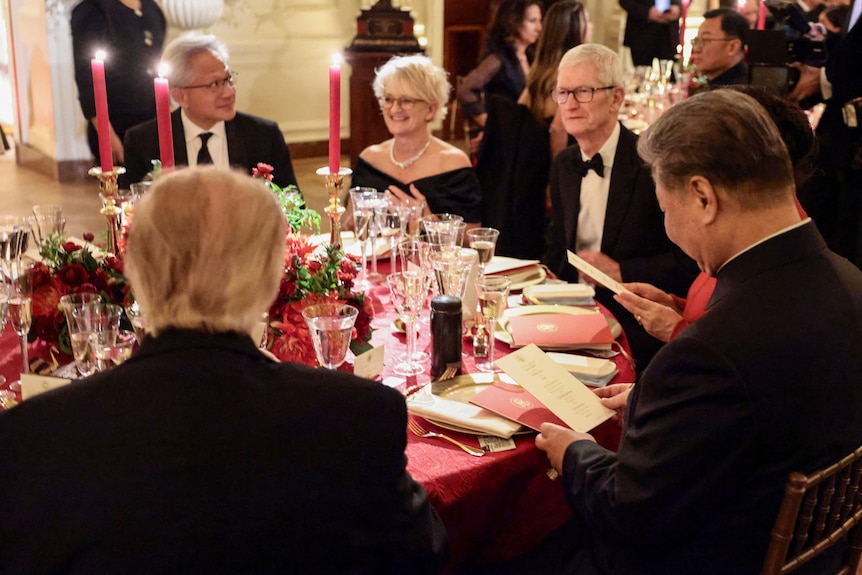
Jensen Huang dined with Donald Trump and Xi Jinping at the White House state dinner this week. (Reuters: Evelyn Hockstein)
Nvidia’s ambitions loomed over Thursday’s White House state dinner, hosted for the state visit of Chinese President Xi Jinping and attended by a long list of tech titans.
Earlier this year, Huang also joined Trump’s delegation to China, following a last-minute phone call from the US president after he noticed Huang had not been invited.
From dishwasher to AI titan
Nvidia is now valued at around $US5.4 trillion ($7.7 trillion), making it the world’s most valuable company as demand for AI hardware and data centres has skyrocketed.
It is a far cry from Huang’s humble beginnings. Born in Taiwan and raised in Thailand, he described a strict upbringing by his Taiwanese parents, to whom “nothing is ever good enough” and whose criticism was relentless.
But he said it was this highly “torturous” education that helped build his resilience in the face of sharp criticism.
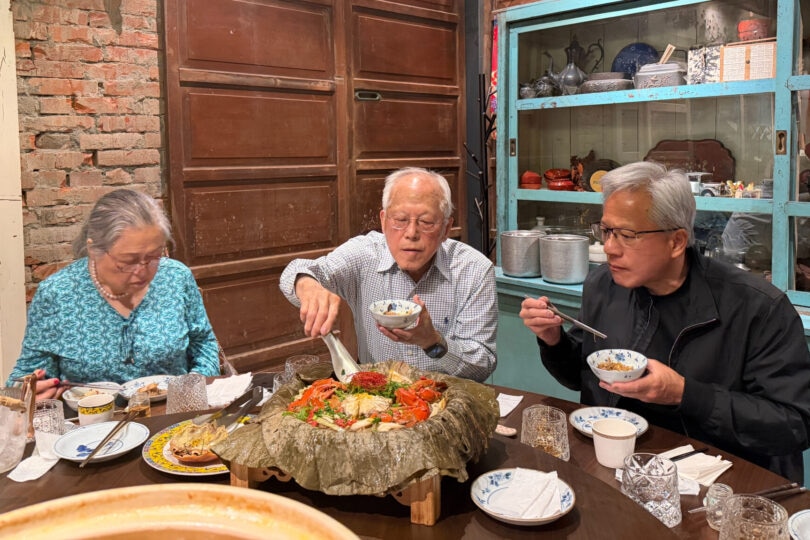
Jensen Huang said a tough upbringing by his parents instilled in him a drive to succeed. (Supplied: Nvidia)
It also shaped his leadership style at Nvidia, where he said he scrutinised everyone’s work to “help them be better”.
At the age of 10, he migrated to the US to attend boarding school, without his parents.
Five years later, in the 1970s, Huang took his first job washing dishes at a US fast-food chain, Denny’s.
He studied engineering while working part-time there, and by his own account, “worked hard”, to be promoted to busboy, then waiter. He remains so proud of that chapter that he kept it on his LinkedIn profile.
In a recent interview with CAN Media Agency, Huang revealed that he still worked seven days a week.
“Because I don’t want to fail, I don’t want Nvidia to fail,” he said.
His biographer, Stephen Witt, described him as “a propulsive, mercurial, brilliant, and extraordinarily dedicated man”.
Witt noted in his book, The Thinking Machine, that for Huang, AI was “a pure force for progress”.
“He doesn’t permit much disagreement on this topic, and his force of personality can be intimidating.”
A zero-sum game?
Huang characterised AI as the next industrial revolution and argued that whichever country had its technology adopted most widely around the world would win the AI race.
“The advance of human society is not a zero-sum game,” Huang told the BBC in September last year.
“President Trump is very clear. He wants America to win, and President Xi wants China to win, and it’s possible for both of them to.”
Independent AI researcher Andy Masley told the ABC he agreed with Huang “in some important ways but not others”.
“Both countries can benefit from AI, through medical and scientific research and useful commercial applications.
“However, I think both countries also have a strong interest in avoiding AI-related risk.
“Huang strikes me as an outlier among people in the field for strongly implying that the odds of really massive civilisation-level risks from AI are basically zero. Most of the leaders of the major AI labs disagree, as do many AI researchers.”
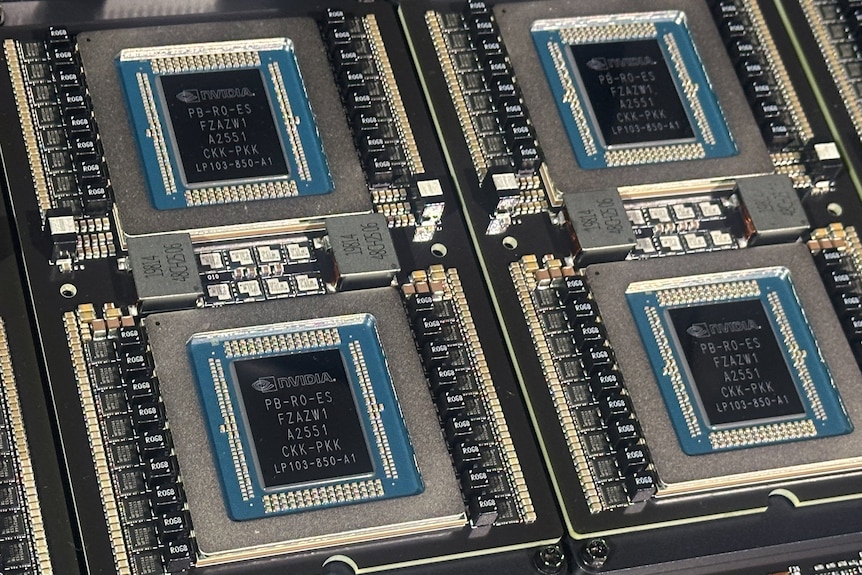
Nvidia is the world’s dominant producer of AI chips. (Reuters: Max A. Cherney)
Hammond, from the Foundation for American Innovation, said Nvidia had a dominant, near-monopoly market share in advanced AI chips outside China, and China was the only market capable of developing an indigenous competitor in the medium-to-long-run.
“Their interest in China is really about defending their long-term position in a growth market,” he said.
That is despite deep concerns expressed by US congressmen, including some Republicans, that the cutting-edge AI technology could power Beijing’s surveillance, censorship and military applications.
Hammond said he had “serious concerns” about Huang’s advocacy to sell his AI chips to China, which he argued would “undermine America’s fragile lead in AI by subverting export restrictions”.
Masley told the ABC that wider access to Nvidia’s most advanced chips would enable Chinese firms to build more capable AI, intensifying competitive pressure on American laboratories.
Currently, the most powerful Nvidia chips are banned from export to China due to measures imposed by Washington.
But last year, Trump approved Nvidia to sell its previous-generation H200 AI chips to approved customers in China, with a 25 per cent tariff.
Bargaining chip
Masley said Trump wanted trade concessions from China, conspicuous diplomatic wins and the preservation of America’s technological and national security advantages.
Experts say Washington also needs to carefully weigh the risk of Beijing tightening its grip on rare earths, which is critical to high-tech products such as precision-guided missiles and drones.
“Trump’s policies on AI chips are more like controlled technological interdependence,” said Chien-Yu Shih, an associate research fellow at Taiwan’s Institute for National Defense and Security Research.
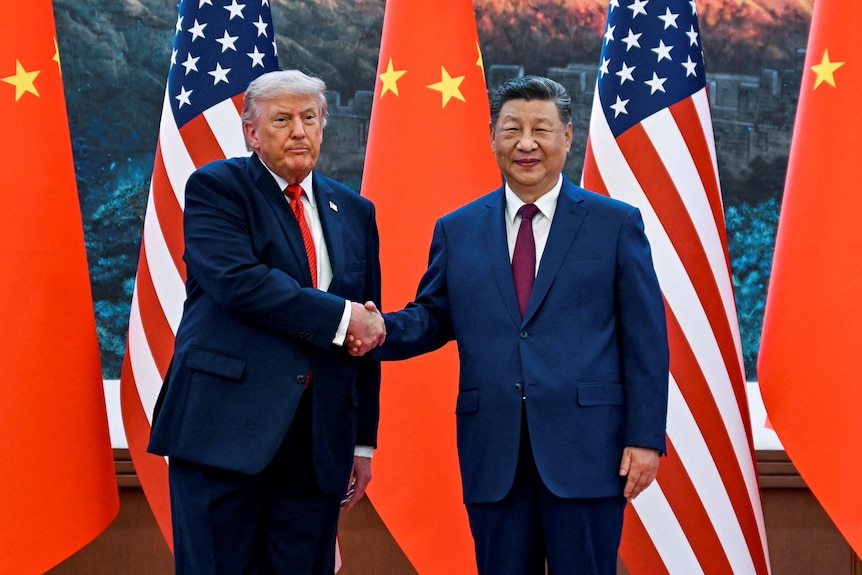
Donald Trump and Xi Jinping have met twice this year against the backdrop of a growing AI rivalry between the US and China. (Kenny Holston/Pool via Reuters, file)
Shih said the US was attempting two “seemly contradictory things”: to deny China the most advanced AI technology, without compelling Nvidia to withdraw from the Chinese market.
Nvidia doesn’t manufacture its own chips — it designs them and outsources the manufacturing to the Taiwan Semiconductor Manufacturing Company (TSMC) and other partners.
Shih believed relaxing the chip ban could also ease geopolitical tensions between China and Taiwan.
Yongfeng Li, a Hong Kong-based AI observer, said: “At its core, Jensen Huang is part of Taiwan’s semiconductor sector. He’s born in Taiwan; his chips completely relied on Taiwan suppliers.
“So long as the AI industry relies on Nvidia, it also relied on Taiwan. This is Taiwan’s biggest advantage, and a critical point for its geopolitics,” Li said.
An impossible equation
China is developing its own chip industry, led by Huawei and Alibaba.
Liang Wenfeng, founder of the leading Chinese AI model DeepSeek, told investors in July that he expected China to build its own AI ecosystem within five years.
However, he conceded that a lack of access to Nvidia chips was the biggest obstacle to DeepSeek reaching recursive self-improvement in its AI model.
Despite export restrictions of Nvidia chips, an international NGO report showed China had been circumventing the rules.
The report from Center for Advanced Defense Studies (C4ADS), based in Washington, documented Chinese universities purchasing 56 restricted Nvidia chips through intermediaries, while another 50 chip shipments diverted to China via Vietnam, India and Malaysia.
Many of Nvidia’s chips are manufactured in Taiwan, where Jensen Huang was born. (Reuters: Dado Ruvic)
Hammond criticised Nvidia for failing to do enough to curb the illicit use through Chinese shell companies and third countries but observed that as Nvidia became “a de facto king maker”, criticism of Huang was “fraught for anyone in the industry who hopes to remain in good standing”.
Trump, meanwhile, faces an almost impossible calculation: how many chips can be sold to China before the balance tips? Huang may prove to be the man who helps him decide.
“The irony of Trump’s admiration for Huang is that Huang is in some ways the archetype of a globalist tech CEO,” said Hammond, “precisely the sort of figure the America First movement should be against.”
The ABC has approached Nvidia for comment.