
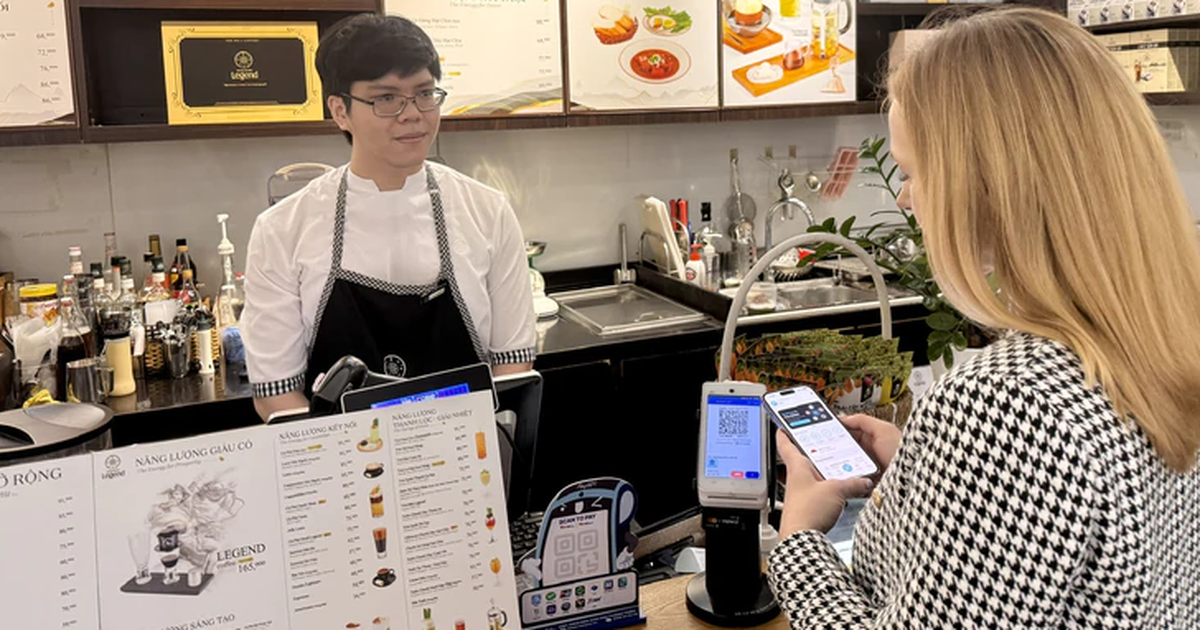
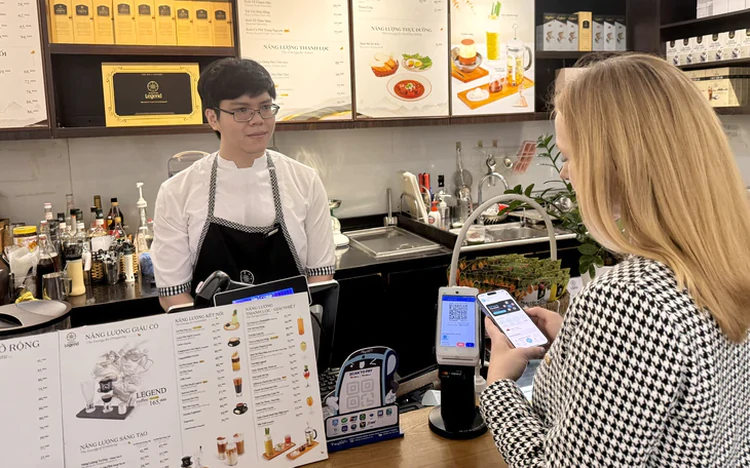
Payment acceptance points for international tourists remain limited. Photo: Tuoi Tre Contributor
The State Bank of Vietnam’s Payment Department, Vietnam National Payment Corporation (NAPAS), and Vietnam Economic Times held a seminar on promoting cross-border QR payments as a new driver for retail and tourism on Friday afternoon.
Speaking at the seminar, State Bank of Vietnam Deputy Governor Pham Tien Dung said the central bank is promoting bilateral retail payments via QR codes with several countries in the region and other key partners.
Expanding these connections will not only provide people and tourists with more convenient payment options but also help businesses, particularly small enterprises and household businesses, reach international customers more effectively, Dung said.
Along with expanding the network, he stressed the need to ensure security, prevent fraud, protect data and customers’ legitimate rights, and maintain smooth payment and settlement operations.
Cross-border payment expansion should be driven by actual economic demand and linked to tourism, trade, investment and payment needs between Vietnam and other countries and territories, Dung said.
Pham Anh Tuan, head of the Payment Department, said customers’ needs are simple. Vietnamese people traveling or working abroad want to use their familiar banking or payment apps.
Likewise, international visitors to Vietnam want to make convenient payments at hotels, restaurants, shops, tourist attractions, transportation services and small household businesses.
The complexity of the underlying infrastructure needs to be translated into a simple user experience, with clear requirements for payment capabilities, exchange rates, fees, security and support when problems arise, Tuan said.
For merchants, participation should also be easy to implement, with reasonable costs, transparent settlement and opportunities to reach more customers.
One of the key tasks ahead is expanding VietQR Global, Tuan said.
“Small traders and household businesses can add a VietQR Global identifier to their existing payment setup,” he said.
By accepting cross-border payments, small traders and household businesses can reach more international tourists, helping boost sales, production and revenue.

Chinese tourists visit Vietnam. China, South Korea and other markets are key sources of international tourists to Vietnam. Photo: Tien Thang / Tuoi Tre
Nearly 90% of Asia-Pacific tourists familiar with QR payments
Nguyen Dang Hung, deputy general director of NAPAS, said VietQR Global is not only a service but also an identifier for cross-border payments.
International tourists currently use three common payment methods in Vietnam: cards, cash and QR payments.
Notably, around 85-88 percent of visitors to Vietnam from the Asia-Pacific region are familiar with QR payments, making them a potential customer group as Vietnam expands cross-border payment services, Hung said.
Since 2021, NAPAS has connected Vietnam’s payment system with those of six countries: China, Thailand, South Korea, Singapore, Cambodia and Laos.
The network will be expanded to other Asia-Pacific markets, including Japan, India, Malaysia, Indonesia and the Philippines.
Pham Van Thuy, deputy head of the Vietnam National Authority of Tourism, said Vietnam’s key tourist markets include China, South Korea, Japan, India, Singapore and several Southeast Asian markets.
China was Vietnam’s largest source of international visitors, with around 5.28 million arrivals in 2025 and about 3.5 million in January-August 2026.
South Korea recorded around 4.33 million arrivals in 2025 and about 2.8 million in January-August this year.
India is also considered a market with significant potential.
International tourists have diverse spending needs, ranging from accommodation, food and transportation to admission tickets, local specialties, handicrafts, fashion, healthcare, nightlife and high-end products, Thuy said.
They generally look for convenient and fast payment methods, familiar options, transparent prices and invoices, security, and support when transactions fail or complaints arise.
“If they encounter payment difficulties, tourists may spend less or switch to another destination,” Thuy said.
Therefore, payment is not merely a matter of collecting money but also directly affects tourism revenue and visitors’ experiences in Vietnam.