

Rocket Lab launched another Earth-imaging radar satellite to orbit for the Japanese company Synspective on Friday night (Sept. 25).
The mission, called “Owlright, Owlright, Owlright,” lifted off aboard an Electron rocket from Pad B at Rocket Lab’s Launch Complex 1 in New Zealand on Friday at 8:39 p.m. EDT (0039 GMT on Sept. 26).
Everything went well: The satellite was deployed into low Earth orbit (LEO) as planned, Rocket Lab announced via X.
Electron launches for the 97th time and deploys the latest StriX satellite to space for @synspective from Launch Complex 1.Highlights from today’s mission:✅Launched on 1st attempt✅18th mission of the year✅13th launch for Synspective with 100% mission success pic.twitter.com/oZUNlUuVrmSeptember 26, 2026
It was the 13th Strix satellite that Rocket Lab has delivered to orbit for Synspective, which is building a constellation of synthetic aperture radar (SAR) spacecraft to collect Earth-imaging data for municipality management efforts around city planning and infrastructure, as well as natural disaster response.
Owlright, Owlright, Owlright was Rocket Lab’s 97th launch overall, and its 18th so far in 2026. This mission brings Electron’s 2026 total to 15, with three other launches this year of Rocket Lab’s suborbital HASTE rocket rounding out the sum.
You may like
Electron is Rocket Lab’s workhorse launch vehicle. It stands 59 feet tall (18 meters), and sports a launch capacity to LEO up to 661 pounds (300 kilograms). Synspective’s Strix spacecraft weigh about 220 pounds (100 kg) each, and expand to a lengthy 16.4 feet (5 meters) wide after SAR antenna deployment.
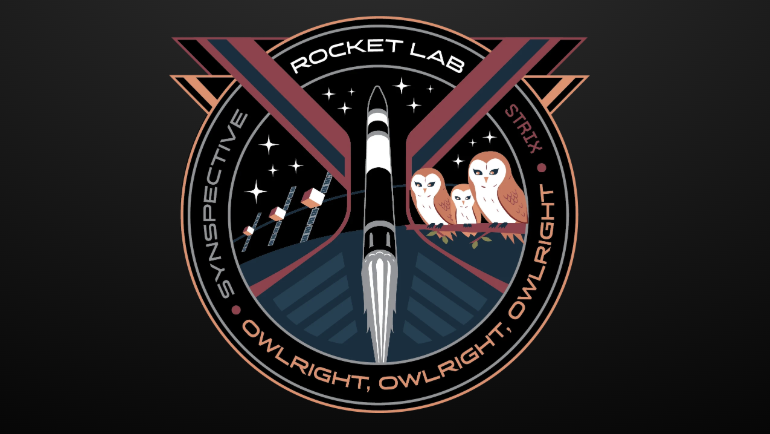
The patch for Rocket Lab’s “Owlright, Owlright, Owlright” mission. (Image credit: Rocket Lab)
Rocket Lab has committed to launching the entirety of Synspective’s Strix constellation, which aims to deliver 30 spacecraft to LEO by the end of the decade. Living up to their namesake — Strix is a genus of owl — the SAR satellites are designed to collect Earth-observation data even in poor lighting conditions, and can peer through cloud cover to study the ground below.

As the constellation expands, each Strix satellite has been delivered to a slightly different orbital destination. Electron sent the Owlright, Owlright, Owlright payload into a 37-degree orbital inclination, deploying it at a LEO altitude of 347 miles (559 kilometers).
Editor’s note: This story was updated with news of successful launch and satellite deployment at 2:45 a.m. ET on Sept. 26.