
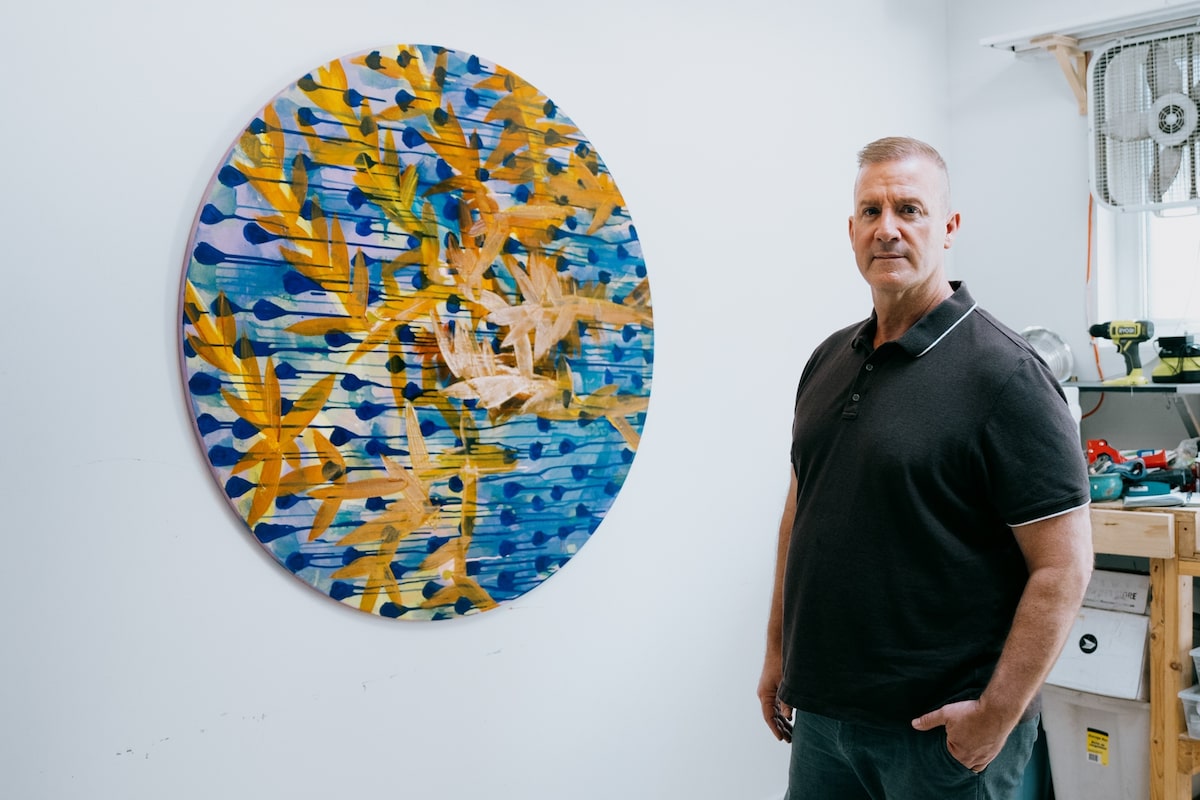
Cree-Métis artist Jason Baerg and their husband and collaborator, Antonio Rodriguez Garcia, pose in Baerg’s Toronto studio on Sept. 23. Baerg said their income could be ‘dramatically’ reduced if they’re unable to teach across the border because of the trade war.Joel Rodriguez/The Globe and Mail
Toronto-based Métis artist Jason Baerg has studied in the United States, taught in the United States and sold artwork in the United States. Until President Donald Trump imposed 50-per-cent tariffs last month on made-in-Canada art crossing into the United States, modern-day borders had rarely been a professional imposition.
But those tariffs have thrown the art market into chaos, forcing artists, dealers, gallerists and shipping companies to rethink how they work as U.S. sales grind to a halt. For Indigenous artists such as Baerg, the tariffs add unnecessary and insulting complexity to the task of making a living through art.
“It’s really disconcerting, because we don’t really recognize the federal borders between Canada and the United States, the colonial states of Turtle Island,” said Baerg, a registered member of the Métis Nation Saskatchewan. Their practice involves digital interventions in painting, drawing, installation, fashion and performance.
“It’s a real rupture in the movement of who we are as people, of the exchange of our knowledges, of our opportunities to share and learn teachings, as well as the movement of our cultures through arts.”
Baerg stands beside a work in progress for an upcoming show at Fazakas Gallery in VancouverJoel Rodriguez/The Globe and Mail
Baerg said they were able to teach over the last decade at the Institute of American Indian Arts in New Mexico under the auspices of the Jay Treaty of 1794, which declared that Indigenous peoples and their personal goods were free to cross the U.S. border. The artist believes this should continue to apply during the current trade war, including to artworks. As it stands, their income could be “dramatically” reduced.
The Jay Treaty is rife with complexities, however. It predates the existence of Canada and was signed by Great Britain. The Supreme Court of Canada decided 70 years ago that it should not be enforced in the present-day country.
To Baerg, that shouldn’t matter. “We are all treaty people,” they said. “You have to honour that.”
Carver and sculptor James Hart of Haida Gwaii, also known as Chief 7IDANsuu, said the Jay Treaty has allowed him to visit neighbouring communities in Alaska from B.C. But he was unsure how it might now apply to carrying artworks across the border, given Trump’s imposition of tariffs after years of free-flowing art between the two countries.
“It’s terrible, actually, how it could be switched around,” Hunt said. “Artists have got to make a living. If we’re getting held up because of that, it’s pretty terrible.” He said he recently got an order for a large sculpture from a buyer in California, but worries whether it’ll be able to cross the border. “It was going to be my next payday for a few years.”
Many artists from First Nations, Métis and Inuit communities have been disproportionately affected by the trade war since Trump took office for the second time in 2025. The first blow came during an initial round of cross-border art tariffs early last year. That was followed last August by the axing of the de minimis tariff exemption on shipments to the U.S. worth less than US$800.
Liz Barron, Winnipeg-based Métis director of the Indigenous Curatorial Collective, a non-profit that promotes Indigenous creative sovereignty, said that move had already harmed artists who sold works such as beaded earrings. With new 50-per-cent tariffs on top of duties, Barron said, a $200 pair of earrings could skyrocket in cost to $400 when crossing the border.
Artists who don’t have the assistance of a professional gallery to sell their work also face the administrative burden of navigating these changes. “It takes them away from creating work or selling other work,” Barron said.
The latest round of tariffs on products entering the U.S. also applies to fur products, bone, horns and other animal products that artists from some Indigenous communities often use in their work, such as carvings or mixed-media sculptures. If that kind of work crosses the border, would the artwork be tariffed, the components tariffed, or both? It’s hard to find brokers willing to help figure that out, Barron said.
The pair work on a design from Baerg’s ‘Rainbow, Luminosity and the Dream’ collection, presented at Indigenous New York Fashion Week.Joel Rodriguez/The Globe and Mail
Works made with animal products were already difficult to get across the border, said William Huffman, executive manager of West Baffin Eskimo Cooperative, a studio with 125 artist members based in Kinngait, Nunavut.
Work from the co-op can be found everywhere from airport souvenir shops to the Venice Biennale, though Huffman says its true niche is drawings and prints. The co-op pays its artists for their work upfront, and for many of them it’s their sole source of income. About 25 per cent of that work has been sold into the U.S. in recent years.
To make up for lost sales to the United States, “we would have to look at cultivating markets, or stimulating markets we’ve already developed,” Huffman said.
That would likely mean going overseas – a more expensive proposition than shipping artwork south, but something artists, managers and gallerists across the country are contemplating.
Losing the U.S. market also means losing both long-standing relationships and cultural exchanges that are important to Indigenous artists.
“We’re at this really great moment where Indigenous voices are getting some play,” said LaTiesha Fazakas, owner and director of Fazakas Gallery in Vancouver, which focuses on contemporary Indigenous art.
“Canada has been at the forefront of that,” she added.
But she worries the cultural dialogue could slow down if Canadian works don’t make it into the United States. Before Trump’s re-election, 30 per cent of the art at Fazakas’s gallery was sold to U.S. buyers. The number has fallen to “virtually zero,” she said. “The upside is we have found that Canadians are buying Canadian.”
The artists she works with are doing okay for now, “but we’d also like to prosper. We don’t just want to hold on tight.”