
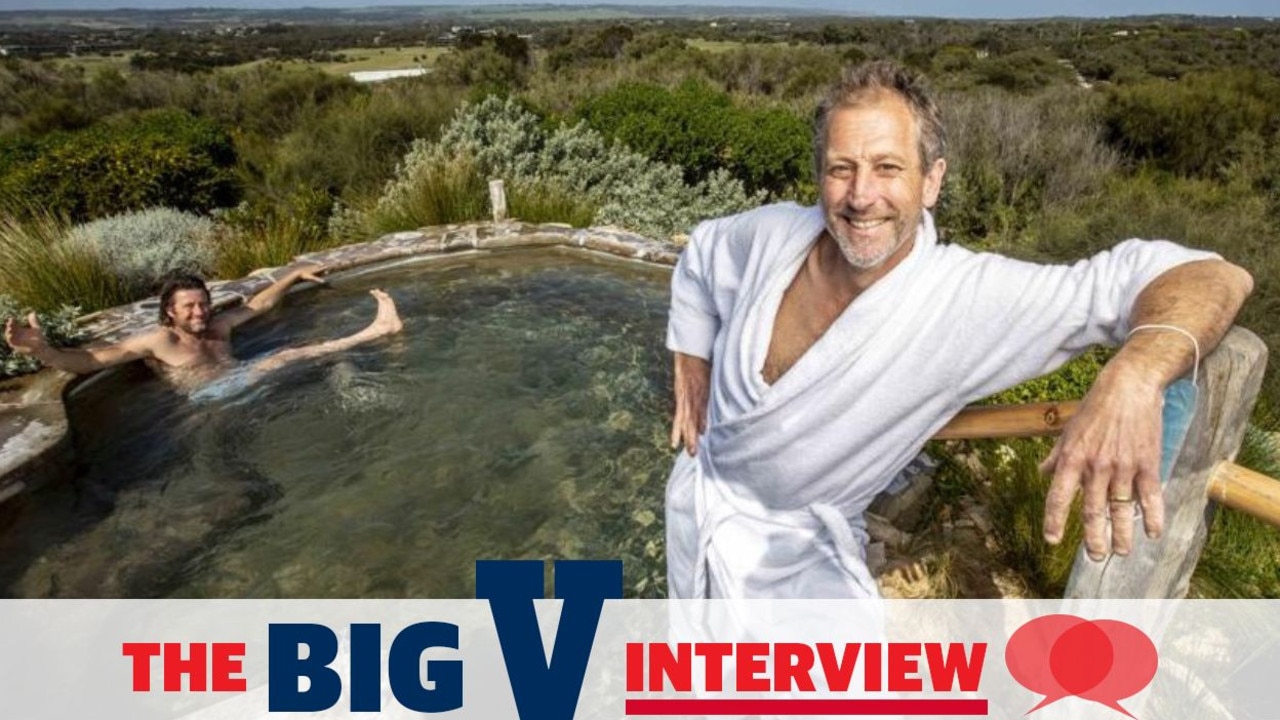
The godfather of thermal bathing in Victoria, Charles Davidson, describes his decision in the 1990s to pursue a hot springs venture as a “Jack and the beanstalk moment”.
“My wife and I had just got married … and we could dig a hole in the ground or we could build a house,” he says.
“It was sort of like the beans or the cow.”
They chose the beans, and after eight years of blood, sweat and tears — which coincided with the arrival of their four children — a Victorian tourism powerhouse was born.
This bubbly fifth offspring, Peninsula Hot Springs, has just turned 21 years old and now hosts half a million people a year, but is still growing.
Davidson sat down for the Big V Interview with Matt Johnston to discuss the ancient culture of bathing, how the recently established Great Victoria Bathing Trail is driving more visitors to the state, and his family’s curious historic link to Napoleon Bonaparte.
A DREAM BUBBLES UP
Davison could talk underwater about balneotherapy — the use of thermal baths for therapeutic purposes.
But there’s something more basic about the hot springs experience that he says has felt since taking a plunge in a Japanese onsen in the early 1990s.
And it easily doubles as a sales pitch for the antidote to today’s busy 24/7 world.
“We operate a reality experience in an increasingly virtual world,” he says.
“You literally have to immerse yourself in the water.
“Nothing has become more true as AI has evolved, and bathing into nature gives people a real down to earth experience, that you can’t ask a robot to do, and you can’t ask AI to do.
“Wake up and be present, get off the device and be in life.”
His initial onsen experience, under a mountain in rural Japan, came while Davidson was working at a trading company in Tokyo in his 20s.
His first thought was “why don’t we have this at home?” but it wasn’t until he had a very Aussie catch-up with a diplomat a few years later that he began to envisage a local option.
“I was having a VB with the head of the Victorian State office,” he says.
“He said, ‘you’re a bit entrepreneurial to be a diplomat, what’s your dream?’ And I said, ‘I’d love to build a hot spring in Australia’.”
Davidson learnt that the government had done test drilling in Victoria in the 1970s and had hit upon hot water, and that maps of the natural resources existed.
The senior diplomat had been sent the report, which governments had hoped would attract Japanese investors to Victoria, and which showed vast reserves of geothermal mineral water deep underground.
“Nothing came of it in terms of getting investors from Japan; but, in fact, 14 years after receiving the report we found an Australian investor in Japan,” he says with a laugh.
“Some other people had actually tried to do something here (in Victoria) but they didn’t get very far.”
Further north, he explains, Australia sits above the Great Artesian Basin where water from Papua New Guinea flows deep underground.
On the Mornington Peninsula the water is more than 630 metres underground and is an endless renewable resource if extracted sustainably.
Once he learnt the water was there, Davidson started to look at land in Fingal.
His brother, Richard, sold his florist business and in 1997 they were all in.
The Peninsula was well known to the family, whose ancestors were original inhabitants of the historic homestead The Briars, in Mount Martha.
Davidson’s ancestral links include a who’s who from Australian history, such as the first colonial treasurer of Australia, William Balcombe, as well as the first non-Englishman to win Wimbledon, Sir Norman Brooks.
Tales from Balcombe’s life, which included a stint on the remote island St Helena while working for the East India Company, inspired Davidson’s love of travel and trade.
This included the story of when Napoleon Bonaparte arrived on St Helena, following his exile after the Battle of Waterloo, and found that his rat-infested lodgings needed major renovations.
“He was looking for a place to stay, and he walked around and saw this property on a hill and it just happened to be William’s house,” Davidson says.
“Napoleon stayed in their garden bungalow known as the Pavillion for seven weeks, and got to know the family very well.”
Although he could have pursued a career in trade himself, Davidson says the dream of creating a hot springs venture kept bubbling to the surface.
“Once it gets hold of you, as an entrepreneur or somebody with a passion, you just follow it,” he says.
“It dominates your life.”
FROM HOT MUD TO A SOUTHERN SPRING
There is a photo on the wall of Peninsula Hot Springs that shows Charles and Richard Davidson outdoors in a yellow plastic bath tub.
It was snapped when they first purchased the land, in 1997, anticipating drilling for thermal springs the following year.
While the first extraction pipes broke underground and spat out hot mud instead of mineral-rich water, it showed what was possible, and they decided to pursue planning permits and secure investors before spending more money.
“People were just fascinated. They thought we were mad,” he says.
After years of talks at rotary and probus clubs about their “crazy dream” the brothers found willing backers and drilling recommenced — slowly.
“It was one of the toughest things, because you knew that the job should have only taken two to three months, but the drilling cost us years of our lives,” he says.
“We had some investors at the start … but after about 10 months they just said, look, we can’t wait any longer, which we felt was totally fair enough.”
“It was very painful for us.”
In 2002, 18 months after starting drilling, they hit liquid gold — 54 degree natural geothermal mineral water.
“The next challenge was to find the money (again), because we’d lost the initial investors,” he says.
Enter former peninsula mayor Bill Goodrem and his wife Joan, who arrived at their home with a bottle of sparkling wine to celebrate the discovery of the thermal springs.
The Goodrems introduced the Davidsons to Norm Cleland, who had lived in Japan and whose wife was Japanese.
Cleland’s brother had the capital they needed, but he wanted Norm to be involved.
“He became our first general manager, which was perfect, because we hadn’t run a company with a lot of staff,” Davidson says.
“We got the letter of the money coming through on the day that our daughter, our fourth child, was born.
“Chiara is her English name but her Japanese name is Nami, which actually means southern hot spring.”
In 2005, the Davidsons opened the Spa Dreaming Centre at the Peninsula Hot Springs.
“It did take us eight years and we went from having one child to four children in that time and I still didn’t have a paying job,” he says.
“There were a number of occasions during those eight years, I thought, ‘what am I doing?’
“‘I’ve got all my kids growing up, they have to go to school’ and we hadn’t even hit the water.”
A DEEP HISTORY AND NEW AGE HEALING
Thermal bathing has a rich global history that stretches back millennia, from ancient Roman baths and Turkish hammams.
In rural Iran entire towns are centred around hot springs and healing, while fire and ice treatments in Scandinavia and Russia have fascinated visitors for centuries.
Davidson has travelled to most corners of the earth to soak it all in and bring back elements to Australia – his original cold plunge pool was built after doing a sauna and ice plunge in Moscow.
“We used to jump in the hot spring, then you roll in the snow. And that contrast is so invigorating, so enlivening, you never feel cleaner or fresher.
“This is why it’s such a good business for Victoria, because of the four seasons in one day. The cooler it is, the better the experience.”
This winter, for example, the site is leaning into the cold with its “seek the heat” night events that include “chakra-inspired colour, restorative sound and warming heat”.
From the outset there was a specific intention of leaning into the diversity of people in Melbourne, where they knew most customers would come from.
“Since our inception, we’ve held the intention of creating community through the bathing experience, and we have done that with a lens of multiculturalism.
“Bathing is something that every human does … it is something that can be universal and connecting.”
A deliberate decision was made to have “humble architecture” to allow bathers to appreciate “you’re right in the middle of nature”.
“What is this business about? It’s about creating space for people to relax in nature with themselves and each other and connect with the deep well of their being.”
Half a million people now visit the site, which has added 20 rooms for overnight stays, as well as amphitheatres and pools spread across vast swathes of the property’s 42 acres.
There are currently more than 320 staff, but if options for up to 116 more rooms are ever realised it would drive even more jobs and visitors.
Davidson is also helping to drive a national bathing culture and the establishment of a Great Victorian Bathing Trail, directing people where they could be immersed in hot water between Metung and Warrnambool.
He’s provided advice for operators in southwest Queensland and other parts of Australia, and would “like to see the trails grow right across the country”.
“We’re trying to bring people on good experiences and good journeys,” he says.
“Victoria has the natural advantage. We don’t have our big iron ore deposits (but what we have) is a natural renewable resource that will go on forever as long as it’s looked after and sustainably yielded.”
Davidson actively promotes the health benefits of the hot springs culture, through the doctor-driven world Federation of Hydrotherapy and Climatotherapy (FEMTEC) and work by good friend, Professor Marc Cohen.
As a result, Peninsula Hot Springs had been considering integrating with health services to provide options for post-operative patients or those treating stress, anxiety, or rheumatoid arthritis.
“Hot springs are incredible at easing arthritic pain, providing relief that can last days, but it’s not a cure,” he says.
While there’s “clear evidence” between hot springs and improved sleep and mental health outcomes, according to Davidson, the reasons for this are multifaceted.
“Partly it can be the minerals in the water and the natural environment, but it’s also the socialisation, the communities coming together that delivers outcomes,” he says.
OFF THE RECORD
What was your first job and pay?
A paper round in 1979, when I was 14. I earned $11 a week delivering newspapers five mornings a week. My first full-time job after university was with Mitsubishi Australia, exporting Australian dairy, grain, fruit and vegetables to Asia and importing products such as cheese, instant noodles and Sirena tuna. Starting salary was $36,000 plus a Mitsubishi company car.
If you weren’t doing this job, what would you be doing?
I probably would have joined another Japanese trading company such as Mitsui, Sumitomo or Marubeni. My career changed when I lived in Japan in 1992 and discovered the country’s hot springs culture.
Five people you’d invite to a dinner party (dead or alive)
Napoleon Bonaparte — My ancestors, the Balcombes, hosted Napoleon for two months at The Briars on Saint Helena after Waterloo. I’d love to hear his side of history.
Dame Edna Everage (Barry Humphries) — One of Australia’s greatest comedians. I could happily listen to Barry’s wit all evening.
The Dalai Lama — His humility, wisdom and gentle humour are remarkable. After hearing him speak about hot springs, I later visited Dharamshala to learn more about Tibetan bathing traditions.
What’s a book everyone should read
‘Good to Great’ by Jim Collins. It highlights the importance of great teams, discipline and focusing on what you’re passionate about while ensuring it can also create lasting value.
If you could live anywhere in the world besides here, where would it be?
I’d split my time between Japan and Australia. Japan’s food, skiing and hot springs keep drawing me back, and I enjoy living between different cultures.
What was your first concert and dream concert? (dead or alive)
First concert: Sammy Davis Jr at Festival Hall. He was an extraordinary entertainer, and meeting him afterwards made it unforgettable.
Dream concert: The Australian premiere of The Planets by Gustav Holst in Melbourne in 1925, organised by my great-aunt Louise Hanson-Dyer. It would have been wonderful to experience such an important moment in our family’s cultural history.
Who is the most inspirational living person?
David Attenborough — for his curiosity, conviction and lifelong commitment to inspiring people to care for the natural world.
What advice would you give your 18-year-old self?
When something clearly isn’t working, move on. Don’t waste time hanging on.
And don’t collect so much stuff. Own fewer things, but choose them well.
What was your first car, current car, dream car?
First: Second-hand Mazda 323.
Current: Volkswagen Amarok.
Dream: A practical hybrid that combines efficiency with adventure.
One thing people didn’t know about you/hidden talent?
When time allows, I paint using natural ochres I’ve collected from hot springs around the world. Each colour reminds me of the place it came from and the journey behind it.
What’s the best and worst birthday present you’ve ever received?
The gift I remember most was actually a Christmas present from my great-grandmother — a foam surfboard when I was about six.
Do you have a rainy day TV binge show?
David Attenborough documentaries with my wife.
What’s a song you get pumped up to?
“Hey Baby” by DJ Ötzi. It became the soundtrack to countless family road trips with our four children.
What’s your death row last meal?
Either a traditional roast leg of lamb with roast potatoes, peas and onions (with mint jelly) — or tonkatsu with shredded cabbage and Bulldog sauce.
What’s your biggest career regret?
Not having a crystal ball to spot problems before they appeared.
What’s the best piece of advice you’ve received?
“Be yourself. Everyone else is already taken.”
What are you looking forward to most this year?
Completing a number of important projects so there’s space for new ideas and new creative challenges
The one thing you’d love to change about Victoria/Victorians?
I’d love to see more Victorians embrace bathing culture as a simple way to improve health, wellbeing and connection with others.
The one thing you love the most about Victoria/Victorians?
Victoria’s cultural diversity. It enriches our food, arts, communities and everyday life, and shows how multiculturalism can strengthen society.