
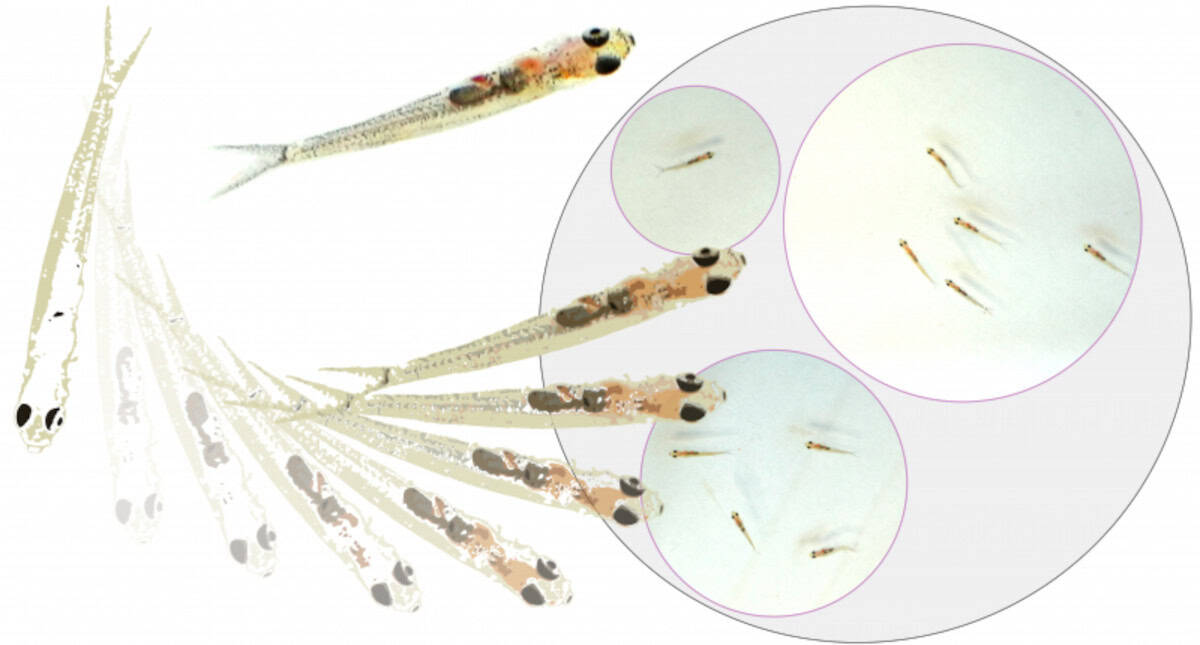
Researchers at the University of California San Diego have uncovered new insights into how schooling fish move.
The team was able to identify fundamental copying behavior that orchestrates collective underwater movement. The team published its findings in Physical Review Letters; the study examined schools of miniature, transparent glassfish (Danionella cerebrum) to determine how individual neural choices generate group synchronization.
Individual Copying Behaviors
The study examined schools of miniature, transparent glassfish across various developmental stages to determine how individual neural choices generate group synchronization. Conventional models historically assumed that fish adjust their swimming trajectory to match the collective average heading of their neighbors.
However, computational modeling and virtual reality testing revealed that individual fish actually mimic the directional turn of a single, randomly chosen peer. When one swimmer completes a turn, it creates a brief window of opportunity for adjacent companions to quickly follow suit.
Mapping Brain Signals Are Key
Commenting on the discovery, co-author Johnatan Aljadeff, an associate professor in UC San Diego’s Department of Neurobiology, stated:
“Identification of these precisely timed social interactions, together with improved technologies for brain-wide neural imaging, will advance our understanding of how processing in the brains of individuals supports collective behavior.”
Assistant Professor Matthew Lovett-Barron, also with the Department of Neurobiology, emphasized the neurological significance of using the naturally see-through species:
“The findings in this paper open exciting new opportunities for understanding how the brains of these fish pay attention to each other and copy each other’s actions. Each fish is sensing and responding to their social partner’s actions at discrete moments in time, and performing a specific mental computation. Since we can record across the brains of these transparent Danionella fish, we can start to uncover how their tiny brains achieve this. We hope to ultimately understand how complex collective behaviors like schooling emerge from the brains of many interacting animals.”
You can read the original research in the Physical Review Letters for more information.