
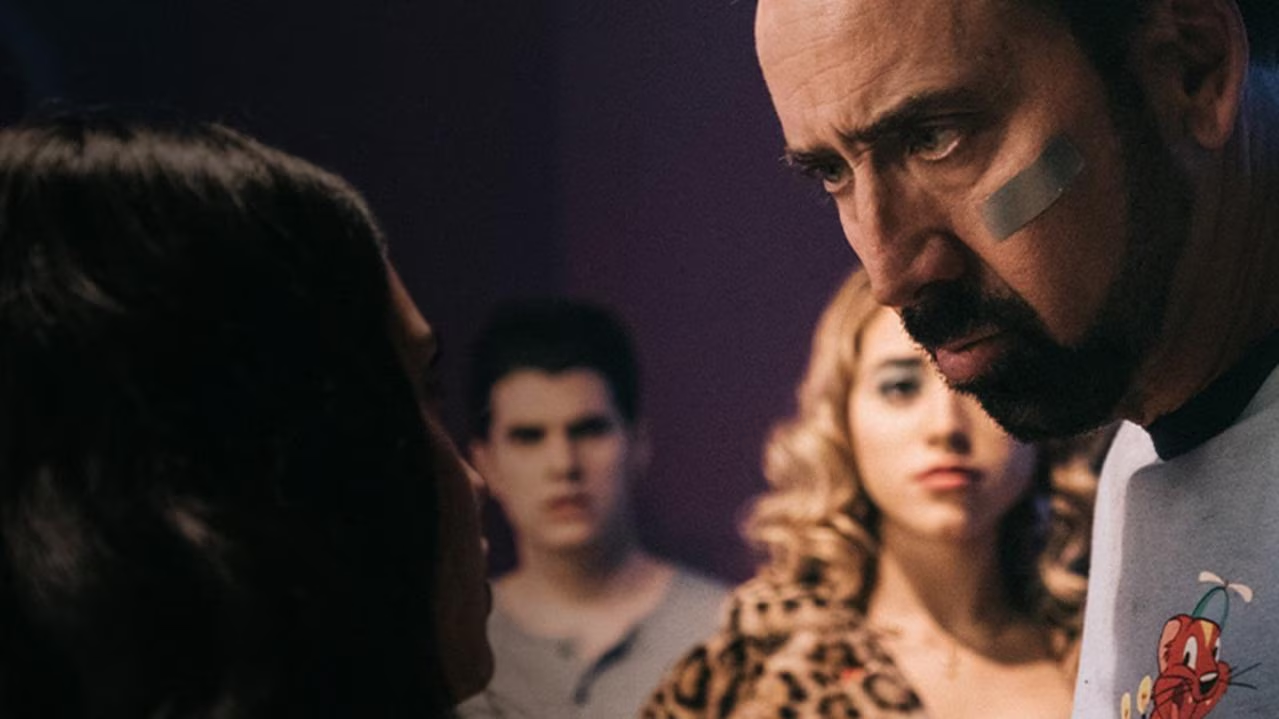
Imagine silent-film star Charlie Chaplin surrounded by the Muppets in a blood-drenched nightmare, and you have Nicolas Cage in Willy’s Wonderland.
The 2021 film, which sees Cage’s unnamed alter ego silently battling ghoulish animatronics in an abandoned family party venue, may be the Oscar winner’s strangest project yet. That is a big call considering he ate a live cockroach while playing an increasingly unhinged publishing executive in the 1988 comedy Vampire’s Kiss and became the subject of endless internet memes for his hammy role in the 2006 remake of The Wicker Man – clearly not to be confused with Alexander Skarsgård’s sexy basket-made charmer in the 2026 rom-com Wicker.
Obsessed with entertainment news? Download our new app and never miss a headline
In Willy’s Wonderland, Cage stars as The Janitor, a quiet drifter tricked into cleaning a cursed family funhouse. What makes the film uniquely bewildering isn’t just its B-movie premise but Cage’s total refusal to engage with it like a traditional horror protagonist. There are no bloodcurdling screams, grunts of pain, or playful, action-hero one-liners. There is only absolute, unyielding silence (and some creepy yet chipper background music).

During a Reddit Ask Me Anything interview, Cage revealed that stripping the character of speech was his own artistic choice.
“The dialogue for my character in Willy’s Wonderland was very sparse, so I decided with Kevin [Lewis], the director, to go full Harpo Marx and take all the dialogue out because I thought that would be a fun acting challenge to see how much I could communicate without words and only with movement and facial expressions,” he explained.
“I’m very happy with the results … It was a good experiment.”
(Willy’s Wonderland is available to stream on Tubi)
To fully grasp the surreal nature of the performance, you need look no further than the film’s infamous pinball sequence. Midway through the night, after violently beating a demonic, bloodthirsty robot ostrich to death with a broken mop handle, The Janitor doesn’t pause to hyperventilate, question his sanity, or even run from the building in terror. Instead, the digital alarm on his wristwatch goes off, signalling his mandatory work break.
He nonchalantly struts to the break room, chugs an energy drink, changes into a fresh shirt, and steps up to a pinball machine. For nearly two unbroken minutes, The Janitor focuses on playing the game – gyrating in complete sync with the neon lights, entirely unbothered by the trail of mechanical gore surrounding him. Then, break over, he returns to wiping surfaces and battling deranged puppets.
For long-time Cage devotees, this oddball turn comes as no surprise. On screen and off, he has always marched to the beat of his own drum. Hailing from the legendary Coppola filmmaking dynasty, he changed his name to carve his own distinct path, consistently refusing to conform to typical Hollywood leading-man cliches.
Although he does have an enviable collection of flashy sports cars, Cage famously channelled his earnings into buying (and then returning) a nearly 70-million-year-old dinosaur skull, briefly acquiring a haunted New Orleans mansion previously owned by serial killer Madame Delphine LaLaurie, and reserving a pyramid-shaped tomb for his eventual burial.
His work ethic reflects that same eccentric, uncompromising commitment. Rather than resting on his Leaving Las Vegas laurels, Cage approaches every role – from prestige indie dramas to schlocky horror – with the same unblinking intensity. Willy’s Wonderland stands as a perfect example of this approach.
By stripping away dialogue, Cage leaves the audience with nothing but The Janitor’s physical presence and hypnotic eyes. And let’s just say you will never listen to The Wiggles performing Heads, Shoulders, Knees And Toes quite the same way again.
(Willy’s Wonderland is available to stream on Tubi)