
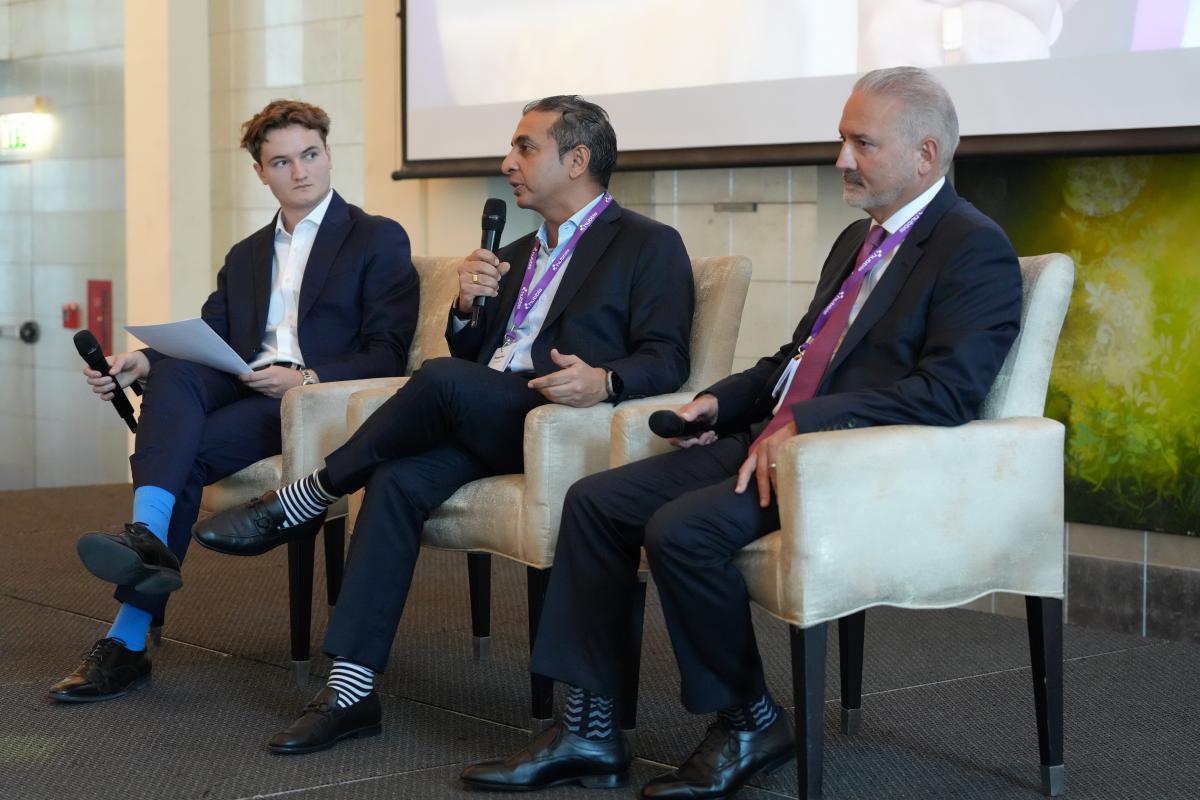
Family offices in the Gulf are becoming more numerous, but an office does not become an institution merely by acquiring a structure, a portfolio or an investment team. At the third panel of the Hubbis Middle East Private Capital Forum 2026, the more demanding question was how entrepreneurial wealth can be governed and invested for a family that will change across generations.
The answer begins with a purpose for shared capital. That purpose shapes the family’s decision rights, the separation of business and investment assets, the people it hires and the risks it can afford to take. The region offers a growing pool of professional talent and supporting infrastructure; the harder transition is from the founder’s judgement to a mandate others can understand and sustain.
Chair: Garett Stanhope, Senior Associate, Hubbis
Panellists
Prateek Pant, Market Head, Middle East & Africa, ASK Private Wealth
Rossen Djounov, Managing Director and Head of Client Solutions, Middle East & GFI, GAM Investments
Key Takeaways
Institutionalisation is a long transition from founder-led decisions to agreed mandates, defined authority and governance that can survive a change of generation.
A common investment policy can protect the family pool while individual members pursue separate businesses, property or higher-risk ideas with their own capital.
The office’s ownership, legal and cross-border arrangements should be settled before investment hiring and portfolio construction drive its shape.
A standalone team must justify its cost. Scale, access to opportunities, the family’s needs and the economics of recruiting a CIO determine what belongs in-house.
Preserving wealth calls for diversification even when its founders succeeded through concentrated risk. Gold and property should have deliberate roles alongside financial assets.
Technology makes fragmented holdings visible and supports research and reporting; it cannot replace a family’s agreement on purpose, risk or accountability.
Governance Has to Outlive the Founder
A founder can make investment decisions quickly because the wealth, the business and the authority to act are closely held. As the family expands, that arrangement becomes more difficult to pass on. Institutionalisation means giving the capital a purpose, assigning decision rights and building a process that remains credible when later generations have different views. The transition can take years; it cannot be accomplished by registering an office or appointing a portfolio manager.
An investment function is itself a business. “It requires massive infrastructure, it requires talent, and most of all, it requires governance,” a panellist said. People must know which assets they oversee, who can authorise a decision and how performance will be judged. Even a strong investment team cannot compensate for an unresolved family mandate.
The progression from entrepreneurial founder to diversification by the second generation and a more formal office by the third is a useful pattern, not a timetable. Some established families are already focused on philanthropy, impact and succession as well as returns. Others remain closely tied to the original business. The Gulf’s regulatory platforms and internationally experienced talent can support either, but the family must accept the discipline of governance and the value of independent expertise.
One Family, Several Investment Appetites
“Meeting one family office means you’ve only met one family office,” a panellist observed. The same diversity exists within a family. Members may disagree on growth, preservation, property or a new venture, particularly when some created the wealth and others will inherit it. Treating every personal ambition as an instruction for the common portfolio makes the office’s purpose unstable.
An agreed investment policy statement (IPS) can distinguish the shared pool from an individual’s capital. It can specify the family’s objectives for growth, preservation and transfer, and give its advisers a mandate against which choices can be assessed. Family members may then use distributions or their own accounts to pursue a business, a property purchase or a concentrated technology investment. The common pool does not have to absorb each idea to keep the next generation engaged.
That distinction preserves some of the founder’s appetite for opportunity while protecting assets held for everyone. It also makes succession a continuing conversation about whose capital is at risk and who has authority to commit it, rather than a last-minute handover of a portfolio.
Build the Office Before Filling the Portfolio
For families that once invested from the same company that housed an operating business, a sale or other liquidity event changes the problem. Capital intended for investment needs a clearer home, ownership arrangement and reporting line. The location of assets and of relatives living abroad can affect the legal and tax questions the family must resolve. A suitable vehicle should follow those facts, with specialist advice, before its investment mandate is populated.
“Investment is like the icing on the cake,” a panellist said. The remark captured a practical order of work: settle what the office is for and how it operates, then choose investments. Regional centres such as the Dubai International Financial Centre (DIFC) and Abu Dhabi Global Market (ADGM) offer possible structures, but the right one depends on the family’s circumstances.
The first person brought inside may therefore be a trusted operator rather than a chief investment officer (CIO). Someone with legal, accounting, banking or business experience can coordinate the family and outside specialists while the office establishes its responsibilities. Investment leadership becomes easier to define once those foundations are in place.
Scale Determines the Team
A full investment office needs more than a salary budget. It requires systems, oversight and access to opportunities beyond the public markets. Recruiting a CIO raises questions about the scope of the role and incentives: should variable pay reward portfolio returns, progress against the IPS or wider work for the family? Those questions are difficult to answer before the mandate and the decision process are clear.
One panellist doubted the economics of a standalone single-family office with assets below several hundred million, but there is no automatic threshold. The volume and liquidity of capital, the complexity of the family’s affairs and the services it expects determine the cost it can sensibly carry. Private banks, external managers and specialist advisers can supply capabilities that a smaller office has little reason to reproduce. Institutional discipline does not require every function to sit on the payroll.
Diversification Tests the Entrepreneurial Instinct
The skills that create a fortune can work against its preservation. A founder who built a business through a large, sustained bet may be drawn towards another familiar sector or fashionable opportunity after a liquidity event. The “temptation to go back on black,” as a panellist put it, is powerful precisely because concentrated risk worked before. A family office has to make the case for a different risk profile when the capital is now expected to support several generations.
Gold can have a place in that allocation, whether held physically or through funds and mining exposure. So can bonds, equities and private markets. Some families have a substantial property concentration and may choose to rebalance towards financial assets. None of these observations establishes a universal allocation or a forecast for the local property market; the question is how each exposure contributes to the family’s overall objective.
Preservation appeared more often than aggressive growth in the families one participant encountered. The observation is anecdotal, but it sharpens the distinction between a founder’s willingness to build wealth through a concentrated business and the office’s responsibility to preserve the resulting capital. An IPS makes that shift explicit and supplies a test for opportunities that might otherwise be approved on instinct.
Technology Makes the Mandate Visible
A family with accounts at several banks and holdings in businesses, property and private assets cannot govern what it cannot see. Consolidation and reconciliation give its team a usable record of exposures and performance. Without suitable systems, even a basic view across institutions can consume a large back office.
Artificial intelligence (AI) can help with research, information gathering, reporting, analytics and scenario work. Its immediate value is to make a small team faster and better informed, provided the underlying data is dependable. Technology can show the family whether a portfolio follows its policy; it cannot decide what that policy should be or secure agreement among the people it serves.
The measure of a more institutional Gulf family office is therefore practical: clear ownership and authority, a mandate the family recognises, a team sized for the work and a reliable account of the risks taken on its behalf. Those disciplines let the office retain the founder’s capacity to act while making the wealth durable beyond the founder.
**
Disclaimer: This article summarises a panel discussion and reflects information available as at 28 September 2026. It is for general information only and is not tax, legal, financial, investment or other professional advice or a recommendation. Its contents may not apply to individual circumstances, products or jurisdictions. Hubbis accepts no responsibility or liability for actions taken or omitted in reliance on it. Readers should obtain independent advice from qualified professionals before making any decision.