
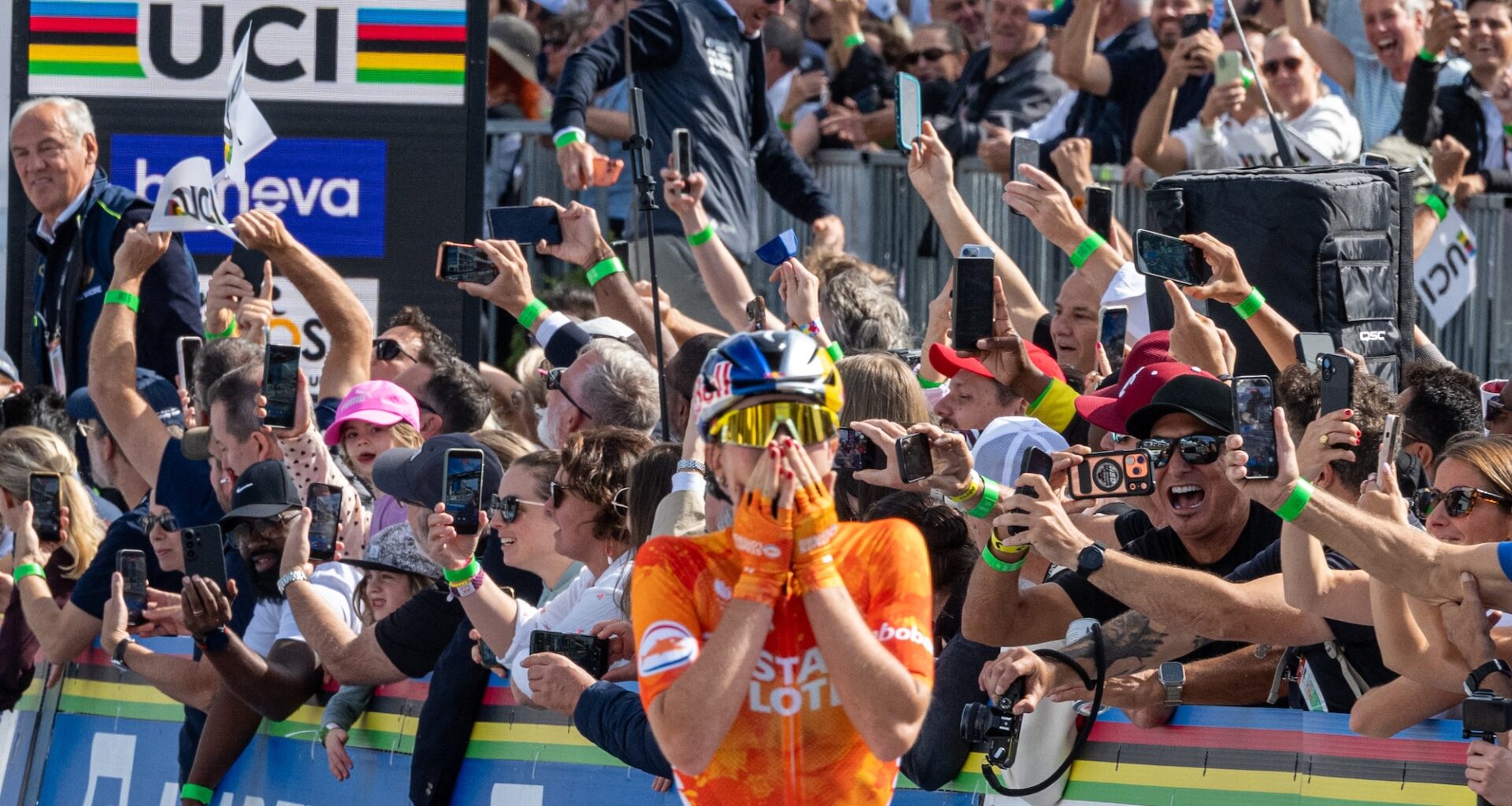
Demi Vollering attacked 38.5 kilometers from the finish in Montréal, watched her lead shrink to nothing before the final lap, and refused to accept it. Her reward was the one jersey her collection had been missing.
Demi Vollering didn’t dare look back. For most of the last 40 kilometers of Saturday’s race she rode alone at the front, and the gap to the chasers never grew large enough to let her breathe: 20 seconds, then 22, then 15. Then, just before the bell, it was gone. Four of the strongest riders in the world were on her wheel, and the race she had tried to win alone became a race she would have to win all over again.
She won it anyway, in an uphill sprint so close that she and Kasia Niewiadoma-Phinney were given the same time. Elisa Longo Borghini finished four seconds back, and the Dutch rider finally had the rainbow jersey.
The Mont-Royal circuit set the terms. The 13.4-kilometer loop wraps around the mountain at the heart of the city and climbs the Voie Camillien-Houde on every lap, 1.67 kilometers at an average of 7.4 percent with pitches of 10. The women faced it eight times inside 180.1 kilometers of racing, and by the final lap it had stripped the race down to its strongest five.
One jersey missing
The rainbow jersey fills the one conspicuous gap in a collection few riders of her generation can match. The Dutch rider has won the yellow jersey of the Tour de France Femmes twice, in 2023 and 2026, the red jersey of La Vuelta Femenina in 2024 and 2025, the pink jersey of this year’s Giro d’Italia Women, and the European champion’s jersey in 2025, along with a long list of classics and stage races. Her 2026 season has been extraordinary even by her standards: 15 victories, including the Ronde van Vlaanderen, La Flèche Wallonne, Liège-Bastogne-Liège, the Giro and the Tour.
The world title had always slipped away. She had taken silver in the individual time trial in 2024 and bronze in 2025, and a bronze at the 2023 UCI Gravel World Championships, but never the road race stripes. On paper, Saturday’s race looked built for her. That didn’t make it simple.
The Dutch take control
The Oranje squad took charge of the race from the start, riding at the front behind the early attackers. The day’s main breakaway included Bulgaria’s Gergana Stoyanova, Portugal’s Beatriz Roxo, Norway’s Marte Berg Edseth and the USA’s Natalie Quinn, and it reached the final circuit with a lead of around three minutes. Behind it, the race lost one of its central figures. A mass crash in the peloton brought down the defending world champion, Canada’s Magdeleine Vallières Mill, racing on home roads, along with Spain’s Paula Blasi.
Once the race reached Mont-Royal, the intensity rose lap by lap. After a series of attacks, France’s Maeva Squiban powered clear with 52 kilometers remaining. The Dutch organized a hard chase behind her, and on the next ascent of the Camillien-Houde, 38.5 kilometers from the finish, Puck Pieterse launched her leader. Vollering caught Squiban quickly, went past her, and rode on alone. Squiban fought on and still finished ninth.
Too early?
A solo from nearly 40 kilometers out is a statement of confidence, and Vollering’s rivals refused to let it become a procession. The chase behind her held a strong pace and kept her on a short leash. The gap never grew into the kind of lead that lets a rider relax, and Vollering felt every second of that pressure. “There were so many moments I thought I went too early,” she admitted. “They stayed so close the whole time and I didn’t dare to turn around and look back because I felt like they were almost in my wheel already. It was 20 seconds, 22, 15…”
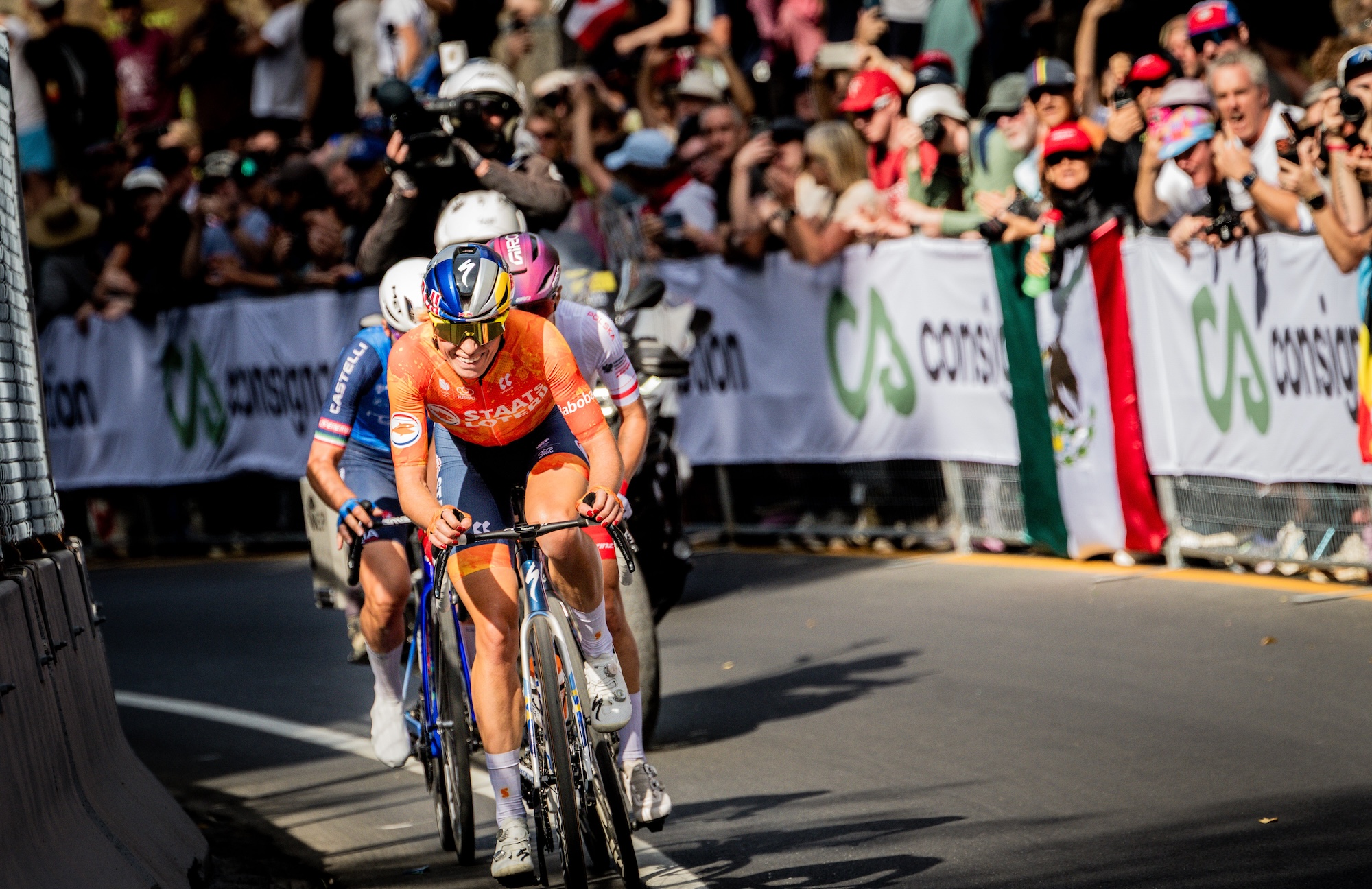 Demi Vollering (Netherlands) leading Kasia Niewiadoma-Phinney (Poland) and Elisa Longo Borghini (Italy) on the final climb up Mont-Royal at the 2026 UCI Road World Championships. Photo courtesy Mondiaux2026
Then they were on her wheel. Poland’s Kasia Niewiadoma-Phinney, Italy’s Elisa Longo Borghini, Switzerland’s Marlen Reusser, crowned time trial champion the previous Sunday, and France’s Juliette Berthet made the junction just before the final lap. The bell that sent them into it was rung by Geneviève Gambillon, the Frenchwoman who won the women’s world road title in Montréal in 1974, a reminder of how long the city has been writing this race’s history.
For most riders, being caught after a long solo means the race is over. The legs have been spent and the rivals smell it. Vollering refused to see it that way. “At one point, they came back,” she said. “But it still wasn’t over, I had to still believe in it. I just dared, tried again and never gave up to the finish line. I was not planning to give it away anymore, I was like: ‘No, no it’s mine.’”
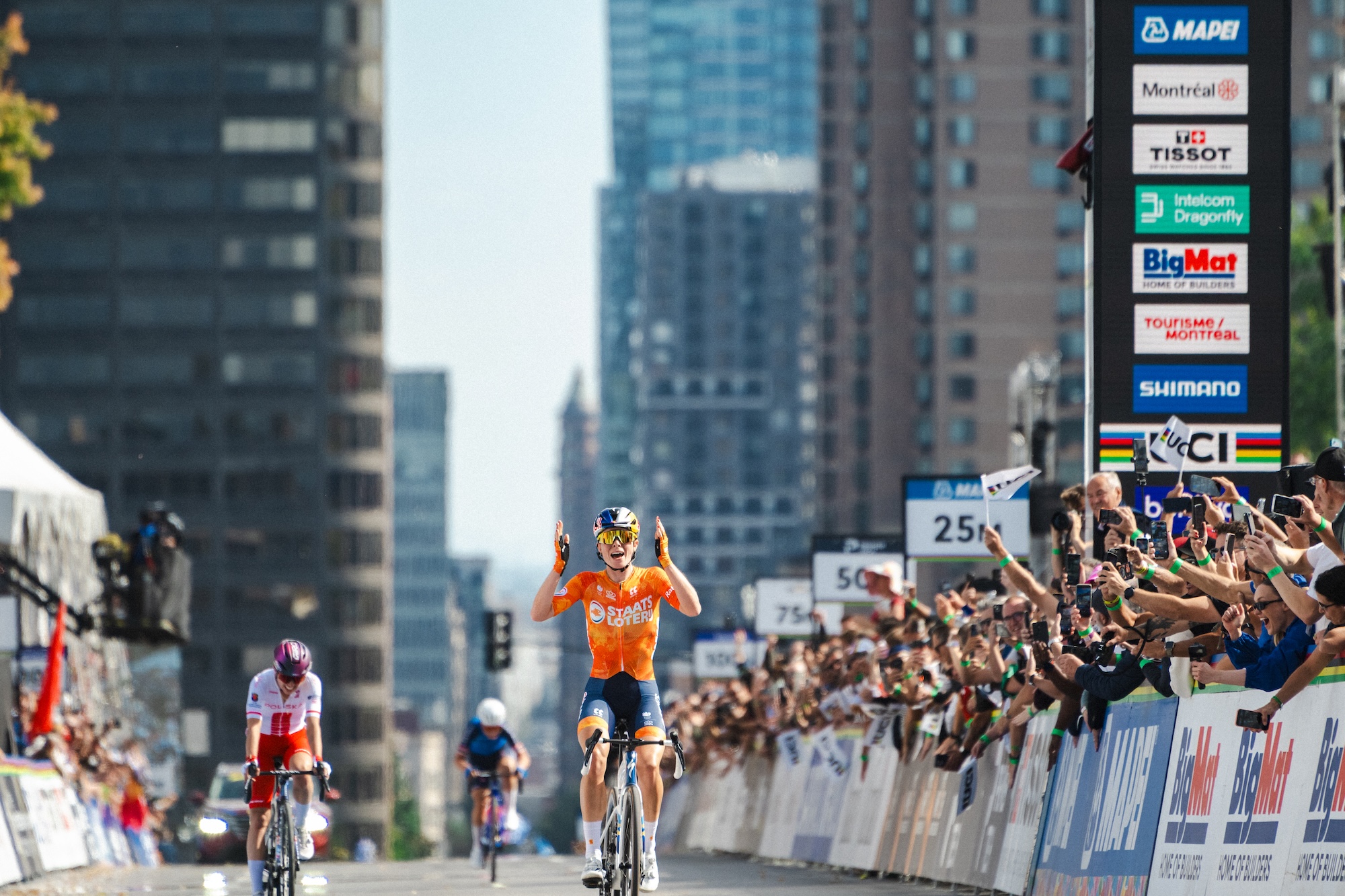 Demi Vollering (Netherlands) wins the 2026 UCI Road World Championships in Montréal, Quebec, Canada on September 26, 2026. Photo courtesy of Mondiaux2026/James Startt.
Berthet could not hold the pace on the final lap and finished fifth, 39 seconds down, which left four women to decide the title. Pieterse, whose lead-out had launched Vollering two laps earlier, had given everything by then and rolled in sixth, more than a minute and a half back. Vollering was on her own. The tension peaked on the uphill finishing straight, and she stayed cool, timed her effort and held off Niewiadoma-Phinney by the narrowest of margins, both riders given the same time. Longo Borghini took bronze four seconds back, and Reusser finished fourth at eight seconds.
Guts and belief
Vollering spoke with visible emotion moments after the finish, and most of what she said concerned the women who had worked for her. “I worked so hard towards this goal,” she said. “It takes guts to truly believe with your whole heart and, together with the team around you, with such strong girls. They all sacrifice for you. It’s a lot to ask from them, but I’m so proud of everybody from the team.” The Dutch, she said, “took the whole race in their hands; they rode the whole race in the front and then Puck did an amazing lead-out; and I could just not not finish the job!”
She becomes the ninth Dutch woman to win the elite road race world title, and the list she joins reads like a history of the women’s sport. Keetie van Oosten-Hage won in 1968 and 1976. Tineke Fopma won in 1975, Petra de Bruin in 1979, and Leontien van Moorsel in 1991 and 1993. Marianne Vos took three titles, in 2006, 2012 and 2013. Chantal Blaak won in 2017, Anna van der Breggen in 2018 and 2020, and Annemiek van Vleuten in 2019 and 2022. Few of them won it after being caught on the final lap and deciding, simply, that the jersey was still theirs.
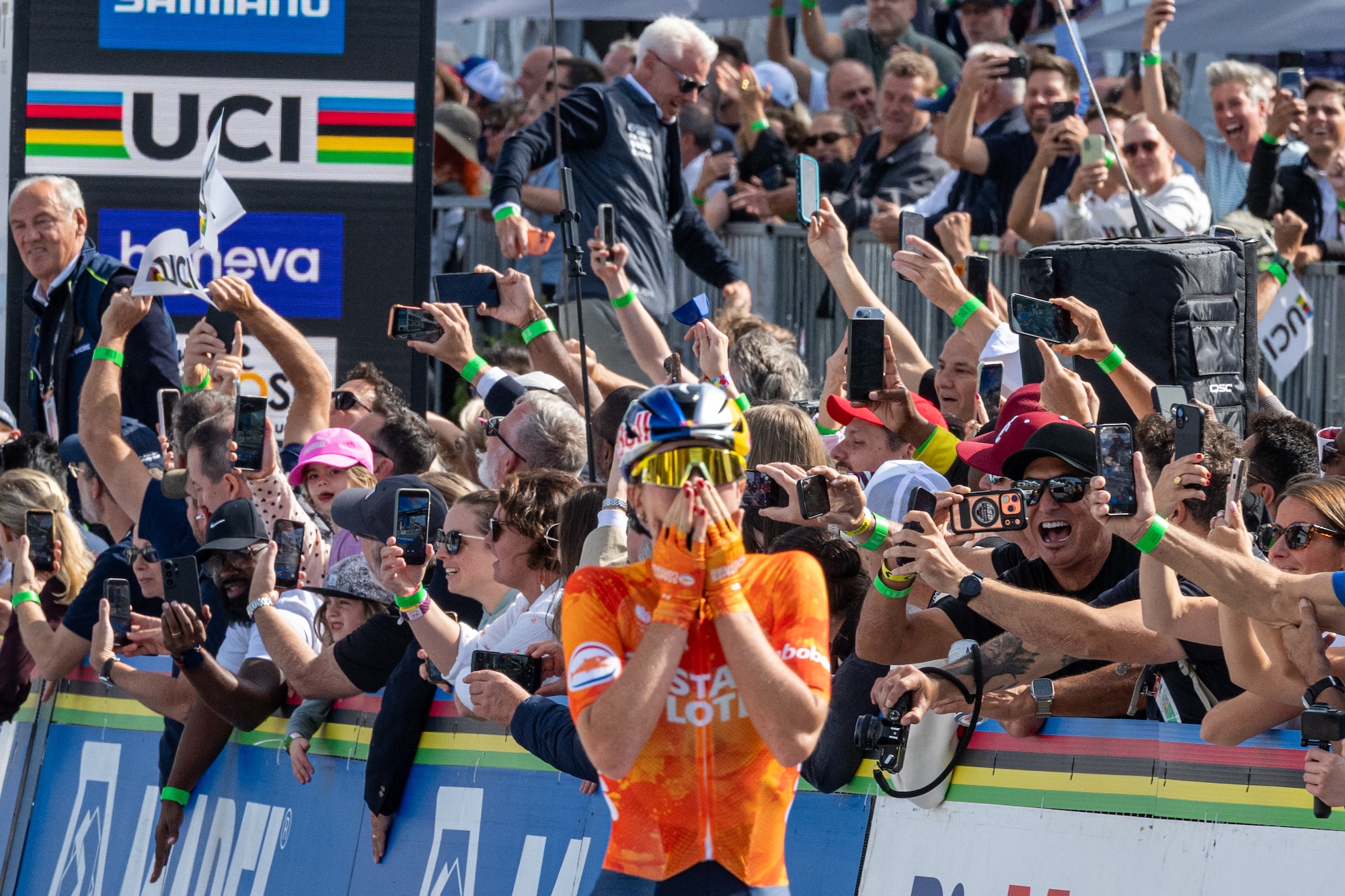 Demi Vollering (Netherlands) wins the 2026 UCI Road World Championships in Montréal, Quebec, Canada on September 26, 2026. Photo courtesy Mondiaux2026.
The hard way
For years the world road title had been the race Vollering circled and never won. She collected medals around it while the stripes went to others. She arrived in Montréal with the Giro, the Tour and three of the spring’s biggest classics already won in 2026, and she left with the one title that had kept slipping away.
She won it the hard way: alone, then caught, then alone again in the final meters of the finishing straight. It takes guts to believe, she said. It also took a team willing to ride at the front all day, a teammate who launched her on the Camillien-Houde and had nothing left for herself, and a rider who, with the title slipping away, decided simply that it was hers.
WOMEN ELITE ROAD RACE, 180.1 KM: TOP 10
Position
Rider
Nation
Age
Time
1
Demi Vollering
Netherlands
30
4:45:09
2
Kasia Niewiadoma-Phinney
Poland
32
s.t.
3
Elisa Longo Borghini
Italy
35
+0:04
4
Marlen Reusser
Switzerland
35
+0:08
5
Juliette Berthet
France
28
+0:39
6
Puck Pieterse
Netherlands
24
+1:36
7
Célia Gery
France
20
+2:55
8
Dominika Włodarczyk
Poland
25
+4:16
9
Maeva Squiban
France
24
+5:48
10
Franziska Koch
Germany
26
+5:51
Source: UCI. Gaps in minutes:seconds; s.t. = same time.
(Visited 5 times, 5 visits today)