
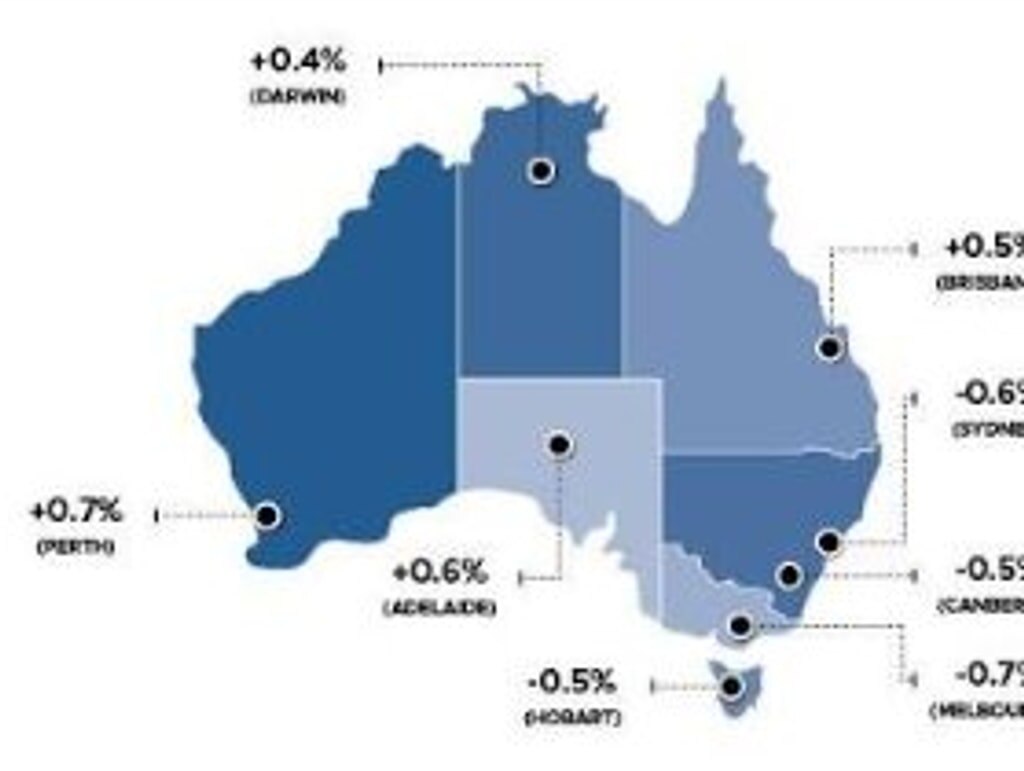
National capital city median dwelling values have fallen across the country for the sixth consecutive month, with one state suffering the biggest drop.
Realestate.com.au’s October Home Index report author, senior economist Eleanor Creagh said “higher interest rates are weighing on borrowing capacity and buyer demand”.
“The spring selling season has not delivered the usual lift in momentum. Auction clearance rates remain soft, homes are taking longer to sell, and sales volumes remain below last year’s levels.”
HOW YOUR STATE PERFORMED
Brisbane property prices fall for sixth straight month
Hobart market halts home price slide
Adelaide records greatest value drop … again
Darwin outperforms southern capitals in game of homes

Realestate.com.au senior economist Eleanor Creagh
“Sydney and Melbourne remain the deepest corrections, but downward momentum has strengthened in Adelaide, Brisbane and Perth, where conditions had previously been more resilient.”
The report said Adelaide has once again suffered the greatest median home value drop of any capital city over the past 30 days, with values down for the fourth consecutive month.
Adelaide’s median home value dropped 0.6 per cent or $13,000 last month, the report showed, and is down 2.5 per cent from its peak in May.
Adelaide’s median combined dwelling value – that of both houses and units – currently sits at $915,000, and is down from $928,000 last month.
Houses also took a hit – down 0.6 per cent or $15,000 for the month from a $1.005m median to $990,000.
Adelaide unit prices followed suit, dropping 0.7 per cent or $6,000 for the month from a $687,000 median to $681,000.
Looking at the other states, both Sydney and Perth suffered value losses of 0.3 per cent for the month to $1.187m and $968,000 respectively, followed by Melbourne and Brisbane which both dropped by 0.2 per cent to $819,000 and $1.033m respectively.
Hobart held steady at $729,000, while values increased 0.1 per cent for the month in both Darwin and Canberra, which recorded medians of $638,000 and $854,000.
Metro Adelaide – the nation’s worst-performing housing market, in contrast to regional SA which was among the nation’s best regional market. Picture: Supplied by Colliers
“Together, these indicators point to weaker buyer demand and a widening gap between buyer and seller price expectations.”
Regional Australia performed better than the capitals for combined dwellings, with values climbing 0.1 per cent in regional Victoria to $601,000.
Aside from regional Western Australia, where values dipped 0.1 per cent for the month to $674,000, all other states held their value for the month.
Darwin recorded the highest annual growth of the capitals for all dwellings at 12 per cent, while regional SA topped the regional markets with values up 10.9 per cent.
For houses, Darwin had the highest monthly growth, with values climbing 0.2 per cent, as they also did in regional Victoria, the strongest regional house market.
Adelaide’s unit market topped the nation for monthly growth at 0.7 per cent, matched by regional SA, the nation’s strongest regional unit market.
Ms Creagh said conditions remained uneven.
“Regional markets continue to outperform the capitals, while units are proving more resilient than houses as affordability shapes buyer demand,” she said.
“Further price falls are likely over the coming months as this week’s interest rate rise, tax changes and the cumulative impact of higher borrowing costs weigh on
demand.
“However, resilient employment, limited forced selling and homeowner equity buffers should contain the severity of the adjustment.
“Reduced buyer purchasing power remains the dominant pressure on prices, rather than large numbers of owners being forced to sell.”
Ray White Group chief economist Nerida Conisbee. Picture: Supplied
Ray White Group chief economist Nerida Conisbee said another interest rate increase by the Reserve Bank of Australia would add to the downturn already underway.
“The RBA has acknowledged that housing prices and activity have weakened by more than it previously expected, reflecting the combined impact of higher rates, the federal budget changes and weaker sentiment,” she said.
“A cash rate of 4.60 per cent will further reduce borrowing capacity and increase repayment pressure, while rising unemployment is likely to add another layer of caution for buyers.
“The increase does not, however, make further rate rises inevitable.
“The RBA is now dealing with much greater tension between inflation and the labour market.
“If inflation remains persistent, another increase is still possible.
“But if unemployment continues to rise and employment conditions weaken further, the case for additional tightening will become much harder to make.
“The next few inflation and labour market releases will therefore be critical in determining whether 4.60 per cent is the peak or whether rates need to move higher again.”