
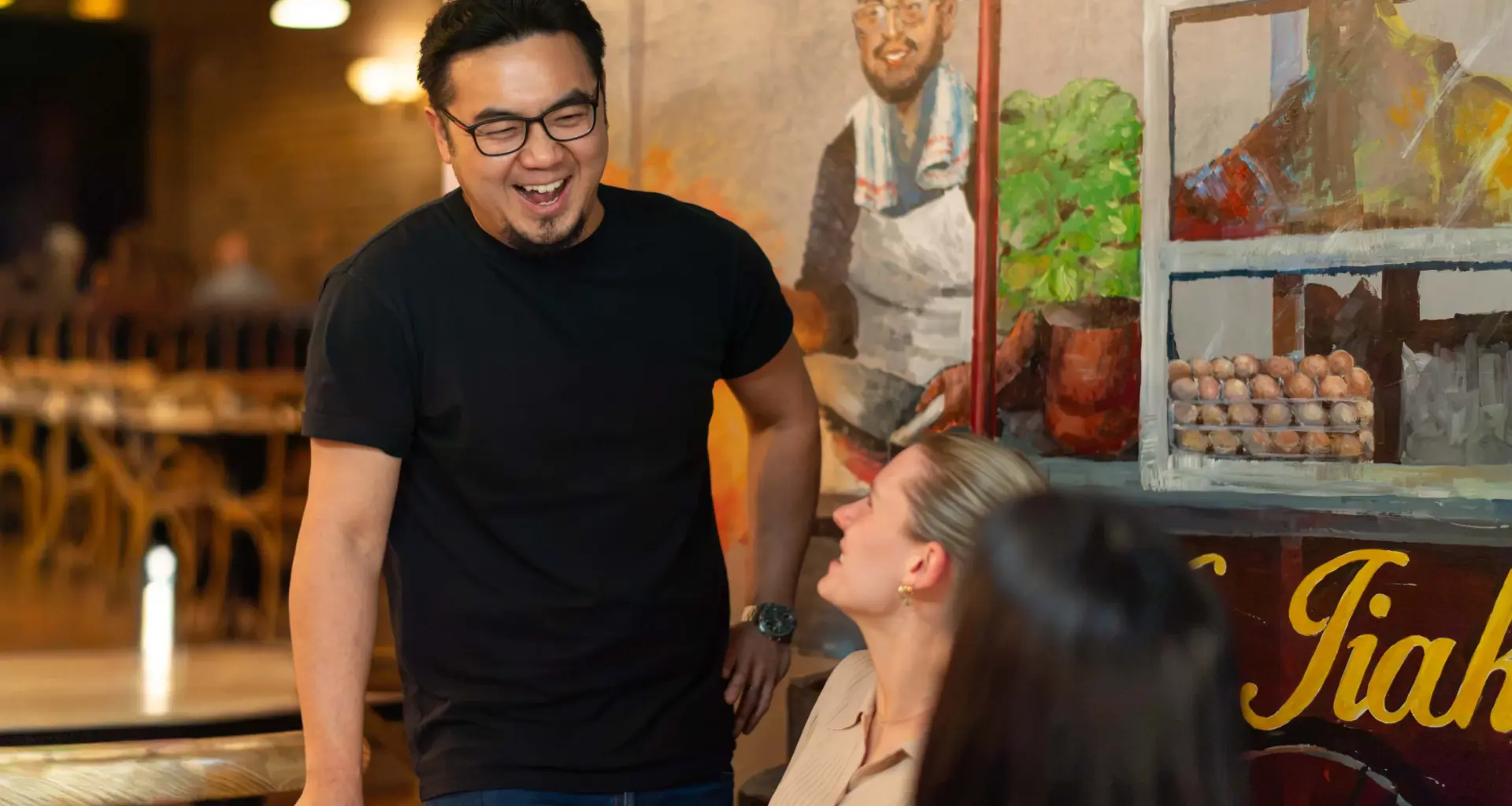
With eight venues, two more opening by the end of the year, and more than 200 people on the books, Junda Khoo has experienced growth most restaurateurs could only dream of.
But scaling in an already volatile industry has brought its challenges. “It’s not easy doing business in Australia,” Khoo says. “Everything is expensive. It costs a lot.”
For Khoo, the toughest test came early. He opened Ho Jiak Town Hall just two days before Sydney’s first lockdown in 2020, at a time when the group already had four restaurants and many of its staff were on skilled work visas. “We could have lost everything,” he says.
Rather than shutting up shop, the business pivoted, offering free and discounted meals to hospitality workers, including its own staff, and ensuring the team had enough shifts to get by.
“We were trying to survive, but helping other people survive as well,” he says.
Khoo says the experience helped clarify what he wanted his role as a chef and employer to be. “The core value is family,” he says. “I treat all of my [team] as though they were my own kids.”
Khoo has watched employees who joined when they were young get married and have children of their own. Despite the size of the group, he still sees it as a small business at heart, though he misses the days when he knew every employee personally.
“The less glamorous part for me right now is I’m not able to give as much of my time to each individual person,” he says.
His days have shifted from working primarily in one kitchen to moving between venues and teams, with more travel, meetings and, inevitably, less sleep. Growth has also meant learning how to delegate in order to be a better leader.
“I have to realise that I can’t do everything on my own,” he says. “It’s time for me to hand over my responsibilities.”
One important transition has been finding systems that can keep things moving as the business expands and customer behaviours shift. For example, cash transactions have dropped by around 90 per cent in recent years, according to Khoo. Digital wallets have become an increasingly normal part of eating out, with many customers now paying directly from their phones.
As one of the accepted payment networks across the group’s venues, Mastercard enables customers to pay quickly and securely using their Mastercard cards, whether with a physical card or via digital wallets. For a business spread across multiple locations, accepting transactions seamlessly helps to keep everything running smoothly. Khoo also says Mastercard has been particularly useful for larger business purchases, giving him confidence that payments can be made securely and reliably across the world.
Ultimately though, Khoo says his biggest support system is internal. For all the challenges that come with that growth, he remains focused on the people who have come along for the ride.
“As the business grows, I’m forced to grow,” he says. “And the [team] with us grows as well.”
This article is produced by Broadsheet in partnership with Mastercard. Every small business starts with a dream. Mastercard provides the infrastructure that helps businesses grow with confidence, so ambition can become something priceless.

Produced in partnership with Mastercard.
Learn more about partner content on Broadsheet.