
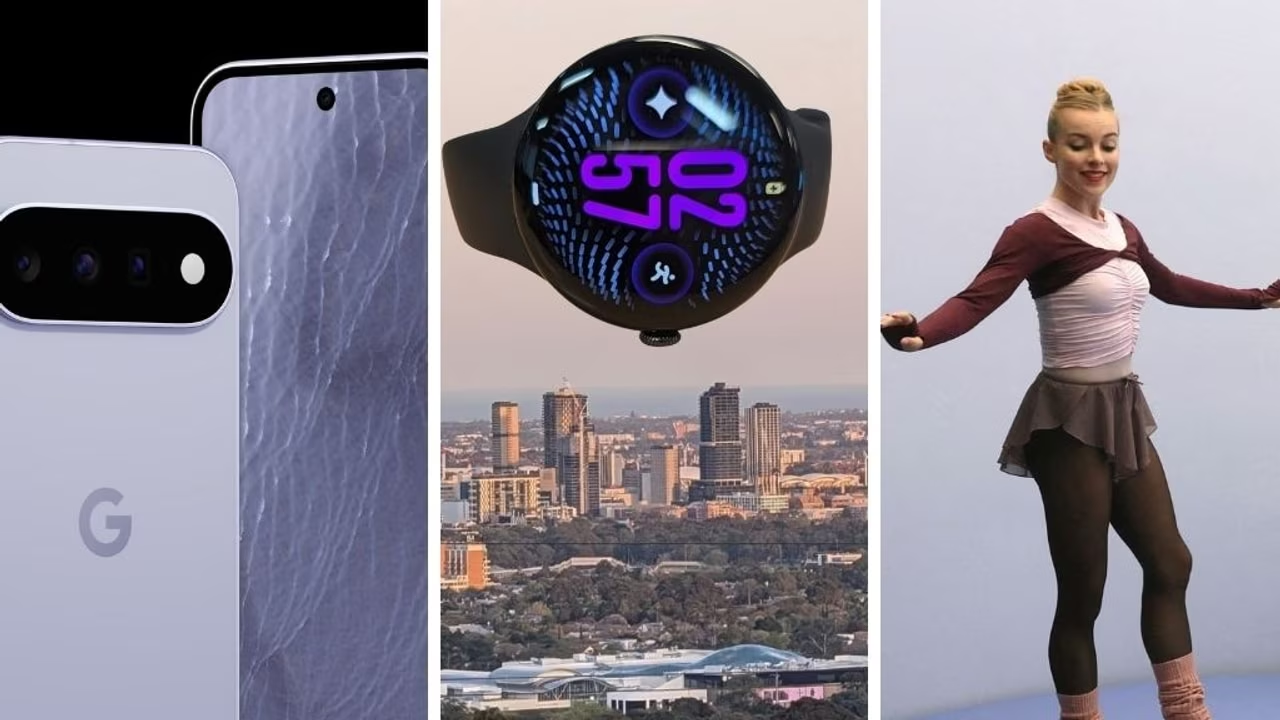
Four years ago, when I was changing jobs I faced an important decision, would I stick with an Apple phone or try an Android and, if so, which one?
After extensive research (how confusing is to compare Apples with Pixels, or anything else) I settled on the relatively unknown Google Pixel 6a.
While Google had been producing phones for six years, at that time the Google Pixel had an estimated 4.1% market share of smartphone sales in Australia, according to IDC’s mobile phone tracker.
The main reason for the choice was that for about half the price of an iPhone, I could get a smartphone that could deliver HDR computational photography and also easily sync with the multiple other Google products I used as part of my daily life – like Google maps, Google search engines and so on.
And thus began my love relationship with my little Pixel, which a year later extended to my very first smart watch, the Pixel watch.
That initial Google Pixel 6a never missed a beat, but when I had the opportunity to upgrade to 9a for a mere $500 two years ago through Google by trading it in, I took it.
And now the new features offered with the Google Pixel 11 have me excited about another upgrade, specifically the introduction of the 10.8MP telephoto camera with 5x optical zoom.
The main wide camera has 48 MP sensor with an ƒ/1.7 aperture, optical image stabilisation (OIS), and laser detect autofocus (LDAF). It features 56% more light sensitivity compared to previous generations.
The ultra wide camera has 3 MP sensor with a 120° field of view and an ƒ/2.2 aperture.
The telephoto Camera has an ƒ/3.1 aperture, and optical image stabilisation.
I am not a photographer, but better telephoto camera allowed me to zoom in capture this strange purple creature that washed up on a Sunshine Coast beach.
And added bonus is I could quickly use my Google lens to then identify what on earth I was looking at – and it turned out to be a violet sea snail of sorts.
The camera also allowed me capture the tiny dots on this beautiful stick insect we picked up alongside the Murray River in South Australia from a safe distance away to not hurt or scare it.
And then, when I discovered my photo was being ruined by the person in the background, I could use the function within Google photos to simple edit that person out as if they were never even there.
The zoom function is a game changer, but there is more to it too.
The Pixel 11 is powered by Gemini technology to instantly transform my blurry photographs into masterpieces, which makes capturing skylines at sunrise easier than ever before.
The Instant Night Sight lets me take photos in the dark without worrying about the image quality.
The Pixel 11 is powered by the most powerful chip yet, the Google Tensor G6, which helps drive computational photography faster and better than ever before
Another significant upgrade from my 9a is the introduction of FaceID, which means that problem of trying to open my phone while holding my coffee cup is no longer a problem.
Importantly, I can also choose between Face ID or fingerprint ID when that options suits me better.
The Pixel 11 has over 30 hours of battery life and 256GB of storage and it is with seven years of support, meaning upgrading every couple of years is no longer needed as my Google Pixel 9a can enjoy the same security upgrades as my 11.
I spent six years working in cybersecurity and Apple products were frequently considered safer because of Apple’s tightly controlled ecosystem, meaning that hardware, software and App Store are under its control, whereas Android device are open-source.
However, the Pixel 11 is packed with personal safety features, including VPN by Google built into your phone at no extra cost providing additional protection against online threats where ever you are connected.
If you are travelling out bush, don’t worry about a satellite phone. The Google Pixel 11 is trialing satellite SOS where you can point your Pixel in the direction of a satellite and connect with emergency services.
The Pixel 11 is also built on exceptional durability with a scratch resistant coating essential for someone like me who is prone to chucking my phone in my swimming bag and taking it to the beach where sand gets in everything.
And it syncs seamlessly with my Pixel watch.
There are a few exciting upgrades between my original Pixel watch, which is still going strong after more than three years after buying it, and the Pixel 5 is the Gemini AI integration to allow from smart responses and voice tasks directly from my wrist.
I am an ocean swimmer, and used my original watch every day without a problem, but the introduction of the water lock mode means I can eject water that may have got in after each swim.
The GPS tracking is also more advanced than ever before, allowing me to use Goolge Maps and direct where I am going from my left wrist.
It also 30 hours of battery life, which means I can sleep with my watch on and use the sleep score tracker to determine exactly how many times my neighbours did actually wake me up the night before.
The Google Pixel watch is incredibly robust. I use mine for bodysurfing and while it most probably isn’t recommended, I’ve never had a problem.
More importantly, the strap has never let me down while my son has lost two Apple watches in the surf.
If you are looking for a new phone, look closely at the Google Pixel. Once you have converted (like me), it is unlikely you will ever look back.
The Google Pixel 11 retails for $1,499 and the Google Pixel 5 watch for $649. If you are looking for an even better Google phone, check out the Google 11 Pro XL review.
Read related topics:Google