
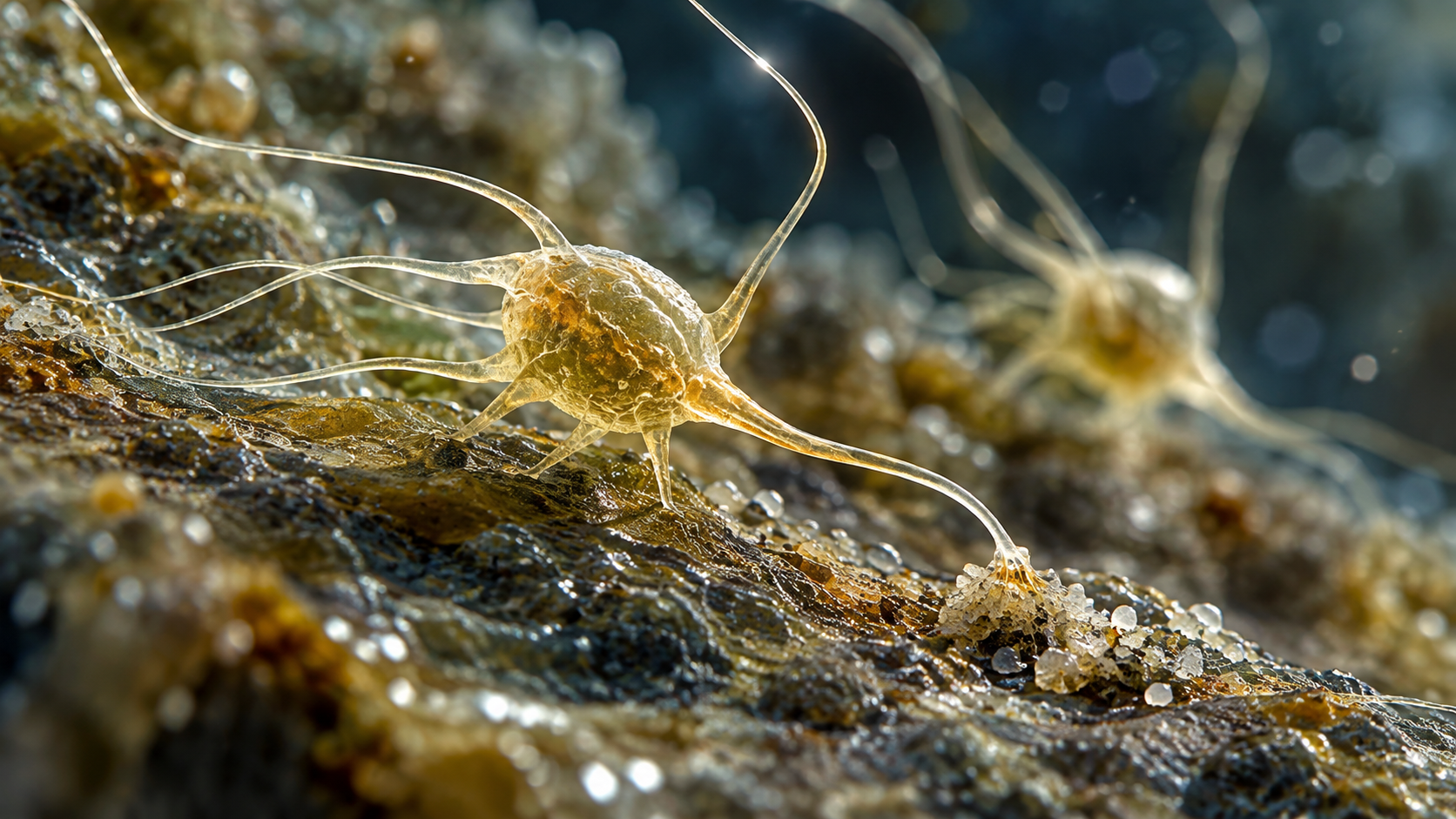
Researchers have filmed living Asgard archaea crawling across surfaces using rapidly growing and retracting protrusions, revealing a form of cellular movement strikingly reminiscent of eukaryotic cells.Experiments with two different Asgard lineages showed that their movement depends on a Lokiactin-based cytoskeleton, suggesting sophisticated actin-driven behavior existed before the emergence of eukaryotes.Because Asgard archaea are the closest known prokaryotic relatives of eukaryotes, the observations give scientists a new experimental way to investigate how cellular complexity arose roughly 2 billion years ago.
Tiny microorganisms related to the ancestors of every animal, plant and fungus can crawl across surfaces using flexible protrusions controlled by an actin-like internal skeleton.
Researchers at the University of Vienna captured the behavior in living Asgard archaea, microorganisms considered the closest known prokaryotic relatives of eukaryotes. Their movements resemble forms of crawling normally associated with much more complex cells, including amoebae and some human immune cells.
The study, published in Nature, provides the first live view of this behavior in Asgard archaea. It also turns features previously known mainly from genome sequences and frozen electron-microscope images into observable biological processes that researchers can experimentally manipulate.
The findings suggest that some of the machinery behind complex cellular movement arose before eukaryotic life itself.
Asgard archaea, our closest known microbial relatives, play a key role in current models of the origin of more complex organisms, known as eukaryotes (all animals, plants, protists and fungi). (CREDIT: University of Vienna) Strange microbes connected to our origins
Asgard archaea entered the scientific spotlight after their genomes revealed an unexpected collection of genes resembling those used by eukaryotic cells. These include genes associated with membrane remodeling, protein trafficking and the cytoskeleton.
Most models of eukaryotic origins now involve an ancient Asgard-related archaeon entering a close association with a bacterium. That bacterial partner eventually became the mitochondrion, the energy-producing organelle found in nearly all modern eukaryotic cells.
Studying living Asgard archaea has been exceptionally difficult because the organisms grow slowly and often depend on other microorganisms. The first cultivated representatives became available only recently, leaving scientists with little direct evidence about how the cells behave.
Earlier microscopy had already revealed unusual anatomy. Some Asgard cells have round bodies surrounded by thin branching extensions that can stretch many times farther than the diameter of the central cell.
Those static images raised an obvious question: were the structures permanent scaffolds, or could the cells actively reshape them?
A temporal projection of L. ossiferum, illustrating the rearrangement of protrusions over time. (CREDIT: Philipp Radler et al, Nature 2026) Living cells transformed within minutes
Philipp Radler and colleagues developed an oxygen-free microscopy system capable of keeping the anaerobic organisms alive while researchers recorded them.
They studied Candidatus Lokiarchaeum ossiferum, cultivated in Vienna, and Candidatus Margulisarchaeum peptidophilum, cultivated by collaborators in Japan. Both transformed their shapes continuously.
The protrusions of L. ossiferum grew at about 1.5 micrometers per minute. Some extended as far as 15 micrometers before retracting, occasionally snapping backward more than five times faster than they had grown.
That is remarkable for cells with bodies only around a micrometer across. A typical cell carried about five protrusions, greatly increasing the surface area available for interacting with its surroundings.
The cells also redistributed existing membrane rather than continually building new surface. As one protrusion shortened, another could extend, suggesting tightly controlled remodeling of a limited membrane supply.
The second species moved even faster. Its protrusions grew at approximately 4.8 micrometers per minute, showing that dynamic remodeling is not restricted to a single Asgard lineage.
Time-lapse of Lokiarchaeota (Archaea genus)
Protrusions pulled cells across surfaces
The structures did more than change shape. They moved the entire organism.
About half of the observed L. ossiferum cells shifted their central bodies across the glass surface. Their median speed was about 1.6 micrometers per minute, while M. peptidophilum moved at roughly 3.4 micrometers per minute.
Some cells attached the tip of a forward protrusion to the surface and then shortened it, apparently pulling the cell body toward the attachment point. Others moved more smoothly in a gliding motion while a protrusion remained oriented ahead of them.
Most wandered irregularly rather than traveling toward a fixed destination. The researchers suggest such movement could help Asgard archaea explore tiny spaces between sediment particles for nutrients or microbial partners.
The mechanism differs from the flagella used by many bacteria and the archaella used by swimming archaea. Other archaea can twitch across surfaces using external pili, but the new observations point instead to a motility system involving an internal cytoskeleton and membrane protrusions.
An ancient version of the actin machinery
The strongest clue to the mechanism came from Lokiactin, an archaeal relative of the actin protein that forms a major part of the eukaryotic cytoskeleton.
Time-lapse of Lokiarchaeota (Archaea genus) stained with a fluorescent dye (purple) for actin
Researchers previously found Lokiactin filaments running through the body and protrusions of L. ossiferum. In the new experiments, fluorescent staining showed Lokiactin inside dynamically changing structures.
The team then exposed cells to compounds that disrupt eukaryotic actin. One, swinholide A, dramatically reduced protrusion growth at concentrations as low as 50 nanograms per milliliter.
At sufficient concentrations, cells stopped crawling. Persisting protrusions lost their usual stiffness and began moving passively with Brownian motion rather than undergoing controlled extension and retraction.
Researchers also identified proteins related to gelsolins and profilins interacting with Lokiactin. Modern eukaryotic cells use these protein families to regulate the assembly and breakdown of actin filaments.
Together, the observations suggest that Asgard archaea possess not just an actin-like protein, but a dynamically regulated actin system capable of reshaping membranes and moving entire cells.
Cellular complexity may have started earlier
The implications extend directly to one of evolutionary biology’s largest unresolved questions: what did the cell that gave rise to eukaryotes actually look like?
Controls for fluorescent imaging and actin inhibitor effects on L. ossiferum. (CREDIT: Philipp Radler et al, Nature 2026)
A 2023 study of L. ossiferum had already revealed an elaborate actin cytoskeleton. Research published in Cell in 2025 then found that Asgard archaea can also produce microtubule-like structures from relatives of the tubulin proteins central to eukaryotic cells.
The new live observations add behavior to those structural discoveries. Actin-based cellular movement may therefore have evolved in archaea before the lineage leading to modern eukaryotes emerged.
That does not mean modern Asgard archaea are unchanged versions of our ancestors. They have experienced roughly 2 billion years of their own evolution, and competing models still disagree about exactly how the archaeal and bacterial partners combined during eukaryogenesis.
What researchers now possess is something they previously lacked: living cells in which those evolutionary ideas can be experimentally tested.
Rather than reconstructing the dawn of complex life entirely from genes and fossils, scientists can now watch one of its closest microbial relatives stretch, attach, pull and crawl under a microscope.
Dig deeper into Asgard archaea and the origins of complex life
These studies and reviews trace the rapidly changing evidence linking Asgard archaea with the cellular machinery that eventually became characteristic of eukaryotic life.
Microtubules in Asgard archaea: Researchers discovered Asgard tubulins that form microtubules resembling simplified versions of one of the major structural systems of eukaryotic cells. (Cell, 2025)
Research findings are available online in the journal Nature.
Related Stories