
What would Brazilian MMA champions have become without the events
that helped launch them internationally during the 1990s and early
2000s? Without promotions such as Frederico Lapenda’s WVC, Sérgio
Batarelli’s IVC, Rudimar Fedrigo and Joinha’s Meca, Wallid
Ismail‘s Jungle Fight, Andre
Pederneiras‘ Shooto Brazil or Tatá and Philip Lima’s WOCS,
Brazil likely would not have become the dominant force it was in
both
Pride Fighting Championships and the
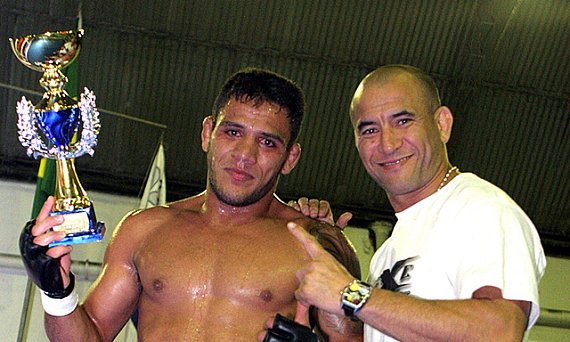
Ultimate Fighting Championship.Rafael dos Anjos and Junior dos Santos won XFC tournaments in
Rio de Janeiro in 2007
Yet, when it comes to pure success rate, none of those events
matched the Xtreme Fighting
Championship, promoted by former UFC fighter Fabiano Iha at
Grajaú Tênis Clube in Rio de Janeiro on April 29, 2007.
Offering a $1,000 purse — well above the Brazilian standard at the
time — the XFC gathered many of the country’s top prospects in four
tournaments: welterweight (170 pounds), middleweight (185 pounds),
light heavyweight (205 pounds) and heavyweight.
Iha’s plan was to select one winner from each division to compete
at the promotion’s second event, scheduled for July 30 in Los
Angeles. Unfortunately, that edition never materialized. Still, the
inaugural tournament proved remarkably prophetic: All four
champions eventually reached the UFC, giving the event a perfect
100% success rate.
The winners were Rafael dos
Anjos (170 pounds), Rafael
Natal (185 pounds), Antonio
Braga Neto (205 pounds) and Junior dos
Santos (heavyweight). As history would show, two of them went
on to become UFC champions.’I met my wife and won $1,000′
Rafael dos
Anjos remembers that he was still at the beginning of his
career when the opportunity arrived during a difficult week.
“It was Monday, and I was in a public hospital in Niterói with a
fever, receiving IV fluids, when my phone rang. My manager said,
‘I’ve got two pieces of news for you—one good and one bad. The good
news is you’re fighting on Saturday. The bad news is you’ll have to
fight twice in one night,'” RDA recalled.
“Even though they were two 10-minute fights, when I heard the
winner would receive US$1,000—which was a huge purse by Brazilian
standards back then—I didn’t hesitate.”
Dos Anjos opened the tournament by submitting Thiago Minu of Boxer
Team with a rear-naked choke before repeating the feat in the final
against tough BTT representative Maurício Souza, who had earlier
defeated José Fabiano of Black House via ankle lock.
“It couldn’t have gone any better. I won US$1,000 and met my wife,”
Rafael said, referring to Cristiane, who was working as a
promotional model for one of the event’s sponsors when they met
backstage.
Representing Gracie Barra Combat Team, led by his coach Roberto
Gordo, Dos Anjos soon won the Fury tournament and then made a
successful international debut in Japan’s Pancrase, quickly
submitting local fighter Hirayama. Those performances earned him a
UFC contract in 2008.
In 2015, he captured the UFC lightweight championship by defeating
Anthony
Pettis. Later, he moved up to welterweight, where he quickly
climbed to the top of the rankings. Now 41, with a professional
record of 31 wins and 17 losses, Dos Anjos will face Alexander
Hernandez at UFC 332 and
can proudly say he has shared the Octagon with many of the greatest
fighters in the promotion’s history.
Junior dos Santos steamrolls the heavyweight tournament
The other breakout star of the event was Junior dos
Santos, a training partner of Antonio
Rodrigo Nogueira and Antonio
Rogerio Nogueira.
Traveling from Bahia, Cigano claimed the heavyweight tournament
after two grueling fights. He first defeated Edson Paredao of Nova
Geracao Paraíba by doctor’s stoppage at 8:46. In the final, he
faced Joaquim
Ferreira of Gracie Barra Belo Horizonte, who received a second
chance after André Mussi injured his arm in their semifinal and was
unable to continue.
Knowing Cigano trained under renowned boxing coach Luis Dorea,
Brazilian jiu-jitsu black belt Mamute immediately looked for
takedowns. However, Cigano defended every attempt, kept the fight
standing and punished him with punches.
Exhausted from his earlier battle and frustrated by Cigano’s
takedown defense, Mamute eventually retired from the fight.
“Paredao is incredibly strong, and Mamute is a great fighter with
excellent ground skills. Both fights were very tough, but I managed
to perform well,” Cigano said afterward.
Following three more victories on the Brazilian circuit, Dos Santos
received a late call to make his UFC debut at UFC 90 against the
far more experienced Fabricio
Werdum. He shocked the MMA world by knocking out his countryman
just 1 minute, 20 seconds into the opening round with a devastating
right uppercut followed by ground strikes.
The victory immediately established him as one of the heavyweight
division’s brightest prospects and marked the beginning of a
journey that culminated in his UFC heavyweight title victory in
2011.
Rafael Natal and Antônio Braga Neto complete the sweep
At middleweight, Rafael
Natal, a student of Vinicius Draculino, delivered an impressive
performance.
Representing Gracie Barra Belo Horizonte, he submitted Nailson
Bahia of Nova União with a textbook armbar from guard before
defeating Gerson Silva of BTT by unanimous decision in the
final.
Gerson reached the championship bout after semifinal winner Danilo
Motoserra suffered a fractured rib and was unable to continue.
“I tell people this, and they don’t believe me. I train six hours a
day. I’d train even more if I had the time. I’ve waited a long time
for this opportunity to fight internationally,” Natal said.
Eight more fights in Brazil eventually earned Natal a UFC contract.
He competed for the promotion from 2010 to 2017, compiling a 9-7
record.
Meanwhile, Antonio
Braga Neto, then a brown belt and reigning IBJJF world champion
in both his weight class and the absolute division, entered the
event with only one professional MMA fight.
The Manaus native submitted Eduardo
Camilo in less than two minutes with an armbar before meeting
Cezar Jesus Ferreira of Black House in the final.
Braga Neto imposed his grappling, secured multiple takedowns,
maintained dominant top position throughout the fight and even
threatened with a rear-naked choke before earning a unanimous
decision.
He eventually joined the UFC in 2013, going 1-2 before returning
full time to Brazilian jiu-jitsu.