
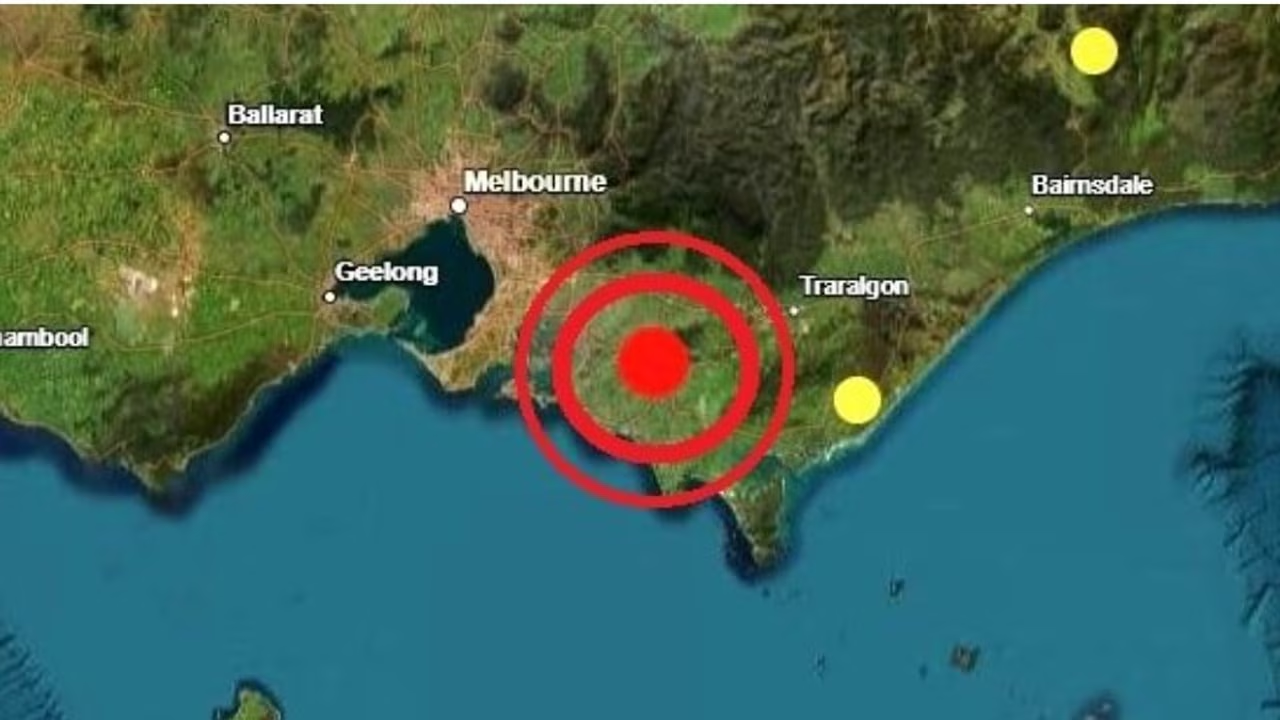
The state’s biggest earthquake in three years struck in the early hours of Saturday morning, shaking Victorians, including a baby boy, awake.
A 4.8 magnitude earthquake hit at 2.01am in what has been a wild few days of weather for Melburnians.
The earthquake epicentre was less than 20km northeast of Leongatha, but was felt more than 136km away in Melbourne, and even as far as Geelong and Torquay.
“It was absolutely wild,” one Leongatha resident said on Facebook.
“Woke me with mugs rattling together and then the windows started and then it was on.”
A Melburnian reported a “scary roaring sound and my bed shaking in Caulfield”.

Mum of five Anakin Martin shared a video of her 10-month old son, Sonny, saying he was “completely unbothered” by the rumbles.
The baby monitor over his cot captured the movement, showing him briefly wake before rolling over and going back to sleep.
Another camera in Ms Martin’s home in Korumburra, just 15km from Leongatha, recorded a loud bang and rattling sounds.
“It was so loud – the whole house was actively shaking,” Ms Martin told the Herald Sun.
“My five-year-old woke up straight away in a fright … my other children were completely oblivious.”
It comes as Melbourne is bracing for up to 30mm of rain on Saturday – two days after the massive deluge on Thursday left motorists stranded and emergency services overwhelmed amid flash flooding.
The rainfall has thrown doubt on whether the Turnbull Stakes race day would go ahead at a sodden Flemington with officials closely assessing the condition of the track.
Campers in parts of the Otways have also been warned to watch for rising floodwater, with up to 150mm of rain expected across the weekend.
“If you are camping close to a creek or river, you may be at risk of flooding and need to move to higher ground, away from waterways,” a State Emergency Service statement said.
A severe weather warning for heavy rainfall is in place for the Gippsland region.
SES volunteers have been bombarded with more than 400 requests for help from October 1 to 7am Saturday.
There were 128 requests for building damage, 134 for fallen trees and 91 requests relating to flood issues.
“With more rain expected today, we’re asking communities to stay vigilant and never drive through floodwater, especially for those in the warning area,” an SES statement said on Saturday.

No reports of any damage or injuries have been reported from the earthquake.
But more than 18,000 people have reported feeling the overnight tremors, sharing their stories of shock and confusion on social media.
“Woke me up on the 11th floor of my apartment building in Melbourne,” another user said.
A Belgrave resident commented: “Woke up the kids, & the frogs went completely quiet throughout.”
Less than an hour later a seismic aftershock struck, reaching a magnitude of 3.1.
Geoscience Victoria seismologist Dr Hadi Ghasemi said “aftershocks are always a possibility” and advised people who feel tremors to report what they felt to the Geoscience website when safe to do so.
“The data is extremely valuable to help us better understand the intensity of earthquakes in Australia and informs important decision-making tools like the National Seismic Hazard Assessment,” a Geoscience Victoria spokeswoman said.
Dr Ghasemi said aftershocks can be recorded for days, weeks, months and in some cases even years after the initial earthquake.
“Looking at our database over the past 20 years in a 100km radius from the recent event, we have actually registered more than 200 events just for that particular region,” he said.
He said the latest earthquake was the second largest in the region behind a 5.4 magnitude in Moa, 60km from Leongatha, in 2012.
Earthquakes occur when pressure ruptures deep within the earth.
The shakes and tremors, also known as seismic waves that people feel is the energy that is produced through the earth.
Dr Ghasemi explains that the complex process of earthquakes is similar to cracking your knuckles: “When you snap your fingers, there is a certain friction … when it snaps, then you hear that sound wave.”
“The tectonic plate we are sitting on is being moved northeast at the rate of 7cm per year … overtime this stress is getting accumulated and released in the form of earthquakes.”
While earthquakes can’t be predicted, Dr Ghasemi says past earthquakes are mapped to create a seismic hazard map to provide a picture of what we may expect.
The largest earthquake experienced in Victoria occurred in 2021, reaching a magnitude of 5.9 near the town of Rawson, 100km from Leongatha.
The Victorian State Emergency Service has confirmed online that there is no immediate threat to the community.
“If you felt the earthquake, stay calm, check for hazards, and be prepared for further possible aftershocks,” the statement said.
There have been no reports of any damage.
For earthquake related emergency assistance from the SES phone 132 500. Only call triple-0 (000) in a life threatening emergency.