
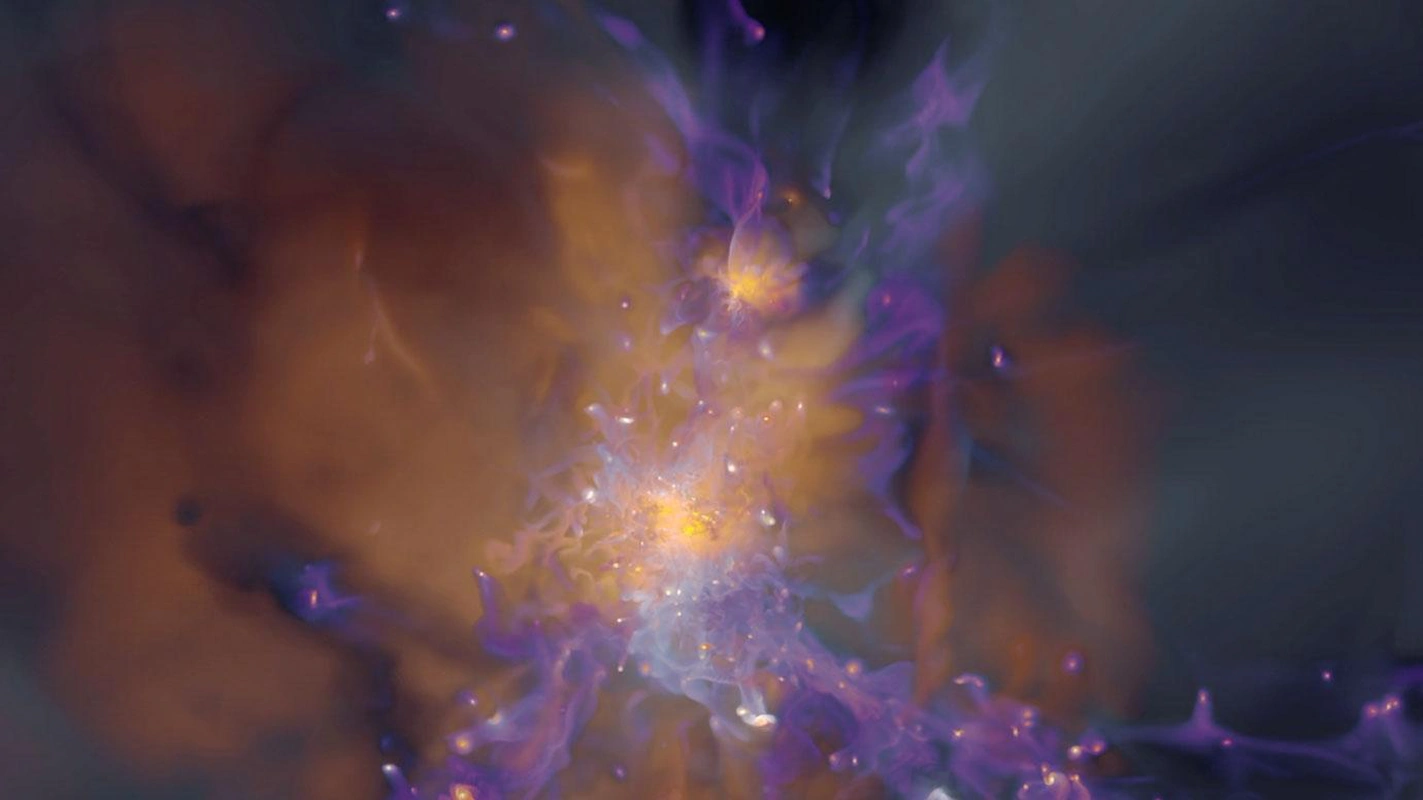
A three-year supercomputer simulation led by the University of Chicago suggests our galaxy started as a crowd of thousands of small ones, some of them without a single star. The same model offers a possible explanation for an old puzzle about iron, pointing to the very first stars in the universe.
Long ago, the patch of sky that would become our galactic neighbourhood looked nothing like a galaxy. It was a collection of thousands of smaller galaxies. Some were turning out stars at a frantic pace, others held nothing but gas, and others were littered with dead stars and black holes.
That is the picture drawn by MEGATRON, a set of computer simulations led by Harley Katz, assistant professor of astronomy and astrophysics at the University of Chicago. The results appear in six papers published on 30 September in The Open Journal of Astrophysics. The simulations took three years to run, even on high-powered supercomputers, and form the most detailed model so far of how a galaxy like the Milky Way may have evolved during its first several billion years.
To get a sense of the timescale, shrink the 13.8 billion years of the universe down to an 80-year human life. The simulation starts about 180 million years after the Big Bang, when that “life” is barely one year old, and follows the galaxy for two billion years, until the child is about twelve and a half.
Katz sums up the goal as a question: what does the Milky Way look like at “cosmic dawn”, the era when the first stars and galaxies were switching on? For the first time, he says, researchers can predict directly how the young Milky Way would have appeared to telescopes such as Hubble or the James Webb.
Rebuilding a place nobody can visit
Nobody can travel back to the early universe, so the alternative is to build a model from the laws of nature. Katz explains that the team feeds in all the physics it considers relevant (gravity, the motion of gas, light, chemistry) and lets the system evolve. Then comes the test: does it end up looking like the universe we see around us today?
What has changed recently is the yardstick. The James Webb Space Telescope, in science operations since 2022, has opened a window onto very young galaxies. Three years ago the team decided to build that knowledge into a model of the Milky Way’s first billion years, so it could compare the simulation with what Webb sees and find out what fits and what is missing.
Run the clock backwards and the simulation shows a web of large and small galaxies of every kind, all destined to merge into the Milky Way we know. The team follows thousands of these smaller systems and calculates how each would look through the most powerful telescopes, on a scale that Katz says goes far beyond earlier simulations. The variety is huge. Some of these systems are in a burst of star formation, some are already dead and some are on their way to dying.
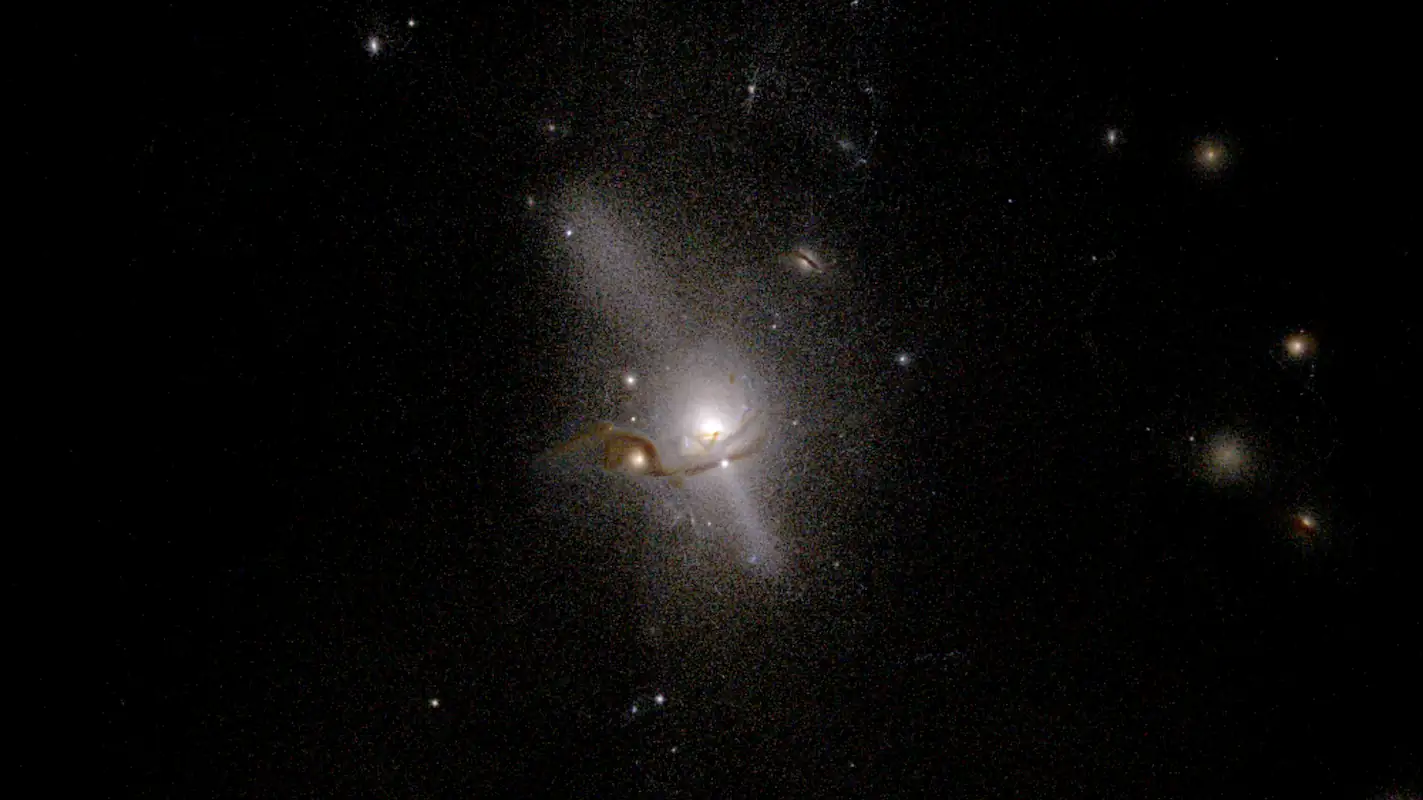 This image shows what our galaxy could have looked like 12 billion years ago. Though young, the galaxy could already have formed a rotating disk like we see today, with a significant amount of heavy elements and dust. The bands of light to the north and south are remnants from a gigantic collision of two galaxies, which left a trail of stars. Credit: Harley Katz/MEGATRON Collaboration
The main paper of the project, signed by Katz and almost thirty co-authors, describes a library of more than 175,000 simulated spectra. A spectrum is a galaxy’s light split into its colours, and astronomers read it to work out what the galaxy is made of and how old its stars are. According to the authors, the range of spectra that Webb has observed comes out naturally in the standard cosmological model, known as ΛCDM, which combines cold dark matter and dark energy. The simulations start from pristine gas that contains only the elements born in the Big Bang.
Galaxies that shine without stars
One of the most striking predictions is the existence of “galaxies” that contain no stars at all and still shine. Some of them may once have had stars that exploded or collapsed straight into black holes. Others may only ever have held gas.
The university’s announcement does not say what would make such objects glow, and it is not clear whether today’s telescopes could detect them.
An iron puzzle and the first stars
Iron is forged inside stars and scattered into space when they explode. In the Milky Way’s surroundings, smaller and fainter galaxies usually contain less of it. That trend breaks down in the faintest systems, where the amount of iron looks about the same whatever the galaxy’s mass. No simulation had managed to reproduce this behaviour until now.
According to the model, the culprits are explosions of an exotic kind of star left over from just after the Big Bang. These are the so-called population III stars. They are so old that they are made only of hydrogen and helium, the first elements to exist, and when they explode they can produce more iron than other supernovae. A galaxy that is big enough has the gravity to hold on to that iron. One that is too small loses it to space.
The technical detail comes from a paper led by Martin Rey, of the University of Bath. His team reports that the dwarf galaxies in MEGATRON reproduce the iron “plateau” seen in real ones. They link it to a particularly violent type of explosion, a pair-instability supernova, which blows the whole star apart. The intense ultraviolet light filling the young galaxy would have made such explosions happen inside dark matter clouds (the invisible “halos” in which galaxies sit) massive enough to keep the debris. The same study predicts that about one in five dwarf galaxies would be unusually poor in iron.
One caveat matters here. This is an explanation that comes out of a simulation and fits what we see in dwarf galaxies. It is not a detection, and no population III star has ever been observed directly. Another paper in the series is the first to show how these stars form in a Milky Way-like environment, and it predicts where they would be most likely to survive, if any still do. That could help guide the search.
As far as we have been able to check, this prediction corresponds to a companion study by Anatole Storck, of the University of Oxford, currently available as a preprint (a paper that has not yet gone through peer review). Its authors estimate that these stars formed at a steady rate of about one Sun’s worth of material every thousand years. Following their remains to the present day, they find that most would end up in the stellar halo, the faint, spread-out cloud of old stars around the Milky Way’s disk, and the rest in smaller systems such as satellite galaxies.
Chemistry that never sits still
Physicists often simplify a problem by assuming that a system’s chemistry is more or less in balance. Galaxies, however, are changing all the time, and that breaks the assumption. MEGATRON is the first large-scale simulation to calculate these “non-equilibrium” effects in detail, together with gravity, chemistry, light and the life cycles of stars. According to Katz, it is also the first to follow the build-up of individual chemical elements produced by individual stars after the Big Bang.
The researchers did not know how much this extra realism would change the results, and it slows the calculation down considerably. Two of the papers show the difference is real, especially in the gas surrounding galaxies, known as the circumgalactic medium. One of them, led by Corentin Cadiou of the Institut d’Astrophysique de Paris, compares its results with traditional equilibrium models. It finds, for example, that the hydrogen clouds that leave their mark on the light of distant galaxies can look quite different. That matters because those models are used to interpret real observations.
Three further papers in the series, with Nicholas Choustikov and Katz among the authors, deal with the ultraviolet colour of distant galaxies, with biases in how we observe their gas, and with the effect of the “recipes” (the rules programmers use to decide when and how stars form in a simulation).
Katz says the results show that the physics at work just after the Big Bang leaves a direct mark on the nearby universe. He adds that the simulation also gets some things wrong, which he finds just as interesting, because it raises the question of what are the parts we’re still missing?
A version of this article is also available in Spanish: Léelo en español
SOURCES
Harley Katz et al., MEGATRON: Reproducing the Diversity of High-Redshift Galaxy Spectra with Cosmological Radiation Hydrodynamics Simulations, The Open Journal of Astrophysics (2026). DOI: 10.33232/001c.169643
Martin Rey et al., MEGATRON: how the first stars can create an iron metallicity plateau in the smallest dwarf galaxies, The Open Journal of Astrophysics (2026). DOI: 10.33232/001c.169605
Corentin Cadiou et al., MEGATRON: the impact of non-equilibrium effects and local radiation fields on the circumgalactic medium at cosmic noon, The Open Journal of Astrophysics (2026). DOI: 10.33232/001c.169640
Harley Katz et al., MEGATRON: The Physical Origins of Steep UV Slopes at high redshift, The Open Journal of Astrophysics (2026). DOI: 10.33232/001c.169642
Nicholas Choustikov et al., MEGATRON: Disentangling Physical Processes and Observational Bias in the Multi-Phase ISM of High-Redshift Galaxies, The Open Journal of Astrophysics (2026). DOI: 10.33232/001c.158199
Harley Katz et al., The Impact of Star Formation and Feedback Recipes on the Stellar Mass and Interstellar Medium of High-Redshift Galaxies, The Open Journal of Astrophysics (2026). DOI: 10.33232/001c.156097
Anatole Storck et al., MEGATRON: The environments of Population III stars at Cosmic Dawn and their connection to present day galaxies arXiv:2510.06853