
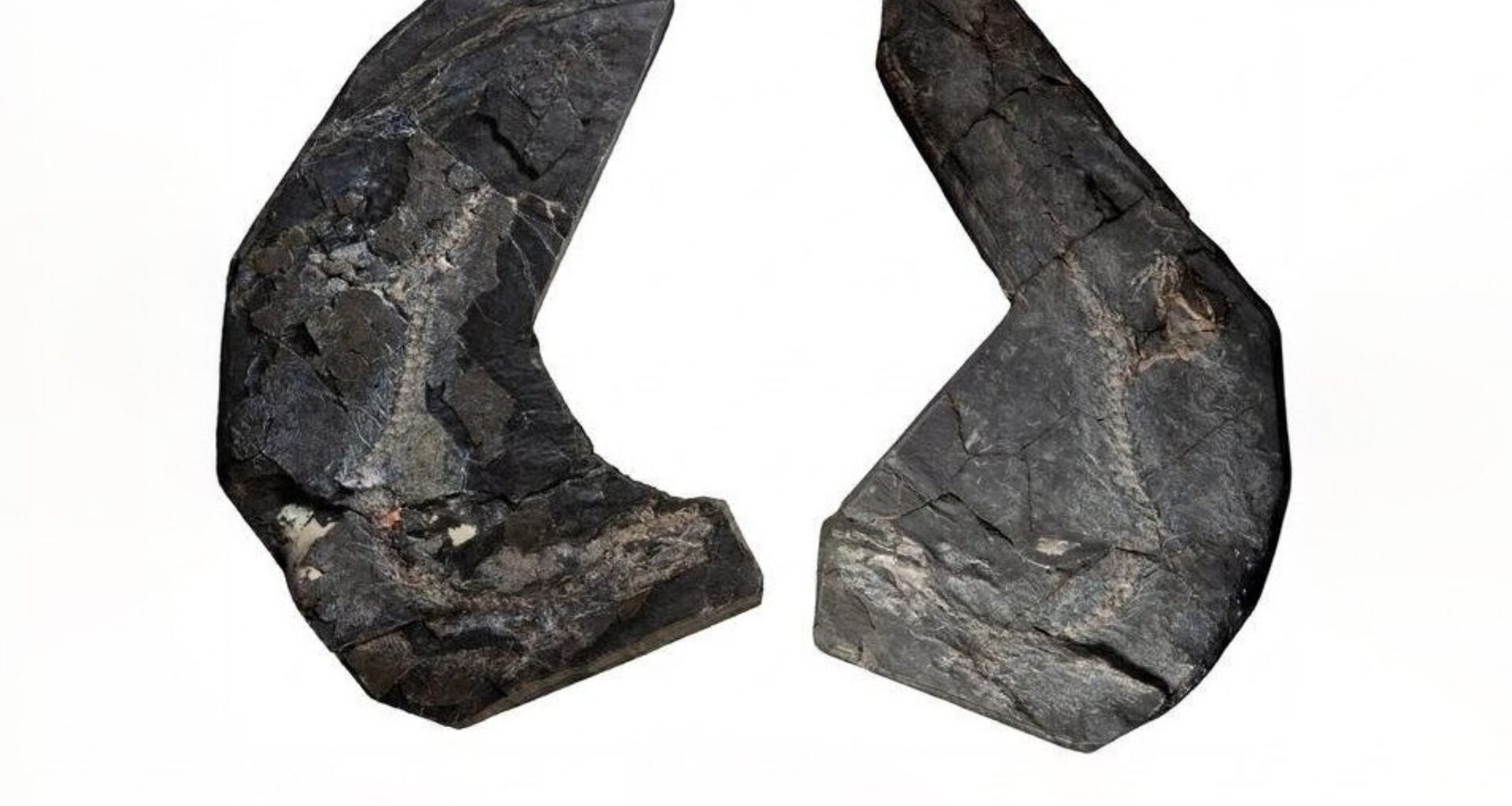
New scans of a 345-million-year-old fossil reveal that Westlothiana, once considered an early reptile, belonged to a far more ancient lineage.
For nearly 30 years, a small Scottish fossil has stood as one of the earliest known reptiles.
New research is now rewriting that story entirely, with technology that didn’t exist when the fossil was first studied.
The fossil, Westlothiana lizziae, nicknamed “Lizzie” for its lizard-like look, was discovered in 1984.
The new study was led by researchers at the American Museum of Natural History and the University of Oxford.
A fossil hidden in plain sight
Lizzie’s fossil dates back 345 million years. It was originally described from what was visible on the surface of two crushed rock slabs.
The nearly complete skeleton preserves four limbs, along with fingers and toes tipped with structures that appeared claw-like.
Such features set Westlothiana apart from many of its contemporaries. Most of those animals had more fin-like limbs better suited to life in the water.
The fossil itself is badly deformed and hard to read. Yet, it became widely cited as the earliest land-adapted amniote, a group of vertebrates including reptiles, birds, and mammals.
After its description in 1990, Westlothiana became a landmark fossil in discussions about when and how amniotes first evolved. It appeared in textbooks and evolutionary timelines for decades as a key transitional animal.
“Lizzie has been an icon for the early evolution of amniotes for decades,” said co-lead author Xavier Jenkins, a postdoctoral fellow in the Museum’s Division of Paleontology.
“But when we were finally able to see inside the fossil, we found an animal that looked very different from what we expected.”
Looking inside the rock
The researchers used X-ray scanning at the European Synchrotron Radiation Facility in Grenoble, France. That let them see through the surrounding rock and reconstruct anatomical structures invisible from the fossil’s surface alone.
Earlier researchers simply had no way to look past the crushed stone encasing Lizzie’s skeleton.
What they found changed everything. The scans revealed a primitive skull, ossified internal gills, and a fish-like mouth lined with thousands of tiny teeth.
Those features rule out Westlothiana as an early reptile or close reptile relative. Instead, they point to an animal that was aquatic or amphibious rather than fully adapted to life on land.
Ben Igielman, the study’s co-lead author, began this research during his graduate work at the University of Oxford.
“The surprisingly primitive features of the skull show us that Lizzie was not only not a reptile but belonged to a much more ancient lineage,” said Igielman.
“It turns out looks can be deceiving, and Lizzie lived a completely different lifestyle than we previously thought.”
Reptile traits that predate reptiles
The findings force a rethink of which traits actually define a land animal.
Researchers now conclude that several features once assumed exclusive to land-adapted amniotes – including claws and a foot structure with five toes on both hands and feet – had already evolved among earlier, more aquatic members of the broader tetrapod lineage.
Thus, traits long treated as hallmarks of land-dwelling life appeared much earlier, in creatures still tied closely to water.
“This is a big surprise,” said study co-author Roger Benson, the Museum’s Curator of Paleontology.
“It shows that, although we think of amphibians as being more ‘primitive’ than reptiles today, some of the traits of reptiles were already there in the ancestor of both amphibians and reptiles.”
The implications stretch beyond this one fossil. They also touch recent interpretations of fossil trackways used to argue that amniotes first appeared during the Devonian Period, more than 359 million years ago.
That argument has shaped debates about just how early the transition to land occurred.
Those trackways preserve the impressions of an animal walking on four limbs, its digits tipped with claw-like marks.
But if early tetrapod relatives like Westlothiana had claws, clawed tracks alone cannot prove an animal was an amniote.
Thus, some ancient trackways previously credited to early amniotes may actually have been left by more primitive, amphibious members of the tetrapod family tree. These animals may have never fully left the water behind.
“The broader lesson is that terrestrial-looking traits, such as a reptile-like foot, a weight-bearing forelimb, and claw-like phalanges were not unique features of tetrapods, but rather accumulated piecemeal in their close relatives, in animals that were still living in and out of the water,” Jenkins concluded.
The study is published in the journal Nature.
—-
Like what you read? Subscribe to our newsletter for engaging articles, exclusive content, and the latest updates.
Check us out on EarthSnap, a free app brought to you by Eric Ralls and Earth.com.
——