
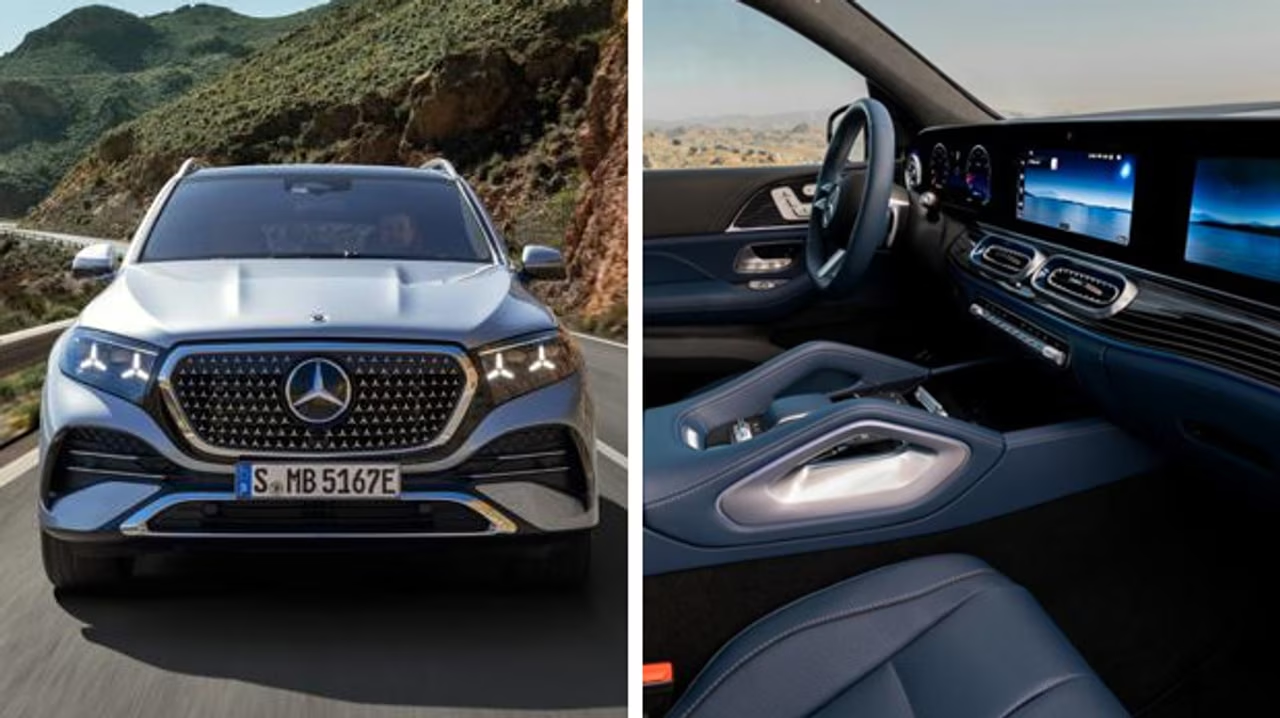
In the ultimate act of chivalry, Mercedes-Benz cars are warning each other about road hazards, so the next Mercedes can make the ride smoother for its passengers.
Cloud Sourced Damper Control as Mercedes calls it, takes data collected from its cars to influence the ride comfort of the next – like the courtesy of holding the door open for someone.
MORE: ‘You d***head’: Swearing car hits Aus roads
If a bump in the road is registered by the first Mercedes, the next connected Mercedes to pass by will make pre-adjustments to the car’s suspension settings to counter the bump before it is even reached.
Mercedes says the technology is intended to make the ride more comfortable for all passengers, but especially those in the rear who can feel the rebound of a bump in the road more than those in the front.

The driver need not do anything special, but an audible and visual alert advises them the car has taken action as the location is reached.
Once the issue is logged by the first Mercedes vehicle, the bump’s GPS location is registered in the cloud with data saved for two weeks. The data is not identifiable, meaning detail of the individual vehicle or driver is not known or saved.
The clever system is fitted to a range of new Mercedes vehicles including the new Mercedes-Benz GLE SUV which goes on sale in Australia next month and the range’s flagship S-Class limousine and E-Class sedan. To work, the cars must be equipped with the brand’s Airmatic adaptive suspension system, and connected to the Mercedes cloud system.
MORE: Popular Aus car hit with horror safety rating
Victorian drivers hoping this innovative technology could help save a rim repair or tyre replacement (like this journalist who has first-hand experience of the issue) will be disappointed. That’s because the system cannot mitigate for potholes or even speed humps, but has instead been designed for comfort.
Speaking at the launch of the GLE, engineers said they “can’t turn off physics” – so a pothole strike cannot simply be mitigated by making suspension changes, in the same way that a bump is addressed.
In addition to making life just a little more effortless for its drivers, Mercedes-Benz will use the same Car-to-X, or car-to-car data sharing smarts to form the backbone of its autonomous driving technology which will arrive soon in Australia.
At the launch of the Mercedes-Benz GLE, staffers confirmed that its own long-awaited version of Tesla’s full self-driving (supervised) will arrive next year – in countries like Australia where Level 2++ is allowed.
The key difference between the Mercedes Level 2++ and Tesla FSD (Supervised) programs is where the driver’s hands go. Tesla’s system is designed to let drivers take their hands off the wheel, using an in-car camera to watch their eyes and check they’re paying attention. While the car gives visual alerts that hands must remain on the steering wheel, it does not penalise a driver for keeping them off for extended periods, only if their eyes stray from the road too often.
Mercedes says it is taking a stricter line. Its system, already on sale in China, can also guide a car through turns and roundabouts, but the driver must keep their hands on the wheel at all times. Let go and ignore the prompts, and the car escalates its warnings until it eventually applies emergency braking.
It’s a more cautious approach than Australian law currently prescribes. Road rules require drivers to keep “proper control” of their vehicle but don’t specify whether hands must stay on the wheel.
Some states have recently issued their own guidance. Western Australia’s transport department advises drivers to keep both hands on the wheel when using supervised driving tech, and Queensland says one.
MORE: ‘Great move’: plan to end EV incentives
With supervised Level 2 systems already legal on Australian roads, drivers here are likely to be among the first in the world to experience the Mercedes approach to self-driving, after China which is currently the only market where the system is enabled.
Some current models including the latest Mercedes-Benz S-Class, upcoming GLE and GLS already carry the full sensor hardware, so when it’s ready, Australian owners will receive the feature via an over-the-air update. There’s no word on whether a specific subscription price might apply as per Tesla FSD (Supervised) but the system is likely to require an ongoing connection to Mercedes me, the brand’s connected car package which features paid tiers.
Originally published as Mercedes-Benz’s new system now warns other drivers about road hazards