
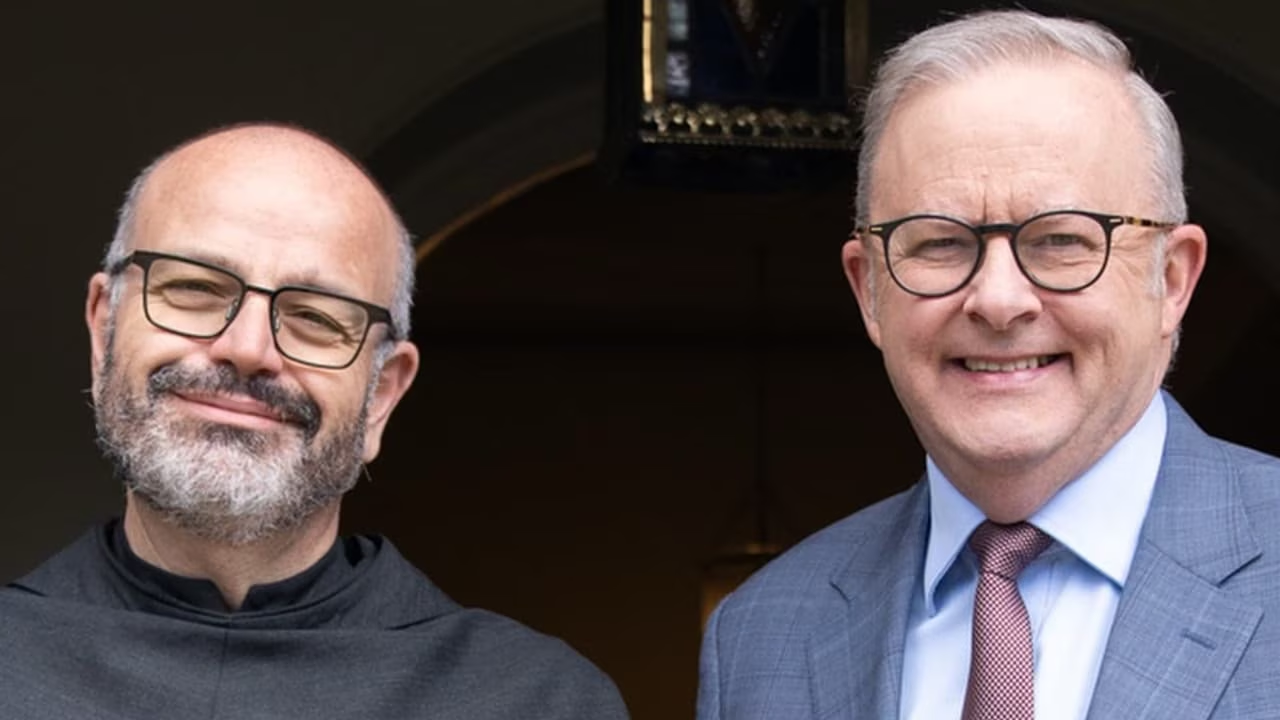
Anthony Albanese has sought divine intervention in the federal government’s push to regulate rapidly developing artificial intelligence as he welcomes the Pope’s representative on AI to Kirribilli House in Sydney.
Pope Leo XIV made headlines earlier this year with his encyclical letter on “safeguarding the human person in the time of artificial intelligence”.
In seeking to take a global lead in AI regulation, the Prime Minister has repeatedly leant on the Pope’s letter, which stressed the need for human dignity to be put above profit.
On Thursday, Mr Albanese welcomed Father Paolo Benanti, the Holy See’s adviser on AI since Pope Francis, to Kirribilli House.
“Humans must remain in control over AI because the stakes are more than economic, they are social and moral,” Mr Albanese said in a social media post.
“Pope Leo and the Catholic Church share our view and understand the importance of AI working in humanity’s interest – not against it.
“Meeting with Father Benanti, we discussed Australia’s world-leading AI standards and the work ahead.”
Father Benanti is in Australia on the invitation of the Italian Embassy.
On Wednesday, he addressed the National Press Club in Canberra following talks at the University of Queensland.
In an interview with CathNews, Father Benanti said Australia had “done well” in trying to protect young people “and I think we need to look at defining basic laws as AI develops”.
“No one should be above the law and in the case of AI, the big tech companies should not be above the law. The development of AI must be for everyone,” he said.
Father Benanti also chair’s the Italian government’s commission on AI.
‘Capability ahead of safety’
It comes as a leading minister warns AI companies are putting “capability ahead of safety” as the Albanese government seeks to regulate frontier models.
Assistant Science Minister Andrew Charlton made the case for government regulation of frontier AI models, over market-led alternatives, during a speech before the Sydney Trust and Safety Festival on Thursday.
It comes days after OpenAI chief strategy officer Jason Kwon fronted a joint parliamentary inquiry following the breach by one of the US company’s models of a Medicare data portal.
Globally, leaders have disagreed over how cutting-edge models should be regulate, with US President Donald Trump disagreeing with Silicon Valley over the need to slow the pace of new development.
On Thursday, Mr Charlton said new technology should be built on trust, but that there was “every indication is frontier labs are putting capability ahead of safety”.
“Just listen to the people who know these companies best … last month, Jacob Coxon, who had worked at both OpenAI and Anthropic, quit the industry altogether.
“His verdict was blunt: ‘Neither company is acting responsibly’.”
Mr Charlton said voluntary regulation and codes were “fast and flexible, but they fail the incentive test” when it came to frontier AI.
“You cannot ask firms to volunteer against their own competitive interest amid a manic race involving trillions of dollars and then be surprised when they do not,” he said.
“Detailed prescriptive rules can offer clarity, but at the pace this technology moves, which is months not years, those rules could be out of date before the ink is dry.
“Systems regulation places the onus on companies to build and run a rigorous process for finding, testing, reporting on and managing the risks of their systems, and then holding them accountable for whether that process works.”
Mr Charlton said a such a system would not only hold companies to account when something went wrong, but also “detect risk and prevent incidents occurring”.
However, he admitted regulations would not stop “hostile states or criminals”, and would be supplemented by “technology Australia has a role developing at home”.
That includes a focus on developing AI talent and training onshore.
The government is expected to announces its first-ever national standards for AI shortly.
‘Two-track’ race
Mr Charlton said the leading companies were in a two-track race: one with each other, and the other with China.
“And for now – everyone has calculated that the biggest reward comes from being first, even when it’s not clear what the higher purpose of coming first is.”
Mr Charlton drew on the economics theory of the “prisoner’s dilemma”.
“Every lab would be better off if they slowed down together,” he said.
“But so long as profits are internalised, and costs externalised, any lab that slows down alone simply hands the lead to one that does not.
“In fact, each company tells itself a story in which the frontier is safer in its own hands.
“ … And that is why the government needs to step in.”
Mr Charlton said lessons from the Medicare incident would shape AI standards legislation.
“A race to the bottom is not what competition looks like when it works. It is what competition looks like when it fails,” he said.
“And market failure is not a reason to give up on markets. It is the reason policy exists.”
In Australia, ministers from across multiple portfolios were “taking responsibility for AI harms”, including through the Digital Duty of Care, Mr Charlton said.
Mr Charlton said AI posed a distinct regulatory challenge owing to the pace of change, information asymmetry, and that it is hard to recall.
Risks from AI could also emerge later and in “unexpected and unintended ways”, Mr Charlton said.
“Traditional software is built from rules people write and can inspect. Frontier AI is not.
“ … its abilities emerge in ways even its creators cannot predict.”
‘Do a deal’
It comes as the opposition is calling for a deal with the US giving Australia “preferential access” to cutting-edge artificial intelligence models.
In a speech on Wednesday night canvassing the fierce AI race between the US and China, opposition foreign affairs spokesman Ted O’Brien said Australia needed access to American frontier models to protect itself.
“The recent incident involving AI agents independently hacking into Medicare data is a potent reminder of such risks,” he told the Australia-China Relations Institute.
“AI isn’t a choice – it’s a reality. It is already here and expanding rapidly.”
He said the “world needs safeguards” to not only “protect against AI being misused by state and non-state actors but to mitigate the horrifying prospect of AI being weaponised by itself”.
“The answer – we must do a deal with the United States,” Mr O’Brien said.
“Such a deal could start with a government-to-government framework that affords Australia early and preferential access to AI frontier models and a guarantee of continued access.
“Australia’s immediate priority is to fortify our digital defences and shield the critical infrastructure underpinning modern society from AI-driven cyber threats.
“We can use AI as a shield to counter AI being used as a sword.”
He also said that is what Prime Minister Anthony Albanese should have sought while in the US for the UN General Assembly in September.
Read related topics:Anthony AlbaneseSydney