
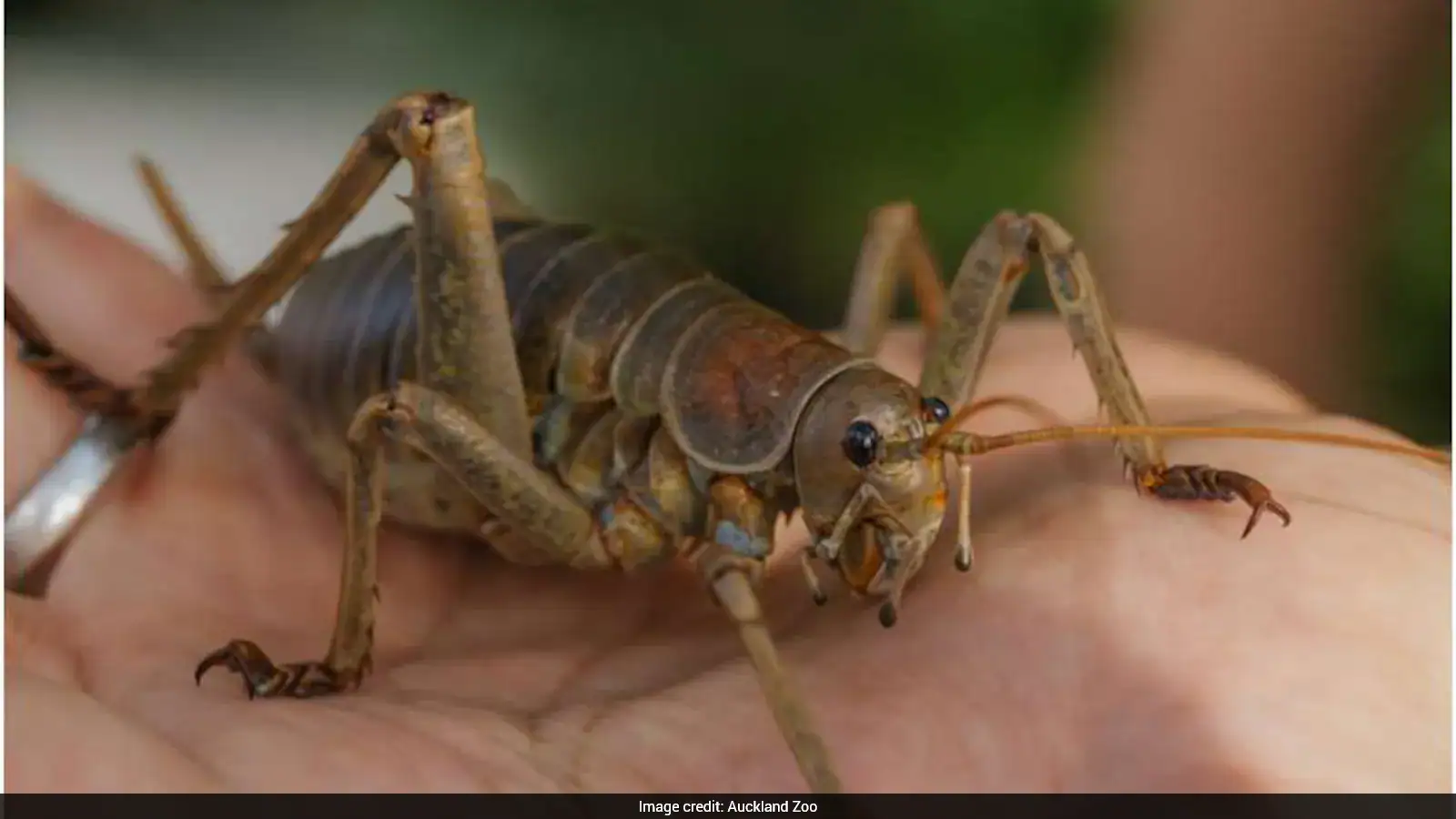
The population of wetapunga, the world’s heaviest insect, has been brought back from the edge of extinction, with conservationists successfully releasing around 11,000 of the creatures into safe wild habitats after a 15-year captive breeding effort in New Zealand, The Guardian reported. The wetapunga is a species of giant weta native to New Zealand. Females can grow up to 4 inches (10 cm) long and weigh around 70 grams, making them roughly the weight of a small mouse.
Wetapunga were once widespread across Northland and Auckland. But their populations collapsed during the mid-20th century due to habitat loss and predators like rats and cats introduced by European settlers. By the 1990s, the species was declared endangered, surviving in the wild on only a single refuge: Te Hauturu-o-Toi (Little Barrier Island).
Also read | 194-Year-Old Giant Tortoise Shares Genetic Secrets To Long Life
Conservation teams led by Auckland Zoo and Butterfly Creek launched a captive breeding programme in 2010 because the wild population was too small to relocate directly. Over 15 years, staff hand-reared young nymphs on diets of fresh leaves, fish protein, and leaf litter before transferring them to predator-free offshore islands.
Across 45 separate relocation efforts, more than 11,000 wetapunga have been released into 10 new wild sites. According to findings published in the New Zealand Journal of Zoology, self-sustaining, breeding populations are now established, with fourth- and fifth-generation insects born naturally in the wild.
“The future of wetapunga is looking bright,” Dr Chris Green, an honorary researcher at the Department of Conservation, said as quoted by the media outlet. “Eleven thousand individuals for release is extraordinary and outstanding.”
Also read | 61-Year-Old Holds Plank For 5 Hours To Break World Record, Internet Calls Her ‘Amazing’
Dr Green is the one who documented the success of the project for the New Zealand Journal of Zoology and also co-authored a report released on 2 October that outlines the success of the breeding programme.
“It’s so exciting, because we are unable to report that for so many of our other threatened species,” Green said.
New Zealand’s Department of Conservation officially upgraded the wetapunga’s status from “nationally endangered” to “nationally increasing” after the success of the programme.
“That’s the extraordinary aspect of it – that we’ve been successful,” he said. “If other institutions can get into that sort of position, then there can be huge benefit for threatened species in New Zealand.”