
There has been a boom in counterfeit cash being detected across Australia, with businesses from bakeries and barbershops to supermarkets and fast food joints all targeted by the troubling trend.
Western Sydney barbershop owner Laith, who did not wish to share his surname, was recently given a fake $100 bill from a customer.
Want more finance news? Download our new app for even more coverage
He only realised the bill was dodgy when he went to deposit it at the bank, and they refused to accept it.
“We hardly get cash anyway. But the thing is, we just opened, businesses are struggling as is, let alone dealing with this stuff,” he told news.com.au.
The quality of counterfeit cash has been improving, authorities have warned, with current notes printed on plastic and often feeling similar to legitimate tender.
Laith’s business, Two Razors, which only opened six months ago, ended up losing $70 to the scam and he is urging other businesses to be “vigilant”.

It’s not the only business that has been dealing with fake cash from customers
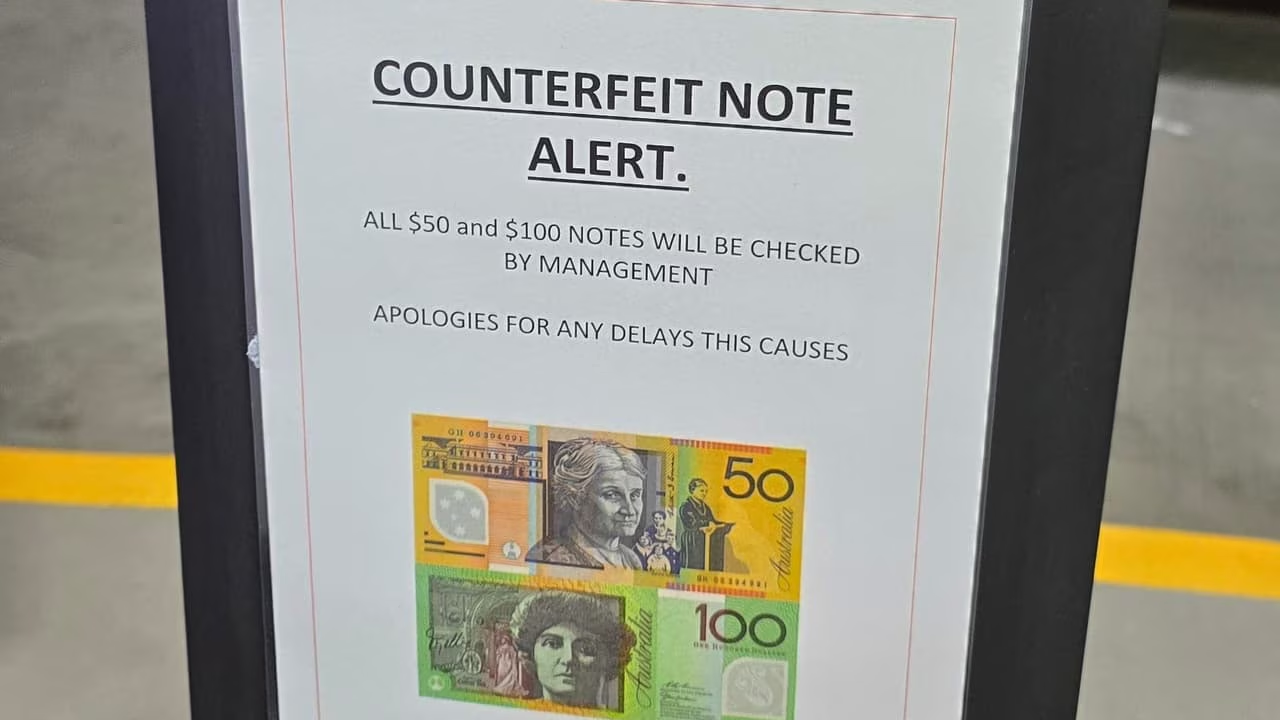
One McDonald’s store on the New South Wales Central Coast has put up a counterfeit note alert for customers at the drive-thru.
“All $50 and $100 notes will be checked by management,” the sign reads.
“Apologies for any delays this causes.”
A McDonald’s spokesperson confirmed to news.com.au a number of McDonald’s restaurants across Australia used counterfeit note detection devices where required.
These devices have been available within the McDonald’s system for more than 15 years and are used by restaurants to help verify the authenticity of banknotes.
Other businesses like service station P Express have also installed scanning machines, while supermarket Drakes is doubling down on training staff to identify the fakes after seeing a rise in fake $50 and $100 notes used in stores.
Counterfeit cash hits 8-year high
Newly released data from the Reserve Bank of Australia (RBA) revealed counterfeit banknotes are at an eight-year high in Australia.
The data, which was analysed by Bond University associate professor in criminology Terry Goldsworthy, showed 40,613 fake notes were caught in the 12 months to March 31 this year.
The vast majority of them – 95 per cent – were $50 and $100 notes.
The rate of fake note detection reached 20 notes per million, the highest level since June 2018. It marks a 277 per cent uptick in 15 months, up from a low of 5.3 notes per million in December 2024.
But it’s still lower than the peak of 30 notes per million recorded in June 2015.
In August, the Australian Border Force (ABF) revealed a substantial increase in counterfeit currency detections in air cargo and international mail imports since early 2025.
It warned there had also been a “concerning improvement in the quality of counterfeit notes”.
In the 2025-26 financial year, the ABF made 700 detections of counterfeit cash entering the country, with a combined face value of more than $6 million.
This was more than 50 times the number of counterfeit currency imports detected the previous year, when 13 detections were made valued at more than $115,000.
“The quality of counterfeit banknotes is improving, which increases the risk of people unknowingly accepting them as genuine currency,” ABF superintendent cargo operations David Henderson said.
“We encourage members of the public to familiarise themselves with banknote security features. Early identification of counterfeit notes plays an important role in protecting businesses, consumers and the broader community.”
How to spot a fake note
Police across Australia have been urging Aussies and businesses to be vigilant and check their cash.
Tasmania Police recently issued a warning over fake $50 notes circulating in Launceston, which they said “look quite similar to the real thing”.
“When accepting any notes, please be vigilant and double-check they’re not counterfeit,” Tasmania Police wrote.
“Sometimes it can be hard to tell, but consider: Does it feel right? Is the clear window part of the note, rather than attached to it? Can you see a rolling colour effect, or movement in the pictures when tilting the note?”
While the number of counterfeits is increasing, the RBA said there were differences between fake and genuine banknotes people can look for.
That includes the feel of the note and looking for key security features like the seven-pointed star and the Australian Coat of Arms, which should be visible when you hold older style notes up to the light.
For newer notes, you should be able to see the bird’s wings move and change colour and the number in the building change direction on the note.
“It is an offence to knowingly possess or use counterfeit banknotes. Suspect banknotes should be given to your local police,” the RBA advises.
“Counterfeits have no value – you will not be reimbursed. If they are determined to be genuine banknotes, they will be returned to you.”
‘Please don’t’: Business’ plea
For small businesses like Two Razors, the scams are just another blow in what is already a difficult operating climate.
The business shared the fake $100 bill it received on social media, saying it had forgiven the person who gave the fake note.
“We believe in second chances. We won’t expose you. But please don’t scam small businesses. It’s hard enough keeping the doors open without being scammed,” the business wrote.
Owner Laith said it was becoming “harder and harder” to run a business in the current economy and he had noticed customers had gone from getting a haircut every three to four weeks to every one to two months.
“People are trying to save even with haircuts. So I can see my next door cafe, I can see everyone struggling. Like we’re barely opening the shop, like leaving our doors open. The last thing we need is something like that,” he said.
His message to other Aussies was simple.
“Please help your local business. Your businesses are struggling. Obviously, don’t pay it with fake money, 100 per cent, but wherever you can, help your local business because they are bleeding at the moment,” he said.