
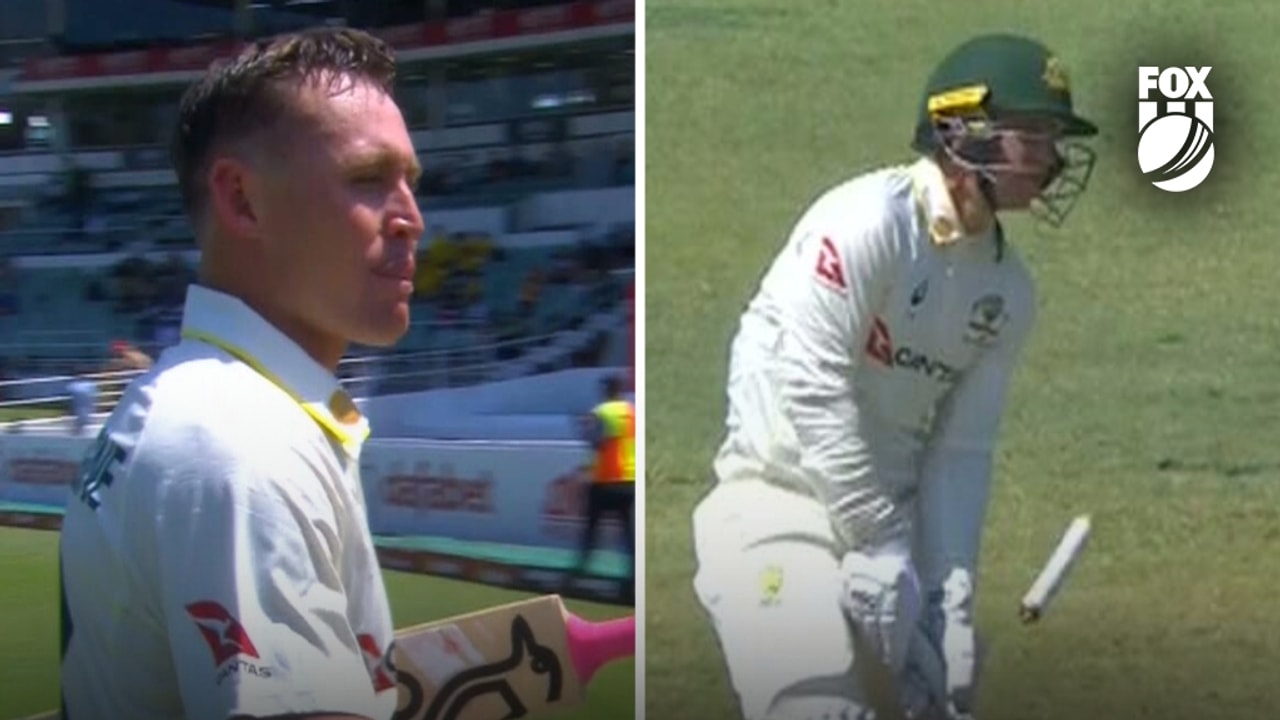
Australia’s latest selection gamble has come under fire after another shaky batting display against South Africa, with Pat Cummins’ call to embrace the “grind” again put to the test.
The skipper eventually showed the way with a late fightback alongside Matt Renshaw, before bad light brought an early end to a dramatic opening day in Durban.
Watch Australia’s Tour of South Africa Live & Exclusive on Fox Cricket, available on Kayo Sports.

Scroll down for the biggest talking points from day one in Durban!
WRAP — Captain Cummins leads vital fight back as all too familiar Aussie tale rears ugly head
‘THROWING DARTS’: AUSSIE GREAT UNLOADS ON SELECTORS
Australian greats including Mark Waugh are wondering if the current side have been set up to fail given the “chopping and changing” that sparked a furore this week when Travis Head took umbrage to the stinging critique from Matthew Hayden.
The Australian selectors have been adamant that the best six batsmen in the country should be able to bat anywhere, an unorthodox approach that has not curtailed their success … yet.
But Waugh said the changes have to prove detrimental at some stage, saying players are specialists in certain positions.
“It looks like the selectors are throwing some darts at the dartboard and hoping to get a bullseye, hoping something’s going to pay off,” Waugh said.
Nic Maddinson’s return to the Australian Test side after a decade away ended with a 33-ball duck.Source: AP
“I mean, what do they say to Connolly? Because he’s played ODI cricket recently. He looked pretty good. He can bowl left-arm orthodox on a pitch that’s going to spin.
“So how do they say to him, ‘Sorry, we left you out for Nic Maddinson, who hasn’t played for two years?’ I think there’s a lot of gambling going on. A lot of gambling going on.
“I mean, the players, yes, they’ll say they’ll bat anywhere, but any player likes to really know their role.”
It is a point backed by Simon Katich, who is in Durban commentating for SEN alongside Kayo Sports broadcaster Gerard Whateley. The left-hander was bemused by what had unfolded.
“How can you keep justifying the chopping and changing and some of the decision making?” Katich on SEN
“There is a certain type of player who can handle roles in Test cricket and that is why the order is important.
“The question is are they putting the right types of players in the right types of roles. At the moment, the engine room, the top four, South Africa has exploited them again today. And it has been like that for a while.”
Brendon Julian was incredulous that Renshaw, having been brought back into the fold as an opener in place of Jake Weatherald, found himself trying to dig Australia out of trouble at No.5.
Maddinson exposes selectors ‘gamble’ | 01:18
“It worries me about Renshaw. The batting gets mucked about a bit,” he said.
“He comes in for one Test (and) all of a sudden he’s batting five and he’s shuffling all around the order to fit in someone else that hasn’t played for a long, long time.”
Renshaw, for his part, was told he would be batting at No.5 on Thursday and said the switch back down the order did not particularly bother him given he had been batting in the middle-order in one-day internationals for Australia.
“I just prepare as much as I can for whatever,” he said.
“I think me in the one dayers, batting in that middle order, shows I’ve done it in the past in middle order and it shows that I can be pretty versatile. That was the thinking, just … continuing on from that successful one-day tour.”
While Waugh also had concerns about all-rounder Beau Webster batting below wicketkeeper Alex Carey, declaring “it’s just not the Australian way”.
Maddinson and the Australians still have another innings, of course, to right the wrongs of the opening morning and prove the selectors “gamble” correct. And Renshaw said the South Africans bowled well on a track that had surprising bounce.
“They bowled well. They bowled tight. They did not give us much to score (from),” he said.
But Kerry O’Keeffe believes the selection of Maddinson was made because they do not have faith in those coming through the system.
“The thing was, Maddinson is dispensable, isn’t he?” he said.
“At 34, if it doesn’t work out, the younger crop will start to get their caps. But I think they were scared.”
Those younger players will surely have to emerge soon as Australia is fielding its oldest Test team in nearly a century this Test.
The average age of 34.59 is the seventh oldest of all-time – the six older teams were all in the mid-to-late 1920s.
DAD’S ARMY?
It is a description cricket teams hate and the Australians have made a habit of defying the norms in recent years on a number of fronts, including a willingness to be flexible with the batting order.
But a fact is a fact and the Australian team which took to the field in Kingsmead created history yesterday as the first from the nation in which the entire XI was aged over 30, with the average almost 35 years old.
It is the oldest team in nearly a century and the seventh oldest on record for Australia, with the six sides aged older all featuring in the 1920s.
In an extraordinary situation, Matt Renshaw is the youngest player in the team and he made his debut a decade ago.
While the Australians are winning, the issue with age has not been considered a problem, but the loss in Darwin prompted greats including Ricky Ponting to declare it was time to regenerate the team.
Creating a history on a day where the Aussies lost its first four wickets for under 100 ensured the spotlight was again on the age profile of the team, particularly with Nic Maddinson preferred to one of the few youngsters in the squad in Cooper Connolly.
In August, coach Andrew McDonald acknowledged poor results would sharpen the focus on the experienced team while defending the policy to continue on with veterans.
“It’s always going to be a conversation, the age profile of the team, where we’re at, how we’re travelling. A loss doesn’t help that,” said McDonald.
“But these players have got a fair bit of cricket left in them, I believe.
“The easy option is to call for change. A lot of people call for change even when we’re winning. They’re entitled to do that as well on the back of a performance like that. Why wouldn’t they? That’s part of our lot.”
Should the Aussies prove unable to swing the Test their way on the second day in Durban, expect those calls to strengthen.
THE SKIPPER SHOWS THE WAY
Pat Cummins has been urging Australia’s batsmen to put a price on their wicket, to dig in and try to build partnerships that take the sting out of the opposition.
It was his rallying cry after the debacle in Darwin and on the eve of this Test he urged the team to grind out the game, saying it was important for success.
On an almost day for Australia – had Labuschagne survived the final ball of the first session and Smith the first over after lunch – the tourists would be far-better placed.
But the Australian captain followed his words with action when partnering Matthew Renshaw to the side’s best partnership for the day, an unbeaten stand that sits at 63.
Former Australian batsman Simon Katich, who made a century in Durban back in 2009, said the partnership had the potential to swing the momentum to the tourists if it continues, noting the bounce on offer should suit the Aussie pace attack and Nathan Lyon.
Pat Cummins led Australia’s fightback with the bat, combining with Matthew Renshaw for an unbeaten 63-run partnership.Source: AP
“What is changing is the momentum here with this partnership,” he said on SEN in Durban.
“A score of 250 might actually be a pretty good score given what we have seen from the conditions here.”
Cummins and Renshaw profited as the ball became softer, which adds to the frustration surrounding the loss of Smith and Labuschagne after they had both posted a start.
But it is an important innings for the Australian captain, particularly as his average against South Africa is the worst from his record against all countries.
The Aussie skipper averages just 10 runs against the Proteas, which includes the fighting 50 he made in Johannesburg back in the infamous 2018 series.
Cummins fought hard at a time when Anrich Nortje was whistling deliveries past his ears shortly before play ended prematurely at 3.22pm due to fading light.
Marnus downed on the stroke of lunch | 01:51
Katich said the captain’s plea for the side to grind through difficult periods made sense, noting that wickets fell in clusters during the opening day.
“It is a basic of Test cricket,” he said.
“You get in a partnership and once you are in, you don’t give them a sniff because you don’t know what is around the corner.
“Australia, if they want to win this series, that is an area they are going to have to really knuckle down on. They need to make it easier for the next guy coming in.”
READ MORE
‘GET THE SANDPAPER OUT’: Smith’s unexpected reception in moment everyone was waiting for
‘CRUEL TO WATCH’: Brutal records in ‘nervous’ 33-ball duck nightmare after ‘bizarre’ Test call
Renshaw acknowledged there were periods where the Australians felt they were in control, only to receive a good ball from their rivals.
“I think (there were) moments in the game where I felt like we were getting close to having the foot on the throat and probably Kez and I were very close (to that),” he said.
“We got through a good spell from (Marco) Jansen after lunch and then a good spell from (Anrich) Nortje. I think we were very close to the getting the foot on the throat.
“Unfortunately Kez got out there and then with Paddy it was just about rebuilding (and) scoring when we could.”
SPEEDSTER’S CHAT WITH AUSSIE ICON REVEALS NEW AGE
Pat Cummins wanted Australia to embrace the grind against South Africa, concerned the nation’s Test wins were coming from individual brilliance rather than tough cricket.
But the captain’s call on Thursday failed to translate into any grittier batting from Australia which squandered a golden chance to set the tone for the series after winning the toss.
Marnus Labuschagne had done the hard work before falling on the last ball before lunch. Steve Smith looked to have found his rhythm, only to fall in the first over after the break.
Travis Head was unlucky. Nic Maddinson endured an awful moment. And Matt Renshaw somehow went from opening to No.5, the position Aussie greats feel Head should be batting.
The quality of the South African bowling aside – and that attack will only get stronger as the series progresses if Kagiso Rabada finds full fitness – there was precious little grind.
Renshaw and Alex Carey attempted to do so during the middle session but the gloveman succumbed to feisty spell from returning speedster Anrich Nortje – who last played a Test in 2023 and had not bowled more than four overs in a match since an ODI against Australia leading up to the World Cup that same year.
Steve Smith looked to have found his rhythm before falling in the first over after lunch as Australia’s batting struggles continued against South Africa.Source: AP
When Nortje had Beau Webster caught behind on review, Australians feared another fast forward Test match with three of Australia’s last seven Tests ending in two days.
This was not a spicy surface, however, even if it seems that the general rule in the Test arena right now is that ball dominates bat.
Former South African speedster Vernon Philander played golf in Cape Town last week for Kayo Sports favourite Brett Lee and the chat turned to how life was easier now for bowlers.
“I had a chat with Binga … and he said how hard it was to bowl to certain batters once they got in, as opposed to the modern day batter who always wants to take them on,” he said on SEN.
“That is why we don’t see the big averages with batters these days. There are only a handful of guys who are averaging more than 45. It is because guys are trying to take it on so early.”
READ MORE
DAY 1 AUS V SA WRAP: Captain Cummins leads vital fight back as all too familiar Aussie tale rears ugly head
AUS A DOMINATE INDIA A: Next-gen Aussies run riot again as young guns seal India series in another demolition
CROWD UNDERWHELMS
Brendon Julian had warned last week that there were few places more hostile towards opposition teams than South Africa, particularly when fielding at fine leg.
But in an indictment given the clash between the world’s two top-ranked Test sides and the rich history of cricket between Australia and the Proteas, the crowd in Durban was poor.
This is despite the opening day of the series being played in idyllic conditions, with the sky clear and the temperature edging towards 30C with barely a breath of wind to be felt.
Kingsmead Stadium is ageing but picturesque, with grassy hills reminiscent of what made the WACA in Western Australia such a special spot to watch cricket before its upgrade.
Unfortunately for South Africa, and in a clear concern for the longer-term future of Test cricket, the crowd in attendance was similar to those who used to watch Western Australia.
In the days leading up to the Durban Test, there were concerns on social media as to whether Kingsmead would draw a crowd befitting a rematch between the 2025 World Test Championship finalists. And they played out on Friday.
Experienced South African journalist Firdose Moonda canvassed the prospect the match would be a fizzer, at least in terms of drawing fans, on the eve of the first Test.
She reported that ticket sales for the opening three days ranged between 7,500 to 8,000 per day, but it would be a surprise if there was half that figure in attendance on Friday.
The perfect weather is a factor, with beautiful beaches just up the road. It is a problem Western Australia has to deal with as well.
This series is held in the midst of a school term – the crowd was inflated on Friday by hundreds of local schoolkids using the hills as a school ground – does not help.
There is also a stagnant economy and the violence that unfolded on Thursday not far from the ground to consider as well, with several cars and businesses torched in protests.
It was notable during the second session when Matt Renshaw and Pat Cummins were at the crease that police helicopters were doing fly-overs close to the ground.
But on Saturday up to 50,000 fans are expected to attend a soccer game between two strong domestic sides, which demonstrates there is still a strong market for live sport here.
“Now, the home fans have the opportunity to see what almost every opposition including Australia describes as a “world-class” team in action against the side that has historically brought out both the best and the worst in them,” Moonda wrote.
“They also have the chance to see Australia for the first time in eight years. Whether they will take to it could well be seen as a measure of how successful Test cricket can continue to be in countries outside of the Big Three, especially as a WTA expansion is on the cards, but that feels like unfair pressure.
“It could well be as simple as that the cricket-watching culture in many cities of South Africa is different to what it is in places like Australia and England and that people check scores and news updates in-between going about their day. It would be a shame if the success of the South African Test team is measured on the size of the crowd but imagine if the latter does right by the former. By the end of this month, we will find out.”
Hayden Canham flew in from Cape Town to attend the game and said there was much to like about watching cricket at Kingsmead on a “beautiful day with a good batting pitch”.
But he is concerned the scheduling of the series will also have an impact on the crowds, noting the second Test in Gqeberha starts on a Sunday, while the finale in Cape Town begins on a Tuesday, meaning most people are either at work or at school.
“That is definitely going to have an impact on how many people can get there, which is a shame, because we want to watch the best cricket on offer,” he said.
PROTEA GREAT’S BAD LIGHT WARNING COMES TRUE
As former South African skipper Dean Elgar was previewing the series on The Follow On podcast in September, the Protea offered a warning about the timing of the series.
October, he said, was an unusual time to be playing Test cricket in South Africa given the potential for time to be lost due to poor light and inclement weather.
It took just over two sessions for the recently-retired opener’s assessment to be proven correct, with the lights flicking on at Kingsmead at 2.45pm before play was halted less than 45 minutes later. Stumps was called shortly before 4pm.
What had started as a magnificent spring day soured as clouds rolled in after midday, with play cut short with 25 overs remaining.
“It’s not ideal, especially with the venues as well. I mean, the bad light is going to come into play,” he told The Follow On.
Poor light brought an early end to the opening day in Durban, with 25 overs lost after play was halted.Source: AP
“(There are) going to be dead rubbers. You will go five days and then bad light is going to be the man of the match, which is a bit sad. You don’t want that against Australia.”
Renshaw said the Australians were happy to take the light when it was offered, noting the presence of a LED screen near the sight screen made it difficult to pick the ball up as the conditions darkened.
“It was pretty dark,” he said.
“I think what I was seeing was the the sight screen, whatever it was, the sheets that were dark, and then there was the LED screen that was lighter than the sight screen. So there was a little bit of difference.
There is some rain predicted on Saturday afternoon in Durban, but the weather after that looks more promising, with Monday in particular expected to be clear. Play in the first two sessions has been extended for Saturday to make the most of the light.
But there was one bright point amid the gloom.
The fight shown by Cummins and Renshaw suggests this Test will last at least three days, with the prospect of it reaching well into a fourth if the Aussie tail can wag on Saturday.