
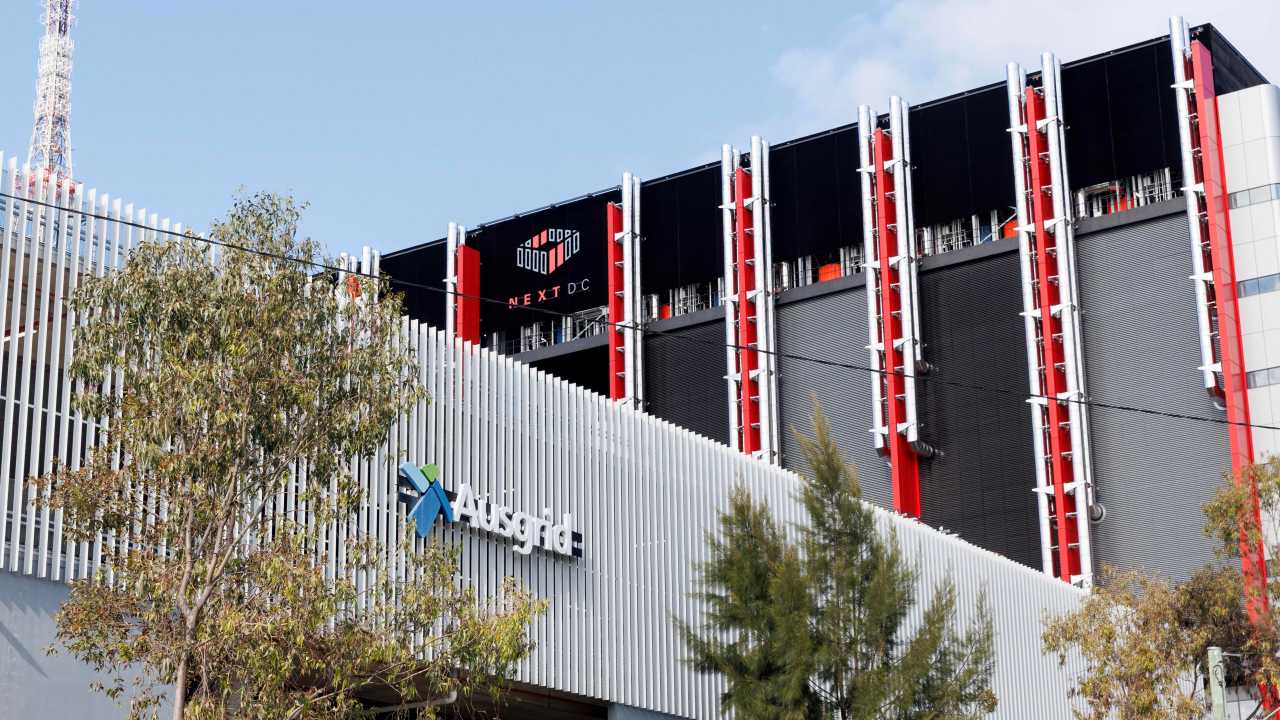
Australia’s data centre boom will put huge new demands on electricity and water.
Done properly, that burden could become an opportunity to strengthen the systems we all rely on.
Australia is preparing for a wave of very large data centres built to run artificial intelligence.
The usual debate asks how much electricity and water they will consume.
That matters, but it misses a more important question.
How much infrastructure must Australia build just to have enough power and water available when these centres need it — and who should pay for that capacity?
The numbers are already large.
The Australian Energy Market Operator said 11 major data centre projects, with a combined maximum demand of 5.4 gigawatts, were moving through the transmission connection process in the first quarter of this year.
About 60 per cent of that capacity was in NSW and 40 per cent in Victoria.
The issue is not simply how many units of electricity those facilities will use over a year.
The grid must be capable of supplying their maximum demand when they need it.
Electricity networks understand this distinction well.
Large industrial users can be charged for the network capacity reserved for them.
They may also pay for new substations, lines, and other works needed to connect them.
Water should increasingly be viewed in the same way.
The scale also needs perspective.
Sydney Water estimates about 130 megalitres of drinking water a day is currently lost through network leakage — roughly 47 gigalitres a year.
By contrast, a federal government paper estimates all Australian data centres currently consume about 5.5GL a year, rising to around 17GL by 2030.
In other words, leakage from Sydney’s drinking-water network alone is currently almost three times the projected national data-centre demand in 2030.
Peak demand, location and drought conditions still matter.
The bigger question is whether new private capital can help strengthen the system itself.
A data centre may require very high flows for cooling during hot weather—precisely when households, industry and the rest of the system may also need water and electricity.
The cost is not just the water: the pipes, pumps, treatment plants, and storage capacity must be large enough to deliver it at peak times.
Some Australian water utilities already recognise this.
Perth considers required flow rates when calculating some infrastructure contributions.
Brisbane and the Gold Coast use meter size or flow capacity in access charges.
But electricity regulation is generally further advanced.
It distinguishes between energy used, maximum demand, capacity reserved, new infrastructure required, and increasingly, demand that can be reduced under stress.
Water regulators are beginning to catch up.
NSW has asked the Independent Pricing and Regulatory Tribunal (IPART) to examine how data centres should pay full costs while protecting existing customers.
The state’s data centre policy also calls for additional water and energy supply.
That points to an opportunity that is being obscured by the argument over whether AI uses “too much” water or power.
Data-centre operators are bringing billions of dollars of private investment to Australia.
They also need reliable power and water.
If the rules are designed properly, some of that capital can fund new capacity and overdue infrastructure instead of consuming spare capacity already paid for by households and businesses.
The crucial word is additional.
A contribution from a developer alone may not be a public benefit if it buys access to capacity that exists.
The better test is whether the investment brings forward power generation, transmission, water treatment, storage, or distribution infrastructure that would otherwise not have been built.
The Australian Energy Market Commission (AEMC) thinks so.

It has recommended that data centres bring new clean and firm electricity supply and bear the costs they impose so existing consumers are not left worse off.
There is another risk that deserves more attention.
The computer equipment inside a data centre has a much shorter life than much of the infrastructure built around it.
Research group Epoch AI estimates that a typical one-gigawatt US AI data centre could require about US$38 billion in upfront investment.
In its model, servers account for more than US$21 billion.
Epoch assumes a five-year life for IT equipment, compared with 14 years for the facility.
Power lines, substations, water mains and treatment plants may remain for much longer.
The computing investment can move; the infrastructure cannot.
When the next generation of compute is bought, an operator can decide not to place it in Australia.
A water main or substation built to serve that demand cannot follow it overseas.
Existing customers should not be left paying for stranded long-lived infrastructure built around one company’s forecast demand if that demand vanishes.
Electricity networks already deal with this, with contracted capacity, connection charges, and financial guarantees.

Similar ideas could be applied to major water users.
If later customers will also benefit from an upgrade, loading the entire cost onto the first investor would discourage investment and create unfairness.
The goal must be to make the price follow the real cost and make the risk follow the party best able to control it.
We do not have to choose between welcoming AI investment and protecting households from higher infrastructure costs.
The data-centre boom could help Australia build more resilient electricity and water systems.
That is the bigger opportunity.
The question is whether Australia can make the AI boom leave behind better infrastructure than it found.
Patrick Rose holds a Master of Cyber Security from Griffith University and is a doctoral candidate researching risk governance and human judgement in automated systems, extending his dissertation, Risk Governance and Decision Failure without Malfunction, following an international career in enterprise systems engineering with IBM, Ernst & Young and GlaxoSmithKline.
Read related topics:Energy crisisLabor’s Renewables Obsession